Organic barbecue sauce accounts for 29.3% of the 2026 market, while supermarkets and hypermarkets represent 27.0% as shoppers compare flavor, claims, and pack sizes
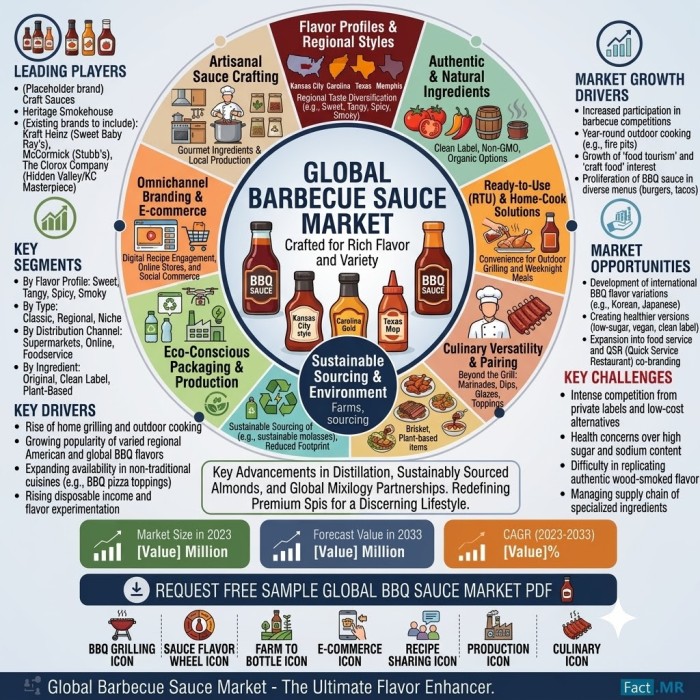
ROCKVILLE, Md. — September 22, 2026 — The global barbecue sauce market is projected to increase from USD 3.95 billion in 2026 to USD 5.77 billion by 2036, expanding at a 4.1% CAGR, according to a new report by Fact.MR. The market was valued at USD 3.77 billion in 2025, creating an estimated absolute opportunity of USD 1.82 billion through 2036.
Barbecue sauce continues to serve household cooking, grilling, dipping, marinating, and foodservice applications. Retail buyers are also evaluating products through ingredient claims, flavor profiles, package sizes, and intended use. These factors are influencing how brands compete across conventional and specialty condiment channels.
Get detailed market forecasts, competitive benchmarking, and pricing trends:
Why Is Organic Barbecue Sauce Gaining Attention?
Organic barbecue sauce is projected to account for 29.3% of market share in 2026, making it the leading type segment identified by Fact.MR.
Clear ingredient claims are increasingly relevant when shoppers compare sauces serving similar grilling and dipping occasions. Organic certification can provide an additional basis for product differentiation, while gluten-free and non-GMO variants address more specific purchasing requirements.
For manufacturers, the opportunity extends beyond formulation. Packaging communication and claim clarity can influence whether consumers understand the product’s positioning before comparing price and flavor.
Why Do Supermarkets and Hypermarkets Remain Important?
Supermarkets and hypermarkets are projected to account for 27.0% of the market in 2026, making this the leading application channel in the Fact.MR assessment.
Routine grocery shopping keeps barbecue sauce visible alongside other condiments and meal-preparation products. Seasonal displays can increase exposure during grilling periods, while physical shelves allow shoppers to compare flavors, claims, bottle sizes, and prices in one location.
Specialty retailers, convenience stores, and online stores provide additional routes to market. Online channels can be particularly useful for specialty varieties and multi-pack formats that may have limited physical shelf space.
What Is Driving Barbecue Sauce Market Growth?
Organic and clean-label positioning is a key demand driver. Fact.MR estimates that this factor has an approximately +1.1 percentage-point impact on CAGR, with relevance particularly across the USA, UK, and Canada.
Retail shelf visibility represents another important factor, with an estimated +0.9 percentage-point impact on CAGR. Grilling and barbecue occasions, ready-to-use sauce formats, and online assortment and pack-size choices provide additional support.
Foodservice is also creating recurring demand. Larger packs can serve restaurants and catering operations that use barbecue sauce for marinades, glazes, prepared dishes, and table service.
What Challenges Could Restrain the Market?
Ingredient and packaging cost variability remains a key restraint. Tomato inputs, sweeteners, and bottle costs can affect production economics, particularly when retailers resist frequent price adjustments.
Labeling and claim review create another challenge. Organic and gluten-free claims require appropriate documentation and review before products are launched in targeted markets.
Established flavor preferences can also make customer switching difficult. Households often return to familiar smoke and spice profiles, meaning newer products may require sampling or clear differentiation to encourage trial.
Shelf competition from adjacent condiments adds further pressure, particularly in supermarkets and hypermarkets where shelf space is limited.
What Does the Fact.MR Analyst Say?
Shambhu Nath Jha, Principal Consultant at Fact.MR, states:
“Barbecue sauce companies must compete through flavor clarity and label trust. Channel fit remains important when Organic, Gluten-Free and Non-GMO products serve the same grilling and dipping occasions.”
Where Are New Opportunities Emerging?
Fact.MR identifies organic private-label ranges as an opportunity, particularly across the USA, UK, and Germany. Retailers can use private-label organic sauces to expand product choice while managing shelf allocation.
Gluten-free and non-GMO extensions provide another opportunity across North America and Europe. Larger foodservice marinade formats can serve restaurants and catering operations, while online multi-pack formats can support digital grocery channels.
Product communication also matters. Explaining whether a sauce is intended for dipping, glazing, or marinating can help buyers understand the difference between products with similar ingredient claims.
Which Countries Show Strong Growth?
Australia is projected to record a 6.3% CAGR from 2026 to 2036, supported by outdoor cooking occasions and supermarket-based product discovery.
The UK is forecast to grow at 6.0%, with organic and free-from positioning contributing to product visibility. The USA is projected to expand at 5.9%, supported by established barbecue culture and foodservice use.
Canada is expected to grow at 5.7%, while Germany is projected to register a 4.6% CAGR. Country-level demand varies according to retail structure, consumer preferences, product claims, and established grilling habits.
Competitive Landscape
The competitive landscape includes The Kraft Heinz Company, McCormick & Company, Incorporated, The Clorox Company-KC Masterpiece, J Lee’s Gourmet BBQ Sauce, and Ken’s Foods, Inc.
Competition is shaped by flavor profiles, ingredient positioning, distribution, pack sizes, retail relationships, and foodservice supply capabilities. Established condiment portfolios provide access to household and commercial buyers, while specialist brands can compete through focused flavor and product positioning.
Report Scope
The Fact.MR Barbecue Sauce Market report analyzes the market by type, application, and region.
Type coverage includes Organic, Gluten-Free, Non-GMO, and Others. Application coverage includes Supermarkets/Hypermarkets, Specialty Retailers, Convenience Stores, and Online Stores.
The regional assessment covers North America, Latin America, Europe, East Asia, South Asia and Pacific, and the Middle East and Africa, with country-level analysis including Australia, the UK, the USA, Canada, and Germany.
The forecast period extends from 2026 to 2036. Fact.MR states that the analysis incorporates 120+ sources, 35+ company portfolios, 25+ countries, and more than 20 industry interviews.
Explore More Related Studies Published by Fact.MR Research:
Acidic Beta-Lactoglobulin Proteins Market
Prebiotic Fiber Pectin Bases Market
Upcycled Carob Prebiotics Market
About Fact.MR
Fact.MR is a market research and consulting firm providing market intelligence, industry analysis, market sizing, competitive assessments, and strategic insights across multiple industries. Its research supports organizations in evaluating demand patterns, market structures, emerging opportunities, and competitive environments.
Media Contact
Fact.MR
11140 Rockville Pike, Suite 400
Rockville, MD 20852, United States
Phone: +1 (628) 251-1583
Email: sales@factmr.com