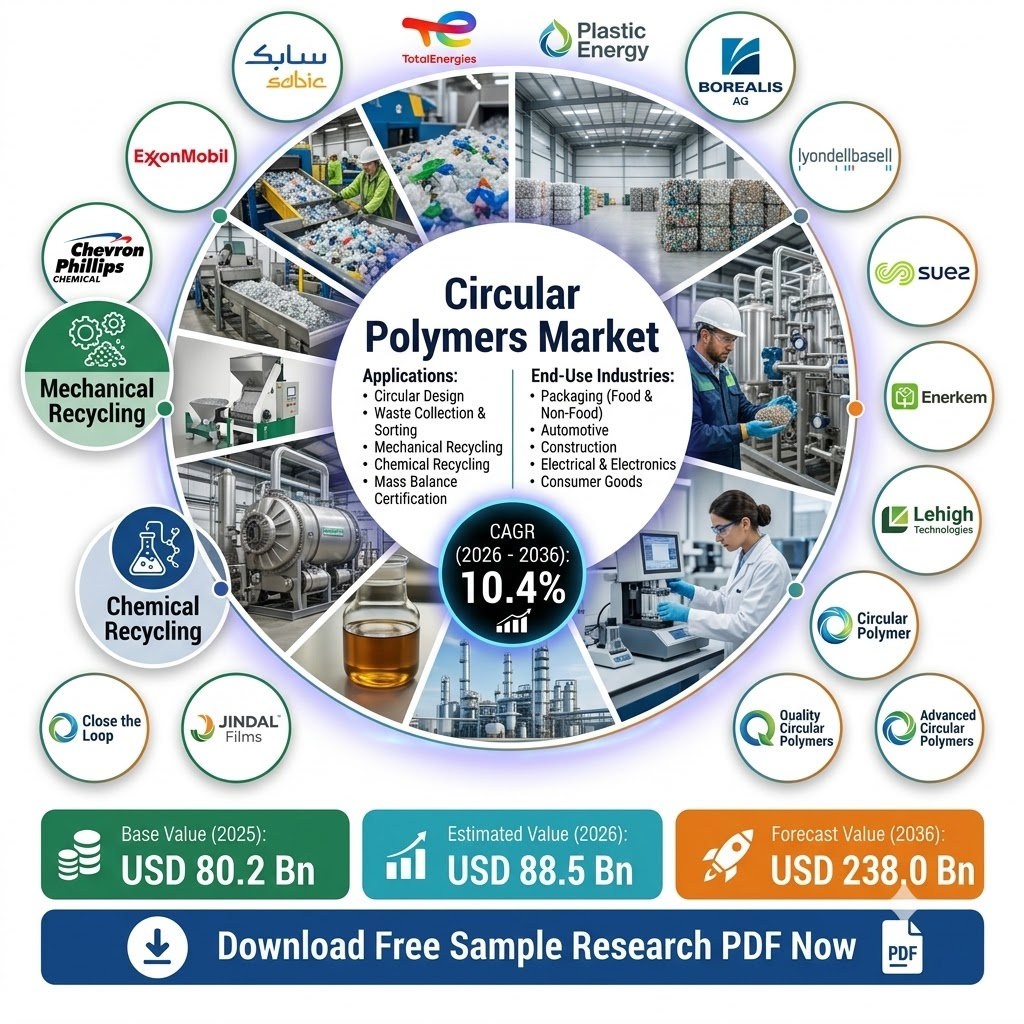
The global circular polymers market is projected to increase from USD 88.5 billion in 2026 to USD 238.0 billion by 2036, expanding at a 10.4% CAGR during the forecast period, according to Future Market Insights (FACT MR). The market reached USD 80.2 billion in 2025, creating an estimated USD 149.5 billion absolute opportunity between 2026 and 2036.
Demand is being shaped by packaging and consumer-goods companies seeking recycled plastic supplies that can meet product, processing, quality, and regulatory requirements. Recycled-content demand, packaging recyclability requirements, investment in sorting and reprocessing capacity, brand-owner qualification, and supply-chain traceability are among the factors supporting market expansion.
Get detailed market forecasts, competitive benchmarking, and pricing trends
PET and Packaging Remain Central to Circular Polymer Demand
PET-based circular polymers are projected to account for 63.8% of the product segment in 2026. Bottle collection, sorting, washing, reprocessing, and established rPET applications provide a relatively mature closed-loop route.
Packaging applications account for 71.2% of the market by application in 2026. Packaging generates substantial material flows and faces continued requirements around recyclability, waste reduction, and recycled content.
The packaging industry represents 66.4% of end-use demand in 2026. Converters and brand owners can specify recycled grades across bottles, trays, films, and other high-volume formats.
By technology, mechanical recycling is expected to account for 44.6% in 2026. Shredding, sorting, washing, and reprocessing remain commercially established for sufficiently clean thermoplastic streams.
Post-consumer recycled formulations account for 58.9% of the formulation segment in 2026, supported by the large feedstock pool created by consumer packaging and product waste.
Direct industrial sales account for 39.4% of distribution channels in 2026, reflecting the need among converters for grade consistency, supply schedules, documentation, and qualification support.
Quality and Traceability Shape Commercial Adoption
Circular polymer demand depends not only on collecting waste but also on converting recovered material into consistent resin grades.
Quality factors include contamination, additive history, molecular degradation, odor, color, viscosity, process stability, traceability, and food-contact status. These factors influence whether recycled materials can replace virgin grades in specific applications.
Shambhu Nath Jha, Sr. Consultant at Fact.MR, states:
“Circular polymer value is created at the interface between waste input and product specification. Collection alone is not enough. Sort quality, contamination, additive history, molecular degradation, odor, color, process stability, traceability, and customer qualification determine whether recovered material becomes a repeatable resin grade.”
The market also faces restraints from feedstock contamination, inconsistent bale quality, competition with virgin resin prices, property degradation, application limitations, and verification requirements for recycled and circular claims.
Mechanical and Chemical Routes Address Different Feedstocks
Mechanical recycling continues to serve sufficiently clean thermoplastic streams. Chemical recycling and advanced recycling address mixed, degraded, or difficult waste streams that may not retain equivalent value through conventional physical reprocessing.
Chemical recycling, depolymerization, solvolysis, AI sorting, and digital traceability can expand feedstock options. However, these approaches also introduce questions around capital requirements, yield, energy use, and verification.
Market opportunities include bottle-to-bottle and food-grade PET loops, higher-quality recycled polyolefin grades, chemical recycling for difficult feedstocks, and digital material passports and chain-of-custody systems.
Country Markets Show Varied Growth Patterns
The circular polymers market is projected to expand at 10.5% CAGR in the USA, 9.7% in the UK, 9.0% in France, 10.0% in Germany, 8.4% in Italy, 11.2% in South Korea, and 9.6% in Japan from 2026 to 2036.
Country-level demand reflects differences in packaging policy, recycling infrastructure, collection systems, industrial requirements, traceability practices, and customer qualification standards.
Competitive Landscape
Competition includes virgin polymer producers expanding circular portfolios, mechanical recyclers, chemical recyclers, waste managers, compounders, converters, digital traceability providers, and regional material distributors.
The report profiles SABIC, Total Energies, Plastic Energy, Borealis AG, Enerkem, Lehigh Technologies, Circular Polymer, Quality Circular Polymers, Advanced Circular Polymers, Close the Loop, TriCiclos, Jindal Films, ExxonMobil, Chevron Phillips Chemical, LyondellBasell, and Suez.
Competitive positioning varies by product portfolio, application coverage, regional reach, technical positioning, feedstock access, yield, grade consistency, certification, customer qualification, and contracted offtake.
Report Scope
The Circular Polymers Market report analyzes the market by Product, Application, End Use, Technology, Formulation, Distribution Channel, and Region. Geographic coverage includes North America, Latin America, Western Europe, Eastern Europe, East Asia, South Asia & Pacific, and the Middle East & Africa.
The country analysis covers the USA, UK, France, Germany, Italy, South Korea, and Japan.
The assessment covers circular polymer materials returned to productive use through mechanical recycling, chemical recycling, advanced sorting, traceability, post-consumer or post-industrial recovery, and bio-circular feedstock routes.
To view Other Report
About fact MR
(FACT MR) provides market research and industry analysis covering market sizing, segmentation, forecasting, competitive assessment, and country-level insights.