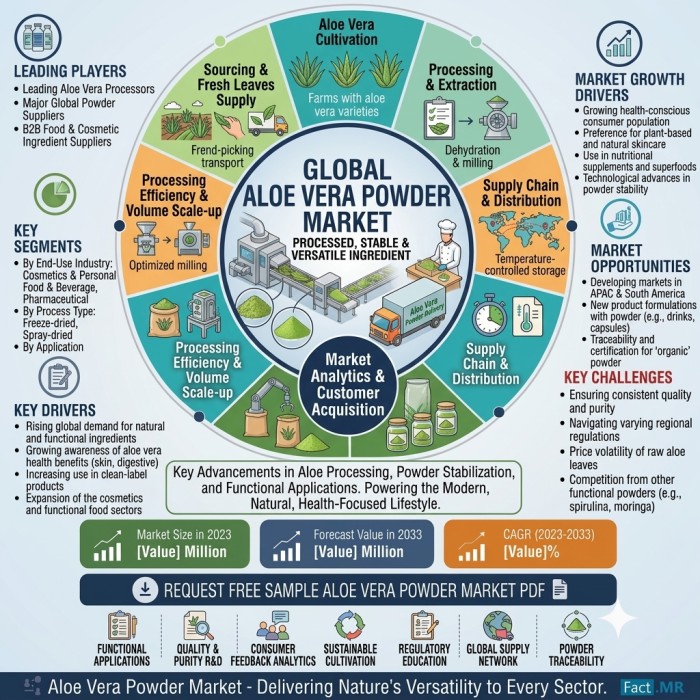
Fact.MR projects the global aloe vera powder market to expand at a 7.3% CAGR through 2036, with food applications and conventional powder formats accounting for leading shares
ROCKVILLE, Md., September 21, 2026 — The global aloe vera powder market is projected to increase from USD 380.3 million in 2026 to USD 679.3 million by 2036, expanding at a 7.3% CAGR during the forecast period, according to Fact.MR. The market reached USD 354.4 million in 2025, while an absolute opportunity of approximately USD 298.9 million is expected to be created between 2026 and 2036.
Demand is being supported by food and beverage manufacturers looking for dry aloe inputs that are easier to handle, store, blend, and dose during production. Powder formats can help manufacturers manage ingredient inclusion without relying on fresh aloe material or liquid intermediates.
Application fit remains central to purchasing decisions. Buyers are expected to assess taste profile, solubility, processing behavior, specification consistency, and labeling requirements before moving from product evaluation to recurring procurement.
Get detailed market forecasts, competitive benchmarking, and pricing trends:https://www.factmr.com/connectus/sample?flag=S&rep_id=15871
Conventional Aloe Vera Powder Holds the Leading Type Share
Conventional Aloe Vera Powder is projected to account for 31.0% of the market by type in 2026, making it the leading category in the Fact.MR assessment.
Its position reflects broad commercial use and familiarity among formulators and purchasing teams. Established processing routes and clearer specifications can make conventional grades easier to evaluate when manufacturers require repeatable inputs for existing formulations.
Diet Aloe Vera Powder represents another segment of demand, particularly where brands require a more specific product identity. The choice between powder formats is expected to depend on the finished-product requirements and the claims or positioning pursued by the brand.
For ingredient suppliers, documenting processing routes, concentration, particle characteristics, and application suitability can help buyers match a powder grade with a specific formulation.
Food Applications Account for the Largest Market Share
Food is projected to represent 32.6% of the aloe vera powder market in 2026, making it the leading application segment.
Food manufacturers can use dry aloe inputs where measured inclusion and batch-to-batch consistency are important. Powder handling can simplify storage and dosing compared with liquid intermediates, particularly for products manufactured at scale.
Beverage applications provide another avenue for market development. Manufacturers evaluating aloe powder for beverage formulations are expected to consider solubility, taste, processing conditions, and finished-product labeling before commercial adoption.
The distinction between food and beverage applications also makes documentation important. Ingredient suppliers need to communicate clear product specifications so customers can determine whether a particular grade fits their formulation and regulatory requirements.
What Is Driving Aloe Vera Powder Market Growth?
Food formulation use is a major demand driver. Manufacturers are expected to favor dry aloe formats when controlled dosing and dry blending can simplify production.
Dry ingredient handling provides another advantage. Powder formats can support storage planning while reducing dependence on fresh aloe material or liquid intermediates.
Retail and online distribution are also expected to contribute to demand. Wider channel availability gives consumer-facing brands more opportunities to introduce aloe-based products and allows buyers to compare different formulations.
Clear application documentation represents an additional growth opportunity. Suppliers that explain processing characteristics and product limitations can make it easier for formulators to assess a powder before approving it for production.
Quality Variability and Compliance Remain Market Challenges
The market faces several constraints.
Input quality variability is identified as the primary restraint. Differences in raw material quality and processing methods can affect powder consistency across purchasing cycles, making specification control important for commercial buyers.
Labeling and compliance reviews can also extend product approval timelines. Companies need to verify how aloe ingredients can be presented within applicable local product rules before launching finished products.
Application-specific performance limitations represent another challenge. Buyers may delay switching when taste, solubility, or other formulation characteristics remain uncertain.
Established ingredient preferences can further slow adoption. Manufacturers may be reluctant to change an existing formulation when the current input already meets production requirements.
The UK Records the Highest Listed Country CAGR
Among the countries analyzed by Fact.MR, the UK is projected to record a 9.4% CAGR from 2026 to 2036, the highest listed growth rate in the report.
Australia follows at 8.1%, while the USA is projected to expand at 7.7%. Canada is forecast to record a 7.2% CAGR, and Germany is expected to grow at 7.0% during the same period.
The UK outlook is supported by retail-ready product positioning and continued interest in botanical ingredients. Australia is expected to see further testing of dry aloe formats across food and beverage applications.
In the USA, broad retail access and a diverse product base provide opportunities for aloe powder suppliers. Canada’s demand is spread across the assessed applications, while Germany’s market is characterized by careful ingredient and labeling review.
Analyst Perspective
“Aloe vera powder demand is expected to depend on how clearly manufacturers prove fit across food and beverage use. Companies that protect consistency are expected to win preference. Clear application limits and clean documentation are expected to matter more than broad botanical positioning,” said Shambhu Nath Jha, Senior Consultant at Fact.MR.
Competitive Landscape
The competitive landscape is shaped by ingredient consistency, aloe sourcing, processing control, and documentation support.
Companies profiled in the Fact.MR assessment include Aloe Laboratories, Inc.; Yunnan Yuanjiang Evergreen Biological Industry (Group) Co., Ltd.; Aloecorp; Terry Laboratories, Inc.; and Aloe Jaumave, S.A. de C.V.
Competitive participation is expected to depend on the ability to provide consistent powder specifications and support food and beverage manufacturers during formulation and approval. Producer documentation and application-specific information can become important differentiators as buyers move from initial sampling toward recurring supply agreements.
Unlock Actionable Insights from the Complete Report: https://www.factmr.com/report/aloe-vera-powder-market
Report Scope
The Fact.MR study covers the global Aloe Vera Powder Market by type, application, and region.
By type, the market is segmented into Conventional Aloe Vera Powder and Diet Aloe Vera Powder. Applications covered include Food and Beverage.
Regional coverage includes North America, Latin America, Europe, East Asia, South Asia and Pacific, and the Middle East and Africa. Country-level analysis covers the UK, Australia, USA, Canada, and Germany. The forecast period extends from 2026 to 2036.
The report analyzes dry aloe vera powder ingredients used in food, beverage, and wellness formulations where powder solubility, mixing behavior, storage stability, specification consistency, and labeling compliance influence product approval and commercial use.
Explore More Related Studies Published by Fact.MR Research
Functional Fonio Grains Market- https://www.factmr.com/report/functional-fonio-grains-market
Gummy Texture Stabilizers Market- https://www.factmr.com/report/gummy-texture-stabilizers-market
Umami Flavor Enhancers Market- https://www.factmr.com/report/umami-flavor-enhancers-market
Functional Soda Fibers Market- https://www.factmr.com/report/functional-soda-fibers-market
About Fact.MR
Fact.MR is a market research and consulting firm providing market intelligence across food and beverage, consumer goods, healthcare, technology, chemicals, industrial goods, automotive, and other industries. Its research combines primary and secondary research, market sizing, forecasting, company analysis, and industry interviews to support strategic business decisions.
Media Contact
Fact.MR
Email: sales@factmr.com
Website: Fact.MR