Fact.MR projects the DEXA market to expand at a 7.1% CAGR through 2036, supported by hospital equipment replacement, repeat bone-density assessment, and advances in detector technology
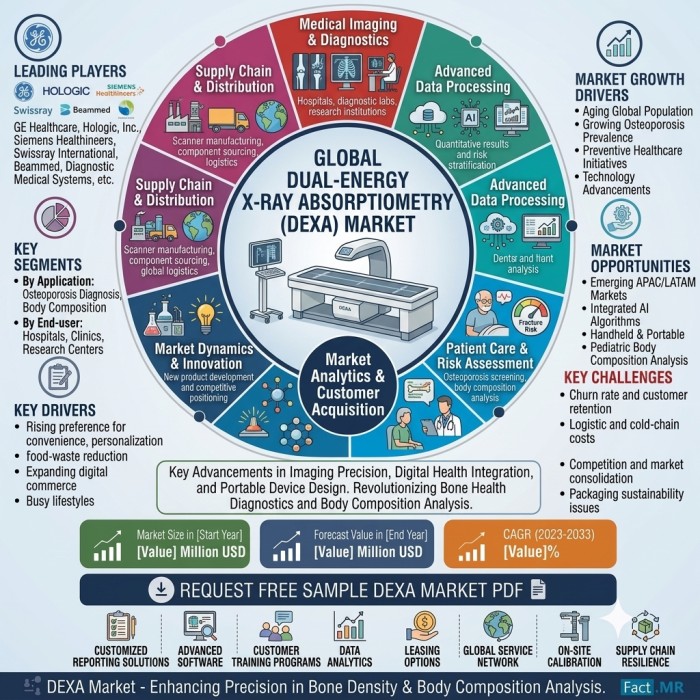
ROCKVILLE, Md., September 21, 2026 — The global Dual Energy X-Ray Absorptiometry (DEXA) market is projected to increase from USD 1.4 billion in 2026 to USD 2.8 billion by 2036, registering a 7.1% CAGR during the forecast period, according to a new analysis by Fact.MR. The market crossed USD 1.3 billion in 2025, with an absolute opportunity of approximately USD 1.4 billion expected through 2036.
DEXA systems are widely used to assess bone mineral density and support body-composition analysis. Demand is being shaped by osteoporosis screening, treatment monitoring, hospital imaging requirements, and replacement of aging equipment. As healthcare providers seek repeatable scan quality and dependable reporting, procurement decisions increasingly extend beyond equipment price to include calibration stability, detector performance, workflow compatibility, and service support.
Get detailed market forecasts, competitive benchmarking, and pricing trends:https://www.factmr.com/connectus/sample?flag=S&rep_id=15959
Central DEXA Systems Account for 45% of the Market
Central DEXA Systems are projected to account for 45.0% of the market by system type in 2026, making them the leading system category. Hospitals and imaging providers use central systems when higher-throughput bone-density assessment and repeatable reporting are required.
Peripheral systems remain relevant for more targeted assessments, while portable and multi-purpose DEXA systems provide flexibility where equipment placement and mobility are important considerations.
The market opportunity is also supported by replacement demand. Healthcare facilities periodically review imaging equipment as systems age, with detector performance, maintenance requirements, scan consistency, and integration with existing workflows influencing upgrade decisions.
Osteoporosis Diagnosis Remains the Leading Clinical Application
Osteoporosis diagnosis is expected to represent 48.0% of the clinical application segment in 2026. DEXA provides clinicians with a standardized method for assessing bone density and supporting fracture-risk evaluation. Follow-up examinations can also be performed using the same imaging approach to monitor changes during treatment.
Body-composition analysis represents another application area, particularly where healthcare and wellness providers require measurements beyond bone density. Oncology assessment and geriatric care provide additional specialist applications.
The continued need for baseline measurements and follow-up assessments supports recurring demand for DEXA equipment and related imaging services.
Hospitals Remain the Largest End-Use Facility
Hospitals are projected to hold 44.0% of the DEXA market by end-use facility in 2026. Their position reflects the concentration of patient referrals, diagnostic imaging services, and clinical reporting within integrated healthcare systems.
Diagnostic imaging centers are also important contributors to demand as outpatient scanning expands. Academic medical centers and orthopedic centers support specialist applications where bone health can influence treatment planning.
Public healthcare providers are expected to represent 40.0% of the customer-type segment in 2026, reflecting the importance of screening access and institutional procurement programs.
Digital Flat Panel Detectors Gain Importance
Digital Flat Panel Detectors are forecast to account for 42.0% of the detector technology segment in 2026. Facilities increasingly assess detector performance alongside image quality, workflow handling, and system reliability when considering new DEXA equipment.
Dual-energy imaging technology remains central to DEXA systems, while AI-assisted image processing and cloud-enabled imaging platforms offer additional opportunities for workflow development and digital integration.
As imaging departments modernize their equipment, compatibility with hospital information systems and reporting workflows may become an increasingly relevant procurement consideration.
Equipment Cost and Compliance Requirements Remain Challenges
The market faces several constraints despite continued demand for bone-density assessment.
System cost and complexity can slow purchasing decisions, particularly where hospitals must evaluate room requirements, installation, maintenance, and equipment acquisition together. Fact.MR also identifies specification and compliance checks as potential sources of delays during vendor approval.
Documentation is another important consideration. Healthcare buyers may require calibration records, technical specifications, service coverage, and evidence of consistent system performance before approving new equipment.
Import-dependent markets may also experience challenges related to lead times, replacement components, and local service availability. These factors create opportunities for suppliers that can combine equipment performance with dependable after-sales support.
United States Leads the Regional Growth Outlook
The United States is projected to expand at a 7.9% CAGR from 2026 to 2036, supported by hospital purchasing activity and wider osteoporosis screening. Japan follows with a projected 7.6% CAGR, while Germany is forecast to grow at 7.2%. Canada is expected to record 6.8%, followed by the United Kingdom at 6.5%, Australia at 6.2%, and South Korea at 5.8%.
Japan’s demand is linked in part to aging-care pathways and continued bone-health assessment. Germany benefits from structured healthcare networks and equipment review processes, while Canada’s regional healthcare requirements create demand for reliable imaging support.
Analyst Perspective
“DEXA systems must deliver repeatable bone-density readings and consistent image quality across hospital and diagnostic imaging workflows. Procurement acceptance is expected to depend on calibration stability, detector reliability and service responsiveness through repeated scan cycles rather than equipment price alone,” said Shambhu Nath Jha, Principal Consultant at Fact.MR.
Competitive Landscape
The DEXA market includes established medical imaging and bone-density equipment providers. Companies profiled by Fact.MR include Hologic, Inc.; GE HealthCare Technologies Inc.; FUJIFILM Healthcare; Swissray – Norland; OsteoSys Co., Ltd.; DMS Imaging – Medilink; Medonica Co., Ltd.; Xingaoyi Medical Equipment Co., Ltd. – XGY; and Canon Inc. – Canon Medical.
Competition is influenced by system reliability, detector technology, imaging workflow integration, calibration stability, service responsiveness, and the ability to support hospitals and diagnostic centers throughout the equipment lifecycle.
Unlock Actionable Insights from the Complete Report: https://www.factmr.com/report/dual-energy-x-ray-absorptiometry-dexa-market
Report Scope
The Fact.MR study analyzes the Dual Energy X-Ray Absorptiometry (DEXA) market across system type, clinical application, end-use facility, customer type, detector technology, and region.
System types include central, peripheral, portable, and multi-purpose DEXA systems. Clinical applications include osteoporosis diagnosis, body-composition analysis, oncology assessment, and geriatric care.
The report evaluates hospitals, diagnostic imaging centers, academic medical centers, and orthopedic centers, along with public healthcare providers, diagnostic service providers, research organizations, and orthopedic specialists.
Regional coverage includes North America, Latin America, Europe, East Asia, South Asia and Pacific, and the Middle East and Africa, with detailed country analysis covering the United States, Japan, Germany, Canada, the United Kingdom, Australia, and South Korea.
Explore More Related Studies Published by Fact.MR Research
Adult Stem Cells Market- https://www.factmr.com/report/adult-stem-cells-market
Cuffless BP Monitor Market- https://www.factmr.com/report/cuffless-bp-monitor-market
DNA Encoded Library Market- https://www.factmr.com/report/dna-encoded-library-market
DNA Repair Drugs Market- https://www.factmr.com/report/dna-repair-drugs-market
About Fact.MR
Fact.MR is a market research and consulting firm providing industry intelligence across healthcare, technology, automotive, food and nutrition, chemicals, consumer goods, and other industries. Its research combines market analysis, primary research, company assessment, market sizing, and forecasting to support strategic business decisions.
Media Contact
Fact.MR
Email: sales@factmr.com
Website: https://www.factmr.com/