Fact.MR projects a 13.8% CAGR through 2036 as hospitals and imaging providers invest in accelerated computing for diagnostic imaging, clinical AI, and high-volume image processing
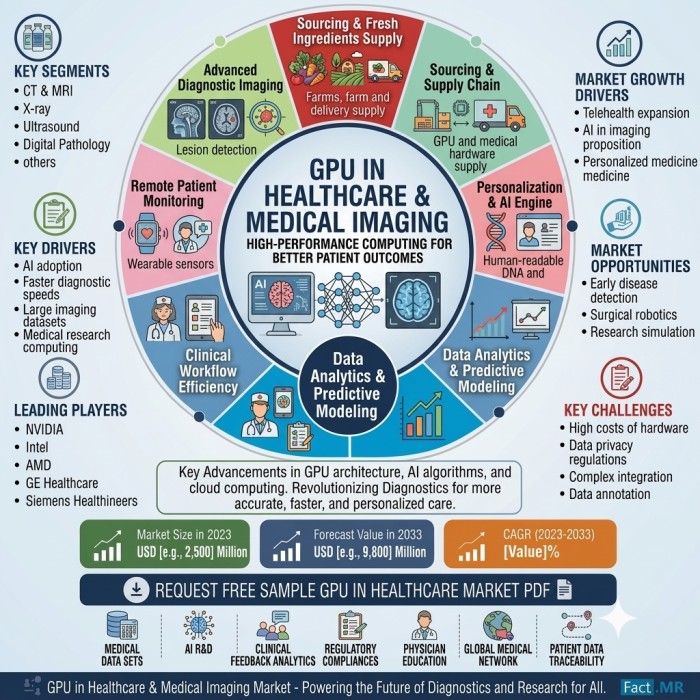
ROCKVILLE, Md., September 21, 2026 — The global GPU in healthcare and medical imaging market is projected to increase from USD 4.6 billion in 2026 to USD 16.8 billion by 2036, registering a 13.8% CAGR during the forecast period, according to a new analysis by Fact.MR. The market was valued at approximately USD 4.0 billion in 2025, with an absolute opportunity of USD 12.2 billion expected through 2036.
The expansion reflects growing use of graphics processing units and accelerated computing infrastructure in medical imaging workflows. Large image files, increasing clinical data volumes, AI-enabled reconstruction, and the need for faster visualization are encouraging healthcare organizations to evaluate GPU infrastructure for radiology and other imaging-intensive applications.
Get detailed market forecasts, competitive benchmarking, and pricing trends:https://www.factmr.com/connectus/sample?flag=S&rep_id=15974
Diagnostic Imaging Remains a Major Application Area
Diagnostic imaging is projected to account for 39.0% of the market in 2026, making it the leading clinical application segment. Radiology workflows involving CT and MRI generate substantial computational requirements, particularly when AI-based reconstruction, segmentation, detection, classification, and visualization are incorporated into clinical systems.
GPU acceleration can support faster processing of imaging workloads while providing the parallel computing capacity required by AI models. Surgical imaging, radiation therapy planning, pathology imaging, and research imaging represent additional areas where accelerated computing can contribute to visualization and model development.
As imaging providers increase the use of AI-assisted workflows, infrastructure requirements are shifting beyond conventional image viewing toward computing environments capable of supporting both clinical inference and image reconstruction.
Data Center GPUs Lead the Solution Segment
Data center GPUs are expected to hold a 46.0% share of the GPU solution segment in 2026. Their position is linked to the dense computing and high memory bandwidth required for medical imaging model training and inference.
Workstation GPUs continue to support research and local visualization, while embedded and edge GPUs can support processing closer to imaging equipment. This creates a broader market opportunity spanning centralized hospital infrastructure, scanner-side processing, research environments, and cloud-connected healthcare systems.
Artificial intelligence GPU computing is forecast to represent 48.0% of the compute platform segment in 2026, reflecting the growing role of GPUs in AI-driven segmentation, detection, reconstruction, and classification workflows.
Hospitals Drive Infrastructure Demand
Hospitals are anticipated to account for 42.0% of the market by end-use facility in 2026. Large healthcare networks typically manage high imaging volumes across multiple departments, creating demand for computing infrastructure that can support radiology, diagnostic, research, and AI workloads.
On-premises infrastructure is estimated to represent 51.0% of the deployment model segment in 2026. Data governance, latency, clinical access, and control over sensitive imaging information are among the factors supporting local infrastructure.
Cloud deployment remains relevant for research and model training, while hybrid infrastructure offers a pathway for healthcare organizations seeking to keep sensitive clinical workloads close to internal systems while accessing scalable computing resources when required.
AI Adoption Creates Opportunities but Validation Remains a Challenge
The adoption of diagnostic imaging AI is one of the principal growth drivers identified by Fact.MR. Hospital GPU infrastructure upgrades and increasing three-dimensional visualization workloads are also supporting demand. Hybrid GPU deployment models, medical imaging foundation models, edge inference near scanners, and GPU-enabled clinical research platforms represent additional areas of opportunity.
However, infrastructure cost remains a consideration, particularly for smaller hospitals and imaging networks. GPU clusters require investment not only in hardware but also in storage, cooling, networking, and software.
Clinical validation can also affect deployment timelines. Healthcare organizations need evidence that AI-enabled imaging workflows perform reliably within clinical environments. Integration with existing PACS and EHR systems adds another layer of complexity, particularly when large image archives and multiple clinical platforms must be connected.
United States Leads Regional Growth Outlook
The United States is projected to expand at a 14.9% CAGR from 2026 to 2036, supported by hospital AI investment and secure imaging infrastructure. China follows with a projected 14.3% CAGR, while Germany is expected to record 13.7%. Japan is forecast to expand at 13.1%, followed by South Korea at 12.5%, Canada at 11.9%, and Singapore at 11.2%.
These markets reflect different adoption conditions, including hospital modernization, medical technology infrastructure, AI research activity, digital healthcare development, and requirements around healthcare data management.
Analyst Perspective
“GPU adoption in healthcare is moving from research clusters into daily imaging operations. Hospitals and imaging vendors are expected to favor platforms that support AI inference and image reconstruction without slowing radiology workflows,” said Shambhu Nath Jha, Senior Consultant at Fact.MR.
Competitive Landscape
The market includes technology companies participating across GPU hardware, cloud computing, servers, and accelerated infrastructure. Companies profiled by Fact.MR include NVIDIA Corporation, Advanced Micro Devices, Inc., Intel Corporation, Microsoft Corporation, Google LLC, Dell Technologies Inc., Hewlett Packard Enterprise Company, and Lenovo Group Limited.
Competition spans accelerator performance, software ecosystems, server infrastructure, cloud deployment, and the ability to support healthcare-specific computing requirements.
Unlock Actionable Insights from the Complete Report: https://www.factmr.com/report/gpu-in-healthcare-and-medical-imaging-market
Report Scope
The Fact.MR study analyzes the GPU in healthcare and medical imaging market across GPU solution, clinical application, end-use facility, deployment model, compute platform, and region.
GPU solutions covered include data center GPUs, workstation GPUs, embedded GPUs, edge GPUs, and virtualized GPU instances. Clinical applications include diagnostic imaging, surgical imaging, radiation therapy planning, pathology imaging, and research imaging.
The study also evaluates hospitals, diagnostic imaging centers, academic and research institutes, ambulatory care centers, and telehealth and cloud imaging providers. Deployment models include on-premises, cloud-based, and hybrid infrastructure.
Explore More Related Studies Published by Fact.MR Research
Adult Stem Cells Market- https://www.factmr.com/report/adult-stem-cells-market
Cuffless BP Monitor Market- https://www.factmr.com/report/cuffless-bp-monitor-market
DNA Encoded Library Market- https://www.factmr.com/report/dna-encoded-library-market
DNA Repair Drugs Market- https://www.factmr.com/report/dna-repair-drugs-market
About Fact.MR
Fact.MR is a market research and consulting firm providing industry intelligence across healthcare, technology, automotive, food and nutrition, chemicals, and other industries. Its research combines market analysis, primary research, company assessment, market sizing, and forecasting to support strategic business decisions.
Media Contact
Fact.MR
Email: sales@factmr.com
Website: https://www.factmr.com/