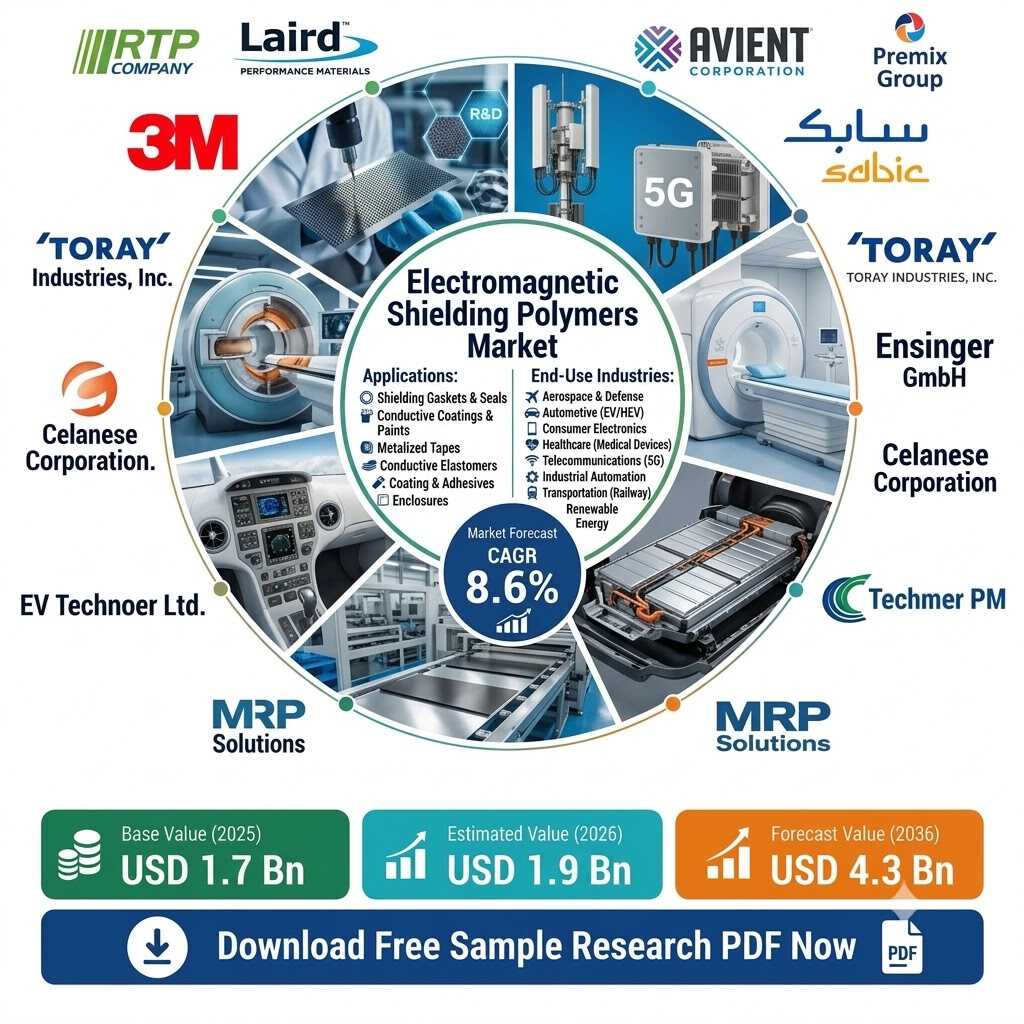
The global electromagnetic shielding polymers market is projected to increase from USD 1.9 billion in 2026 to USD 4.3 billion by 2036, expanding at a 8.6% CAGR during the forecast period, according to Fact.MR.
The market reached approximately USD 1.7 billion in 2025 as conductive polymer compounds gained applications across electronics and vehicle qualification programs. The projected growth represents an absolute opportunity of USD 2.6 billion between 2026 and 2036.
Growing electronics density is creating additional requirements for electromagnetic compatibility inside compact devices and systems. 5G radios, high-speed data links, ADAS sensors, inverters, charging electronics, and medical circuitry can create additional electromagnetic coupling paths. This is encouraging equipment manufacturers to evaluate molded polymer solutions that can combine structural functions with electromagnetic shielding.
Get detailed market forecasts, competitive benchmarking, and pricing trends:
Conductive thermoplastics remain a major material platform
Conductive thermoplastics are projected to account for 42.0% of the market in 2026. Their position is linked to the ability to integrate conductive functionality into polymer platforms already used with established molding and extrusion equipment.
Polycarbonate, ABS, and polyamide compounds provide different options depending on mechanical performance, thermal requirements, appearance, and processing conditions. However, adding conductive fillers can change viscosity, toughness, surface quality, and other processing characteristics. Material suppliers therefore need to demonstrate performance across the complete production window.
Carbon-based fillers are projected to hold 39.0% share in 2026. Carbon black, carbon nanotubes, graphene, and carbon fibers can create conductive pathways while supporting lower-density material systems compared with many metal-based approaches.
Consumer electronics and injection molding create significant application opportunities
Consumer electronics are expected to account for 34.0% share in 2026. Smartphones, laptops, and wearable devices increasingly place radios, processors, displays, cameras, memory, and power-management circuits into compact housings.
A separate metal shield, coated shell, or gasket can compete for space with batteries, antennas, thermal paths, and industrial design requirements. Polymer-based shielding can therefore provide an alternative when molded components meet the required frequency-specific EMC performance and retain their mechanical and appearance characteristics.
Injection molding is forecast to represent 48.0% share in 2026. The process allows shielding functionality to be incorporated into housings, connectors, and other components using established production equipment. Overmolding and micro injection molding can address programs requiring localized material placement or smaller features.
Qualification remains a critical consideration
The market also faces challenges associated with part-level qualification. Material-level conductivity data does not automatically establish shielding performance in a finished component.
Frequency, wall thickness, filler dispersion, flow direction, weld lines, apertures, surface contact, grounding, and molded geometry can influence final performance. Higher conductive-filler loading may also increase viscosity, tool wear, density, brittleness, or surface defects.
These requirements are making application engineering and production-scale validation increasingly relevant to material selection.
Shambhu Nath Jha, Principal Consultant at Fact.MR, states:
“Commercial adoption will depend on whether a compound solves the complete EMC part problem. Buyers will not accept conductivity that raises viscosity; tool wear; brittleness; or surface defects beyond the production window. Suppliers that combine part-level shielding data; stable filler dispersion; design guidance; and disciplined change control will move more programs from qualification into repeat production.”
Regional demand outlook
Japan is projected to record a 9.2% CAGR from 2026 to 2036, followed by the USA at 8.9%, the UK at 8.6%, Germany at 8.3%, and France at 8.0%.
In the USA, demand is linked to electronics, data infrastructure, and vehicle qualification programs. Germany’s market is shaped by automotive-grade traceability, engineering documentation, process capability, and long production cycles. Japan’s market is characterized in the report by requirements around consistency, precise process windows, supplier relationships, and local technical response.
Competitive landscape
The competitive environment includes RTP Company, Laird Performance Materials, Avient Corporation, Premix Group, 3M Company, Sabic, Toray Industries, Inc., Ensinger GmbH, Celanese Corporation, and Techmer PM.
Companies compete through conductive compound development, filler engineering, application support, material consistency, regional technical assistance, and controlled change management.
The report also identifies developments involving Avient Corporation, Sabic, and Premix Group across conductive thermoplastics and related manufacturing capabilities.
Report scope
The Fact.MR assessment covers polymer pellets, compounds, concentrates, elastomer formulations, and semi-finished polymeric materials specifically sold for EMI/RFI shielding.
The analysis examines the market by polymer type, filler type, application, processing technology, end use, and region. Coverage includes conductive thermoplastics, carbon-based fillers, consumer electronics, injection molding, electronics manufacturers, and related subsegments.
The assessment uses a hybrid bottom-up and top-down approach incorporating supplier participation, material and processing splits, end-use demand, qualification cycles, regional production patterns, pricing, and technology substitution.
Read the full Electromagnetic Shielding Polymers Market report:
Sludge Treatment Chemicals Market Transformation Report 2036: Innovation Trends, Sustainability Drivers & Competitive Positioning
High Performance Polymers Market Report 2026-2036: High-Value Insights for Strategy, Product Development & Growth Planning
Global Composite Adhesives Market Outlook 2026-2036: Strategic Trends, Innovation Drivers & Growth Opportunities
Fluoropolymers Market Landscape 2036: Strategic Benchmarking, Pricing Trends & Regional Hotspots
About Fact.MR
Fact.MR provides market assessments covering industry demand, segmentation, regional markets, competitive activity, technology developments, and market forecasts.