The global Inulin-FOS Pectin Blends Market is projected to increase from USD 1.3 billion in 2026 to USD 3.8 billion by 2036, expanding at an 11.0% CAGR, according to Fact.MR. The market crossed USD 1.2 billion in 2025, creating an estimated absolute opportunity of USD 2.4 billion through 2036.
Demand is being shaped by a practical formulation challenge: adding soluble fiber without compromising texture, dispersion, taste, gel strength, or storage stability. Inulin-FOS pectin blends address this need by combining soluble-fiber functionality with pectin’s gelling, water-binding, viscosity, and texture-control properties.
Get Detailed Market Forecasts, Competitive Benchmarking, and Pricing Trends
Fiber Fortification Is Moving Beyond Simple Ingredient Addition
Supplement brands are increasingly looking for fiber systems that work consistently across powders, capsules, sachets, gummies, and chewable formats. Gummy manufacturers face a different requirement, as inulin and FOS need to be incorporated without weakening bite or creating storage problems.
Beverage developers also need blends that provide body while limiting sediment and flavor masking, particularly in acidic formats. Dairy-alternative manufacturers have another formulation challenge as changes in protein and sugar levels can affect water binding and texture.
This gives blended systems an advantage over treating fiber and hydrocolloid selection as separate formulation decisions.
Fact.MR analyst Shambhu Nath Jha, Principal Consultant at Fact.MR, states, “The commercial test for this market is not whether a blend contains fiber. The stronger question is whether the blend survives real processing conditions while keeping texture, taste and label clarity intact. Suppliers that combine pectin know-how with inulin and FOS formulation support are expected to gain better access to supplement and gummy accounts.”
Citrus Pectin and Inulin-Enriched Blends Lead
Citrus pectin is projected to account for 29.0% share in 2026. Citrus peel streams provide a scalable raw material base, while citrus pectin is widely suited to acid-set gels and fruit-forward formulations.
Inulin-enriched blends are expected to capture 36.0% share of the fiber blend segment in 2026. Inulin contributes fiber, body, and mild sweetness while complementing pectin functionality.
Other leading segments include:
- Prebiotic Support: 31.0% share in 2026 as brands position soluble-fiber blends around digestive wellness.
- Supplements: 37.0% share, supported by powders, capsules, gummies, and other formats designed for measured fiber delivery.
The combination of pectin and soluble fiber also supports formulation objectives around mouthfeel, water binding, gelling, viscosity, and texture stabilization.
Gummy and Reduced-Sugar Formulations Create New Demand
The market’s growth is closely linked with the development of functional confectionery and reduced-sugar products.
Prebiotic positioning in supplements and gummies is identified as a major demand driver. Citrus and apple pectin functionality in acidic systems also supports adoption across Europe, China, and the United States.
Reduced-sugar texture requirements create another application opportunity. As developers adjust sugar levels, pectin-based systems can help manage gel structure and mouthfeel while allowing brands to incorporate soluble-fiber positioning.
Application-lab support is also becoming more important. Ingredient producers can help shorten reformulation cycles by documenting fiber content, gel strength, processing behavior, and application stability together.
Raw Material and Labeling Constraints Remain Important
The market faces formulation and supply-side constraints.
Raw material variability in fruit and chicory streams can affect consistency across ingredient batches. Claims and labeling documentation can also increase development requirements, particularly in the United States, European Union, and Japan.
Processing sensitivity is another consideration in acidic or high-solids formats. Gummy and beverage developers therefore need to evaluate pH, solids, moisture behavior, and storage performance before replacing established texture systems.
These requirements create an opening for suppliers that can provide application guidance alongside the ingredient itself.
China Leads Country Growth Through 2036
China is projected to grow at 11.7% CAGR from 2026 to 2036, followed by France at 11.6%, the United States at 11.2%, Germany at 11.0%, and Japan at 10.1%.
China’s functional food and processed food base supports demand across supplements, beverages, and gummies. The National Bureau of Statistics reported 2,399.1 billion yuan in 2025 retail sales of grain, oil and food products by units above designated size, providing a substantial market environment for functional formats.
France benefits from fruit-processing depth and pectin formulation expertise. Agreste estimated French table-apple production at 1.59 million tonnes as of November 2025, supporting ingredient availability for fruit-based and pectin-driven applications.
The United States remains a significant market for supplement and functional food formulations. USDA ERS reported USD 2.51 trillion in inflation-adjusted U.S. food spending in 2025, supporting a broad base for fiber-enriched gummies, powders, beverages, and other functional products.
Germany is projected at 11.0% CAGR. Destatis reported approximately 1.138 million tonnes of apples harvested in 2025, including around 270,000 tonnes intended for processing or industrial use.
Japan is forecast to grow at 10.1%, supported by health-food applications and a food-processing sector valued at USD 174 billion in 2025, according to USDA FAS.
Suppliers Compete on More Than Fiber Content
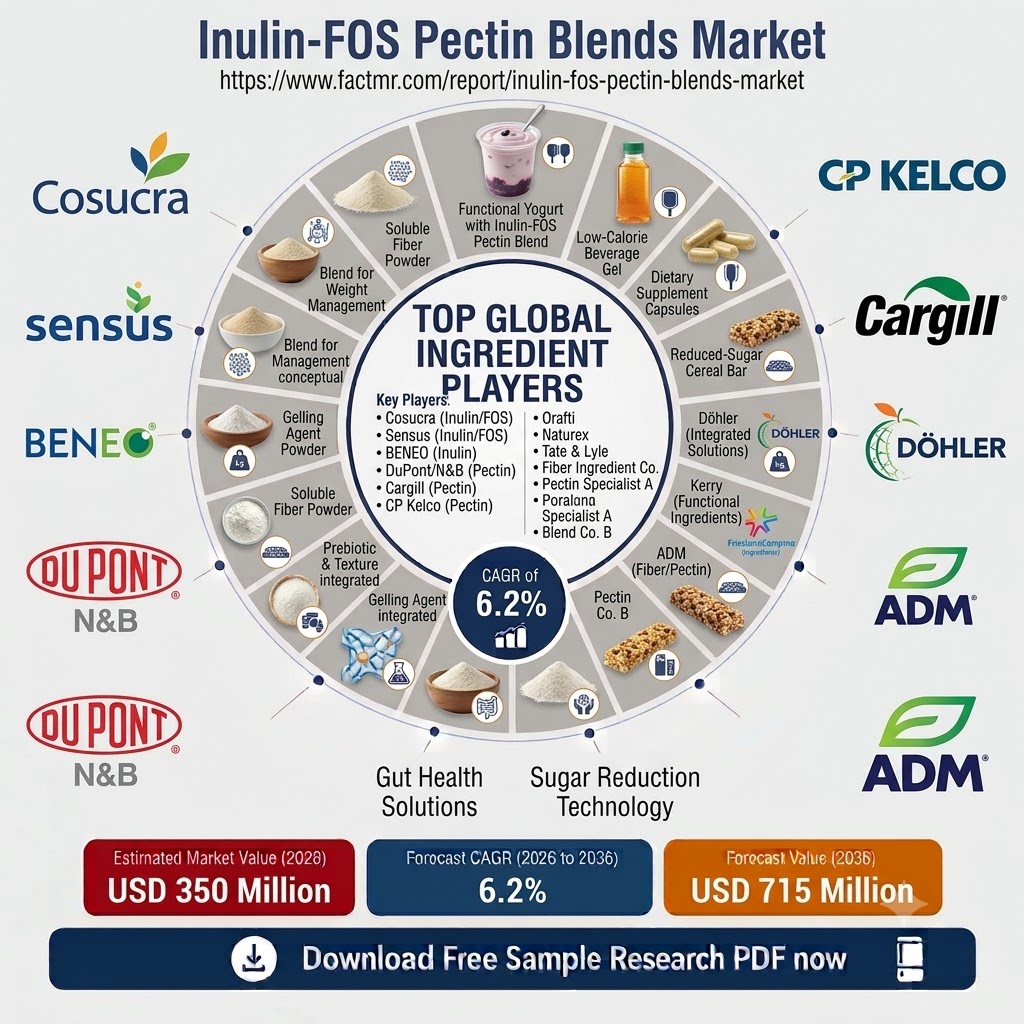
The competitive landscape includes Tate & Lyle, including CP Kelco, Cargill, Ingredion, BENEO, and Cosucra.
Tate & Lyle, including CP Kelco, brings pectin and hydrocolloid capabilities relevant to formulations requiring gel control, mouthfeel, water binding, and soluble-fiber functionality.
Cargill and Ingredion strengthen the market through food-texturizing and specialty-ingredient capabilities. Their relevance extends to applications where formulators need to balance fiber enrichment with dispersion, viscosity, taste, and processing stability.
BENEO and Cosucra contribute soluble-fiber expertise, complementing pectin functionality in prebiotic and texture-focused formulations.
Competition is therefore centered on pectin expertise, soluble-fiber functionality, gel strength, mouthfeel, water binding, processing stability, and application support. Suppliers able to combine pectin know-how with inulin and FOS formulation guidance can address multiple application requirements through one development pathway.
Market Outlook Through 2036
The Inulin-FOS Pectin Blends Market is expected to benefit from growing demand for fiber-bearing supplements, gummies, beverages, dairy alternatives, and bakery snacks.
The commercial opportunity extends beyond fiber content alone. Brands need ingredient systems that maintain texture, support dosage consistency, perform under processing conditions, and provide clear labeling support.
For ingredient producers, this creates opportunities in customized blends, synbiotic fiber systems, upcycled fruit pectin, and application-specific formulation support. For food and supplement manufacturers, blend selection will increasingly depend on the interaction between fiber delivery and finished-product performance.
Report Coverage
Fact.MR’s analysis covers ingredient blends combining inulin, fructooligosaccharides, and pectin for prebiotic support, gelling, viscosity, water binding, and texture stabilization in food and supplement applications.
The study examines citrus pectin, apple pectin, upcycled fruit pectin, LM pectin, and HM pectin, along with inulin-enriched, FOS-enriched, resistant-fiber, whole-fruit, and synbiotic fiber systems.
Applications covered include supplements, gummies, beverages, dairy alternatives, and bakery snacks across North America, Latin America, Western Europe, Eastern Europe, East Asia, South Asia & Pacific, and the Middle East & Africa.
The analysis draws on 120+ sources, 35+ company portfolios, 25+ countries, and more than 20 industry interviews. Market sizing combines historical performance, demand indicators, pricing and volume trends, segment shares, company participation, country-level growth, adoption patterns, and market barriers.
Other Reports:
Papaya Powder Market
Dry Extrusion Proteins Market
Calamansi-Derived Gelling Agents Market
About Fact.MR
Fact.MR is a market research and consulting firm providing syndicated and customized research across industries and geographic markets. Its research combines primary interviews, secondary research, market modelling and validation to support business planning, competitive analysis and strategic decision-making.