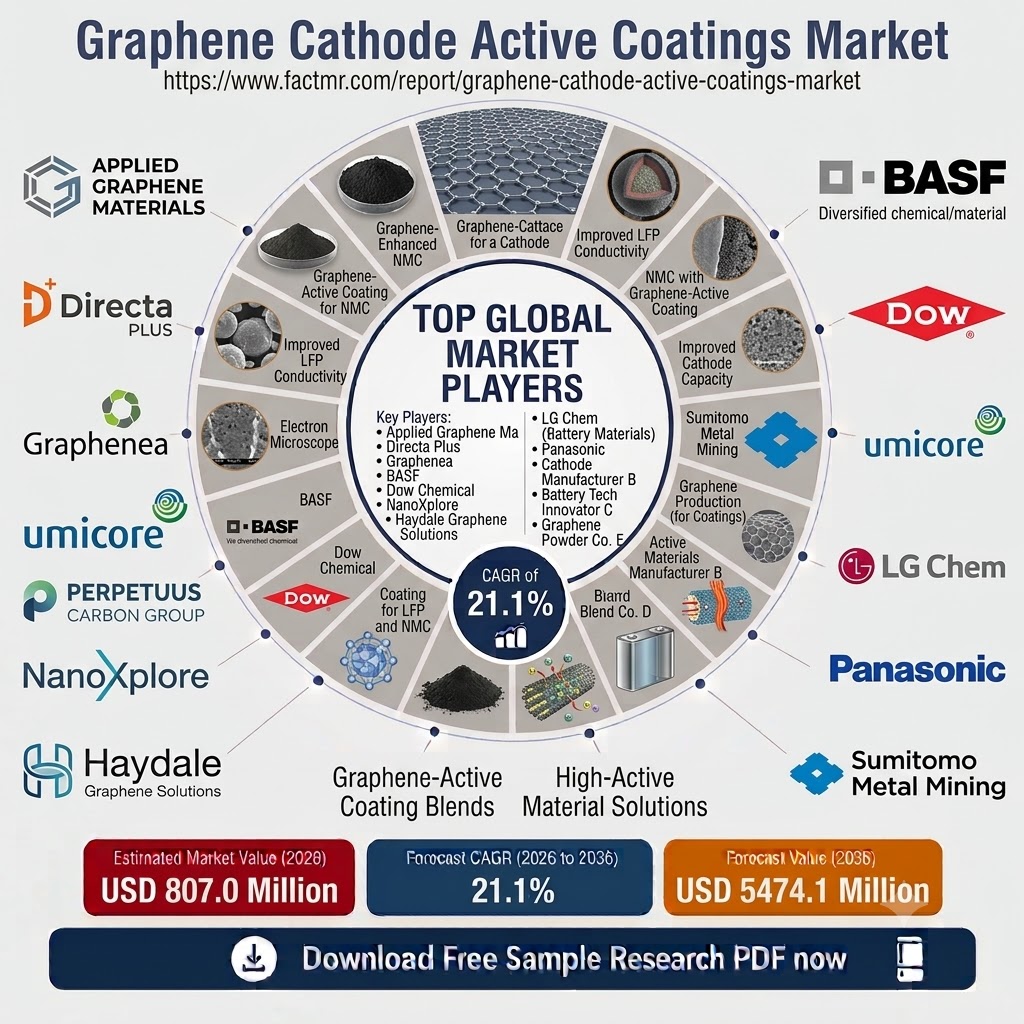
The global Graphene Cathode Active Coatings Market is projected to grow from USD 807.0 million in 2026 to USD 5,474.1 million by 2036, expanding at a 21.1% CAGR during the forecast period. The market reached USD 666.4 million in 2025, while the absolute opportunity is estimated at USD 4,667.1 million between 2026 and 2036.
Demand is being shaped by battery developers seeking conductive surface treatments that can improve cathode performance without requiring a complete change to established lithium-ion manufacturing processes. Graphene coatings are being evaluated for particle-level conductivity, fast charging, high-voltage operation, and cycle-life performance.
Get Detailed Market Forecasts, Competitive Benchmarking, and Pricing Trends
EV Cells Account for the Largest Application Share
EV cells are estimated to represent 49.0% of the market in 2026, making electric mobility the leading application.
Traction batteries place simultaneous demands on charging speed, cycle life, conductivity, and thermal stability. This makes cathode-surface engineering an important part of battery-material qualification.
The U.S. Energy Information Administration reported in August 2026 that light-duty EVs consumed 23,532,855 MWh of electricity in 2025. The expanding electricity demand from electric mobility reflects a larger operating base for battery technologies where charging performance and energy efficiency remain key engineering considerations.
For coating suppliers, the commercial requirement extends beyond demonstrating an improvement in early laboratory cells. Battery manufacturers need consistent performance across larger cell formats and production-scale material batches.
Graphene Shells Lead Coating Architectures
Graphene shell on cathode particles is expected to account for 35.0% of the market in 2026.
Particle-level graphene shells place conductive material directly at the active-material interface. The approach is intended to preserve electron pathways during cycling while targeting conductivity improvements at relatively low graphene loading.
However, coating consistency becomes increasingly important as production volumes increase. Uneven particle coverage can create lot-to-lot differences in impedance and electrochemical behavior.
Suppliers therefore need reproducible surface treatment, controlled dispersion, and defined processing windows for mixing, coating, and heat treatment. These factors can help battery manufacturers distinguish coating performance from changes caused by the underlying cathode chemistry.
LFP Emerges as the Leading Cathode Chemistry
LFP is projected to hold a 30.0% share in 2026, supported by its use in cost-focused EV and stationary-storage cells.
LFP has comparatively limited electronic conductivity, creating an opportunity for conductive graphene interfaces to target this constraint while retaining the established cathode chemistry.
Japan’s Ministry of Economy, Trade and Industry set a target of 150 GWh of annual domestic battery-manufacturing capacity from 2030 into the mid-2030s. Such capacity development creates additional opportunities for materials that can be qualified within established battery chemistries and manufacturing workflows.
The commercial decision for LFP developers will depend on the balance between conductivity improvement and the additional cost and processing requirements associated with coating.
Fast Charging Drives Coating Development
Fast charge is anticipated to capture 38.0% share in 2026, making it the leading performance target.
Higher charging rates increase current density and expose resistive losses at the electrode interface. Conductive graphene coatings can address part of this constraint, but commercial qualification requires more than a single performance measurement.
Battery developers need evidence across charge rates, heat generation, retained capacity, cycle life, and practical electrode loading. The coating must continue to provide a measurable benefit through repeated charging and changing temperature conditions.
This is also why compatibility with existing cathode production is important. A coating that improves electrochemical performance but requires extensive changes to slurry, drying, or electrode-processing conditions may face a longer qualification path.
Qualification and Coating Uniformity Remain Constraints
The market is expected to benefit from EV-cell fast-charge requirements, battery-material localization, higher-voltage cathode development, and compatibility with existing cathode lines.
Graphene encapsulation for LFP and LMFP cathodes represents an opportunity, while conductive coatings for high-nickel and manganese-rich cathodes could support longer-term demand. Dry-electrode-compatible graphene interfaces provide another development route.
At the same time, battery qualification cycles, dispersion control, coating uniformity, and added material and processing costs can slow commercial adoption.
For coating companies, reproducible qualification packages can become an important differentiator. Data covering conductivity, coating coverage, electrochemical performance, processing compatibility, and thermal behavior can help cell-development teams assess the material at commercial electrode loading.
South Korea Leads Country Growth
South Korea is projected to record the fastest growth among the five profiled countries, with a 22.3% CAGR from 2026 to 2036. The United States follows at 21.7%, Japan at 19.6%, Germany at 18.5%, and Switzerland at 16.5%.
South Korea’s battery manufacturing base and electric-mobility expansion are supporting material qualification. The Ministry of Climate, Energy and Environment reported that registered electric vehicles reached 899,101 in 2025.
In the United States, the Department of Energy announced in August 2026 that USD 500 million was selected for seven critical-mineral and battery projects covering processing, battery manufacturing, and recycling capacity. This investment is expected to expand qualification routes for coated cathode materials.
Japan’s battery strategy, Germany’s expanding electric-vehicle base, and Switzerland’s research infrastructure provide additional development environments for graphene cathode coatings.
Suppliers Focus on Cathode Integration and Material Consistency
The competitive environment includes companies with capabilities spanning cathode encapsulation, graphene materials, conductive additives, and battery-electrode integration.
Volexion, NanoXplore, NEI Corporation, Graphene Manufacturing Group (GMG), CARBON T&C, and HydroGraph are identified among the key companies profiled.
Volexion positions its technology around graphene encapsulation for lithium-ion cathode active materials, with a drop-in approach designed for compatibility with existing and next-generation lithium-ion manufacturing.
NanoXplore launched xGnP D500-HP in May 2026, with the company reporting verified purity of 99.8% at full commercial volumes. The product is positioned for applications requiring high-purity graphene to replace conventional conductive additives.
Competitive differentiation in the market includes cathode-specific integration, graphene quality, manufacturing compatibility, reproducible material properties, and cell-level performance evidence.
Analyst View
Shambhu Nath Jha, Principal Consultant at Fact.MR, states:
“Commercial success depends on repeatable particle coverage in existing cathode processes. The market is expected to reward formulations that pair electrochemical evidence with manufacturing compatibility.”
Report Coverage
The Fact.MR study covers graphene-enabled layers applied to cathode active materials to improve electrode conductivity, surface stability, cycle life, fast-charge behavior, and high-voltage performance.
The analysis covers graphene shells, conductive overcoats, graphene-binder hybrids, graphene-carbon composite layers, and functionalized graphene interfaces. Cathode chemistries include LFP, NMC, LMFP, high-nickel NCA/NCM, and next-generation manganese-rich materials.
Applications include EV cells, grid storage, consumer cells, power tools and mobility, and aerospace or specialty uses.
The analysis draws on 120+ sources, 35+ company portfolios, 25+ countries, and more than 20 industry interviews. Market sizing combines cathode-material demand, EV and storage adoption, coating architecture, country policy evidence, company portfolios, and material-qualification factors.
Related Reports:
Odor-Blasting Laundry Additives Market
Biobased Laundry Pod Systems Market
Biodegradable Sulfate-Free Thickeners Market
About Fact.MR
Fact.MR is a market research and consulting firm providing syndicated and customized research across industries and geographic markets. Its research combines primary interviews, secondary research, market modelling and validation to support business planning, competitive analysis and strategic decision-making.