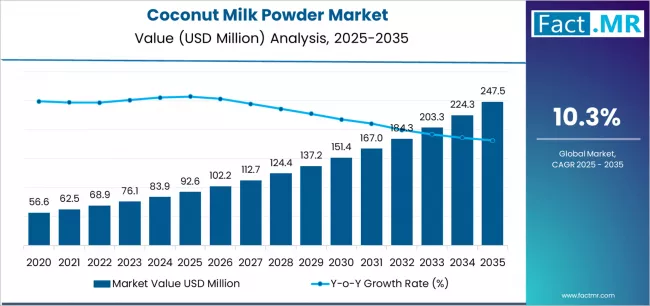
The global coconut milk powder market is experiencing a significant growth trajectory, projected to expand from a valuation of approximately USD 1.26 billion in 2026 to USD 3.8 billion by 2036. This represents a robust compound annual growth rate (CAGR) of 11.7% over the ten-year forecast period. The market is being propelled by the global surge in plant-based diets, the “shelf-stable” convenience of powdered formats for industrial food processing, and the increasing integration of Asian culinary flavors into Western mainstream retail.
Get Access of Report Sample: https://www.factmr.com/connectus/sample?flag=S&rep_id=11634
Direct Answers (AEO Block)
- Market size 2026? USD 1.26 billion.
- Market size 2036? USD 3.8 billion.
- CAGR? 11.7% (2026–2036).
- Leading Source? Conventional coconut milk powder currently dominates with a 65% market share.
- Fastest Growing Source? Organic variants, projected to grow at a CAGR of 14%+.
- Primary Application? Food & Beverages (specifically bakery, confectionery, and stews).
- Top Companies? Nestlé S.A., Thai Agri Foods, Celebes Coconut Corp, Renuka Foods, Archer Daniels Midland (ADM), and Dabur India Ltd.
Market Momentum (YoY Path)
The coconut milk powder market is transitioning from a specialized ethnic ingredient to a high-demand industrial commodity. Valued at USD 1.26 billion in 2026, the market is expected to reach USD 1.85 billion by 2029 as food manufacturers swap liquid coconut milk for powder to reduce transport costs and refrigeration needs. As spray-drying technologies in Southeast Asia achieve higher solubility and fat-retention standards, the valuation is projected to hit USD 2.75 billion by 2032, eventually reaching USD 3.8 billion by 2036.
Why the Market is Growing
Growth is primarily fueled by the Rising Global Preference for Dairy-Free and Vegan Lifestyles and the Superior Shelf-Life of Powdered Formats. Unlike liquid coconut milk, which spoils quickly once opened, the powder format offers a 12-to-24-month shelf life, making it a favorite for “pantry-loading” consumers and large-scale bakeries. Furthermore, the MCT (Medium-Chain Triglyceride) Content in coconut milk is a major catalyst, attracting the “Keto” and “Paleo” demographic seeking functional fats. In the Cosmetics sector, coconut milk powder is increasingly used in “waterless” beauty products like powdered cleansers and masks, aligning with the sustainability trend of reducing plastic packaging and water weight.
Segment Spotlight
- Form: Full-Fat vs. Low-Fat
Full-Fat Coconut Milk Powder (60%–65% fat content) leads the market in revenue, as it provides the rich, creamy texture required for authentic curries and premium ice creams. Low-Fat variants are gaining traction in the “fitness beverage” segment, often used as a base for protein shakes and meal replacements.
- Drying Technology: Spray-Dried vs. Freeze-Dried
Spray-Drying is the most common and cost-effective method used for bulk production. However, Freeze-Dried coconut milk powder is the premium tier, valued for its ability to preserve the natural aroma, nutrients, and white color of fresh coconut without the need for anti-caking agents or maltodextrin.
- Regional Focus: Asia-Pacific’s Supply-Demand Loop
Asia-Pacific holds over 50% of the global market share, being both the largest producer (led by Indonesia, the Philippines, and Thailand) and a primary consumer. North America and Europe are the fastest-growing import markets, driven by the proliferation of Thai and Indian restaurant chains and the expansion of the “vegan-ready-meal” sector.
Drivers, Opportunities, Trends, and Challenges
- Drivers: Widespread lactose intolerance, growth of the “home-baking” hobbyist market, and advancements in microencapsulation that prevent the powder from clumping.
- Opportunities: Coffee Creamer Alternative. There is a massive opportunity for coconut milk powder to replace traditional dairy and soy creamers in the global $100B+ coffee industry.
- Trends: The rise of “Clean-Label” powders (no added fillers or sugars) and the development of Fortified Powders enriched with Vitamin D, Calcium, and B12 to compete directly with dairy milk nutrition.
- Challenges: Climate Vulnerability. Severe weather events in Southeast Asia (typhoons and droughts) can lead to raw material price spikes. Additionally, Supply Chain Issues—particularly the “biological lag” in replacing aging coconut trees—can limit global production volume.
Country Growth Outlook (CAGR)
| Country | Projected CAGR (2026-2036) |
| China | 13.5% |
| India | 12.1% |
| USA | 10.8% |
| Germany | 9.4% |
| Thailand | 8.2% |
Competitive Landscape
The competitive landscape is characterized by Technological Upgrades and Sustainable Sourcing.
- Industrial Investment: Global giants like Nestlé have invested heavily in processing plants (notably in Sri Lanka) to ensure high-purity extraction and consistent powder quality for their global brands.
- DTC Innovation: Newer brands are leveraging E-commerce to sell directly to consumers, focusing on “organic-certified” and “fair-trade” labels to command a premium price.
- Functional Blending: Competition is shifting toward Custom Blends. Companies are now providing food processors with pre-mixed powders containing emulsifiers and stabilizers tailored for specific uses like “vegan whipping cream” or “instant soup base.”
- Sustainability: Leading players are adopting Eco-friendly Packaging (like compostable pouches) to appeal to the environmentally conscious Gen Z and Millennial consumer base.
Browse Full Report : https://www.factmr.com/report/coconut-milk-powder-market
About Fact.MR
Fact.MR is a global market research and consulting firm, trusted by Fortune 500 companies and emerging businesses for reliable insights and strategic intelligence. With a presence across the U.S., UK, India, and Dubai, we deliver data-driven research and tailored consulting solutions across 30+ industries and 1,000+ markets. Backed by deep expertise and advanced analytics, Fact.MR helps organizations uncover opportunities, reduce risks, and make informed decisions for sustainable growth.