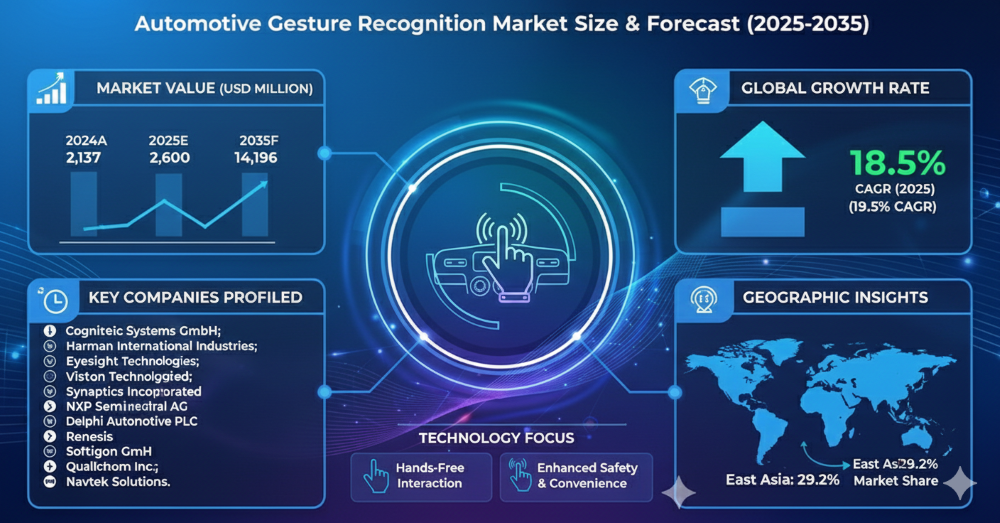
The automotive gesture recognition market is redefining how drivers and passengers interact with vehicles by enabling touchless control of key functions. As vehicles evolve into intelligent mobility platforms, automakers are increasingly integrating advanced technologies that enhance convenience while minimizing driver distraction. Gesture recognition allows users to perform actions such as adjusting volume, accepting calls, or navigating infotainment systems with simple hand movements, creating a safer and more intuitive driving experience.
With growing emphasis on smart interiors and connected car ecosystems, gesture-based controls are becoming an important component of next-generation vehicle design. This technology reflects the broader shift toward human-machine interfaces that prioritize ease of use, responsiveness, and safety.
Market Overview
Automotive gesture recognition refers to systems that interpret physical movements—typically hand or finger gestures—through sensors and cameras to execute commands without requiring physical contact. These systems rely on sophisticated software algorithms, infrared sensors, and 3D cameras to accurately detect motion even in varying lighting conditions.
The market is gaining traction as consumers seek seamless digital experiences similar to those offered by smartphones and smart home devices. Automakers are responding by incorporating gesture recognition into infotainment units, climate controls, and navigation systems, reducing reliance on traditional buttons and touchscreens.
In addition to improving user comfort, gesture recognition supports safer driving by allowing motorists to keep their focus on the road. As automotive electronics continue to advance, the technology is expected to become increasingly refined and widely adopted.
Key Growth Drivers
One of the primary factors driving the automotive gesture recognition market is the rising demand for enhanced in-vehicle safety. Minimizing manual interaction with dashboards helps reduce cognitive load and distraction, which is becoming a critical priority for both regulators and manufacturers.
The growing popularity of premium and luxury vehicles is also accelerating adoption. Automakers in these segments often introduce advanced features to differentiate their offerings, and gesture recognition aligns well with consumer expectations for innovative, high-tech interiors.
Another significant driver is the rapid expansion of connected vehicle technologies. As cars integrate artificial intelligence, voice assistants, and advanced display systems, gesture recognition complements these tools by offering an alternative, non-verbal method of control.
Furthermore, increased consumer familiarity with touchless technologies—supported by broader digital transformation trends—has strengthened acceptance of gesture-based interfaces within vehicles.
Technology Trends and Innovation
Continuous innovation is shaping the automotive gesture recognition landscape. Modern systems are leveraging artificial intelligence and machine learning to improve gesture accuracy, reduce false inputs, and adapt to individual user behaviors. These capabilities enable more personalized and responsive vehicle environments.
Three-dimensional sensing technology is gaining prominence for its ability to detect depth and spatial movement, ensuring reliable performance across diverse driving conditions. Meanwhile, sensor miniaturization is allowing manufacturers to integrate gesture controls without compromising vehicle aesthetics.
Another emerging trend is the combination of gesture recognition with other interface technologies, such as voice recognition and eye-tracking systems. This multimodal approach enhances usability by allowing drivers to choose the most convenient interaction method.
Automakers are also focusing on energy-efficient hardware and optimized software platforms to support long-term system reliability.
Regional Insights
North America remains a strong market for automotive gesture recognition, supported by high adoption of advanced vehicle technologies and robust investment in automotive innovation. Consumers in the region often embrace features that enhance driving comfort and technological sophistication.
Europe is demonstrating steady growth due to its well-established luxury automotive sector and emphasis on safety-driven design. Automakers in this region frequently integrate cutting-edge human-machine interface solutions to maintain competitive differentiation.
Asia-Pacific is emerging as a dynamic growth hub, fueled by expanding automotive production, rising disposable incomes, and increasing consumer interest in smart vehicle features. Rapid technological development and strong manufacturing capabilities are further supporting market expansion.
Other regions are gradually adopting gesture recognition as awareness of intelligent vehicle technologies continues to grow.
Applications & End-Use Outlook
Gesture recognition technology is primarily applied within infotainment systems, enabling users to control media playback, answer calls, and adjust settings without physical contact. Climate control adjustments, sunroof operation, and interior lighting are additional areas where gesture commands enhance convenience.
Passenger vehicles represent the leading area of adoption, particularly in mid-range and premium models where comfort and digital integration are key purchasing factors. However, the technology is expected to expand into a broader range of vehicle categories as costs decline and system capabilities improve.
The integration of gesture recognition also aligns with the development of autonomous vehicles, where intuitive interaction methods will be essential for managing increasingly sophisticated onboard systems.
Competitive Landscape
The automotive gesture recognition market features a mix of technology providers, semiconductor companies, and automotive suppliers working collaboratively to develop advanced interface solutions. Partnerships between automakers and technology firms are playing a crucial role in accelerating innovation.
Companies are focusing on improving sensor precision, software intelligence, and system scalability to meet evolving industry requirements. Strong research and development efforts, combined with strategic collaborations, are helping market participants strengthen their competitive positions.
As the demand for smart cockpit technologies rises, suppliers capable of delivering reliable and user-friendly systems are likely to stand out.
Future Outlook
The future of the automotive gesture recognition market appears promising as vehicles transition toward greater automation and connectivity. Touchless interfaces are expected to become increasingly common, supporting safer and more immersive driving environments.
Advancements in artificial intelligence, sensor technology, and real-time data processing will further refine gesture-based controls, making them faster and more intuitive. Over time, these systems may expand beyond simple commands to support complex interactions tailored to individual driver preferences.
As consumers continue to value convenience and innovation, gesture recognition is poised to become a defining feature of modern vehicle interiors.
Conclusion
Automotive gesture recognition is transforming the way people engage with their vehicles by introducing a natural, touch-free method of control. By enhancing safety, improving convenience, and supporting the evolution of smart cabins, this technology is playing a pivotal role in shaping the future of mobility.
A clear understanding of market trends, technological advancements, and regional developments can help stakeholders identify opportunities and remain competitive in an industry driven by continuous innovation.
Browse Full Report – https://www.factmr.com/report/20/automotive-gesture-recognition-market