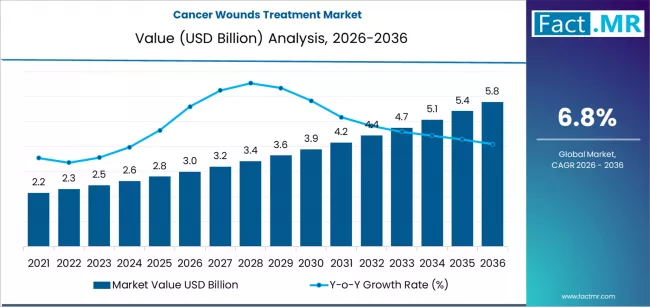
The global cancer wounds treatment market is entering a phase of critical clinical expansion, with its valuation projected to grow from USD 850 million in 2026 to USD 1.57 billion by 2036. According to a specialized industry analysis, the market is set to expand at a compound annual growth rate (CAGR) of 6.3%, driven by the rising global incidence of cancer and a transformation in how healthcare systems manage complex, non-healing malignant wounds.
Malignant wounds, often resulting from tumor infiltration of the skin or as complications of radiation and surgical interventions, present unique challenges that traditional wound care cannot address.1 For oncology leaders and investors, the market is moving toward specialized advanced dressings and topical therapies designed not just for healing, but for the effective management of exudate, odor, and pain—factors that directly impact patient dignity and quality of life.
Summary Table: Cancer Wounds Treatment Market Outlook
| Metric | Details |
| Market Value (2026E) | USD 850 Million |
| Forecast Value (2036F) | USD 1.57 Billion |
| Projected CAGR (2026-2036) | 6.3% |
| Leading Product Type | Advanced Wound Dressings (48.2% Share) |
| Primary End-User | Hospitals & Oncology Centers (55%+ Share) |
| Highest Growth Market | India (8.5% CAGR) |
To Access the Complete Data Tables & in-depth Insights, Request a Discount on this report: https://www.factmr.com/connectus/sample?flag=S&rep_id=13583
Core Market Dynamics: Answering the Strategic ‘Who,’ ‘What,’ and ‘Why’
Cancer wound treatment involves specialized products used to manage cutaneous lesions caused by primary or metastatic tumors, as well as treatment-induced wounds.2
-
Who is leading the sector? Key market participants including Smith & Nephew, Mölnlycke Health Care, ConvaTec Group, 3M (Acelity), and Coloplast are at the forefront, developing dressings that incorporate antimicrobial agents and odor-absorbing charcoal layers.3
-
What is the dominant product category? Advanced Wound Dressings command a significant 48.2% market share.4 These products, including foams, alginates, and hydrogels, are preferred for their ability to maintain a moist environment while handling the high volume of fluid often produced by malignant lesions.
-
Where is growth most accelerated? India is emerging as the fastest-growing market with an 8.5% CAGR, fueled by expanding oncology infrastructure. China follows with a 7.8% CAGR, supported by a rapidly aging population and increased healthcare access.
-
Why is the technology shifting? The industry is moving toward Bioactive Wound Care. There is a surge in demand for dressings that do more than cover a wound; modern solutions now utilize collagen and silver-impregnated materials to manage the local microbial load and support the integrity of periwound skin.
Sector Insights: Hospitals and Specialty Oncology Centers Lead Demand
The Hospitals and Oncology Clinics segment remains the primary end-user, projected to hold over 55% of the market share by 2026. However, the Home Healthcare segment is seeing the fastest growth as palliative care models shift toward home-based management to improve patient comfort.
“Managing a cancer wound is as much about psychological well-being as it is about clinical closure,” the analysis states. “Malignant wounds often cannot be ‘healed’ in the traditional sense due to the underlying disease.5 Consequently, the market is pivoting toward ‘Symptom-Focused Wound Care,’ where the priority is controlling odor and exudate to allow patients to maintain social interactions and personal comfort during their treatment journey.”
Key Market Trends and Strategic Outlook
1. Optimization through Odor-Control Technology
One of the most significant absolute dollar opportunities lies in Activated Charcoal Dressings. Malignant wounds are frequently associated with social isolation due to malodor. Manufacturers are integrating advanced carbon-fiber layers and antibacterial agents to neutralize odors at the molecular level, a feature that has become a high-priority requirement for palliative care units.
2. The Rise of Negative Pressure Wound Therapy (NPWT) in Oncology
In the United States (5.5% CAGR) and Germany (5.1% CAGR), there is increasing adoption of NPWT for managing surgical site infections following tumor resections. These systems help in reducing edema and promoting granulation tissue, potentially shortening hospital stays for oncology patients.
3. Regulatory and Palliative Care Tailwinds
Growth is being supported by new clinical guidelines that emphasize early intervention in wound management. In North America, which currently holds a 34% global market share, the integration of wound care specialists within multidisciplinary oncology teams is becoming a standard of care, ensuring that skin integrity is monitored alongside systemic treatments.
Investment Perspective: A High-Necessity Global Market
The cancer wounds treatment market represents a robust opportunity for medical device and pharmaceutical firms. As cancer becomes a chronic managed condition for many, the demand for long-term, high-performance wound management solutions—capable of addressing the specific biological complexities of malignant tissue—is expected to remain a stable growth driver through 2036.
Browse Full Report: https://www.factmr.com/report/cancer-wounds-treatment-market