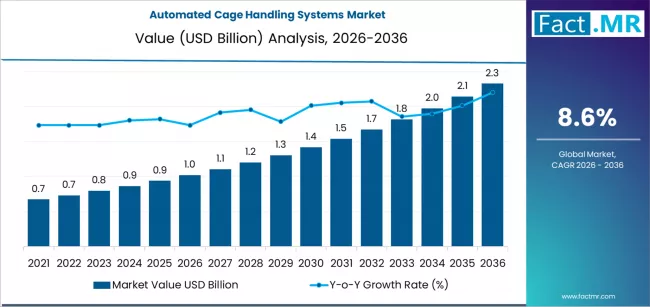
The global automated cage handling systems market is entering a phase of rapid industrialization, with its valuation projected to rise from USD 540 million in 2026 to USD 1.2 billion by 2036. According to a specialized industry analysis, the market is set to expand at a compound annual growth rate (CAGR) of 8.3%, signaling a transformative shift in how life science facilities manage animal research environments.
As biomedical research volumes increase and labor costs rise, research institutions are transitioning from manual labor to sophisticated robotic systems for the washing, bedding, and transportation of laboratory cages. These systems are no longer viewed simply as operational upgrades but as critical infrastructure for maintaining biosecurity, enhancing animal welfare, and ensuring the repeatability of scientific data.
Summary Table: Automated Cage Handling Systems Outlook
| Metric | Details |
| Market Value (2026E) | USD 540 Million |
| Forecast Value (2036F) | USD 1.2 Billion |
| Projected CAGR (2026-2036) | 8.3% |
| Leading Technology | Robotic Washing & Bedding (48.5% Share) |
| Primary End-User | Pharmaceutical & Biotech (55%+ Share) |
| Highest Growth Market | India (10.2% CAGR) |
Request for Sample Report | Customize Report – https://www.factmr.com/connectus/sample?flag=S&rep_id=13580
Core Market Dynamics: Answering the Strategic ‘Who,’ ‘What,’ and ‘Why’
Automated cage handling systems are integrated robotic solutions designed to automate the lifecycle of laboratory animal housing, including de-stacking, emptying, washing, bedding, and re-stacking of cages.
-
Who is leading the sector? Key market participants including Tecniplast S.p.A., Allentown, LLC, IWT s.r.l., BetterBuilt, and Gruppo Fucinati are at the forefront, developing modular robotic cells that can be customized for varying facility footprints.
-
What is the dominant technology? Robotic Cage Washing and Bedding Systems command a significant 48.5% market share. These units eliminate the most ergonomically taxing and repetitive tasks in a vivarium, drastically reducing the risk of workplace injuries.
-
Where is growth most accelerated? India is emerging as the fastest-growing market with a 10.2% CAGR, fueled by a surge in contract research organizations (CROs). China follows with a 9.5% CAGR, supported by massive state investment in biotechnology and pharmaceutical R&D.
-
Why is the technology shifting? Beyond labor savings, automation is a biosecurity mandate. By minimizing human-animal contact, automated systems reduce the risk of allergens and cross-contamination, protecting both the personnel and the integrity of the research subjects.
Sector Insights: Pharmaceutical Companies and Academic Research Lead Demand
The Pharmaceutical and Biotechnology sector remains the primary end-user, projected to hold over 55% of the market share by 2026. The shift toward personalized medicine and complex biologics has necessitated higher throughput in animal testing, which manual processes can no longer support efficiently.
“The modern vivarium is becoming a ‘smart’ facility,” the analysis states. “Automated cage handling is the backbone of this evolution. By integrating robotics with digital tracking, facilities can ensure that every cage is processed to an exact, validated standard of cleanliness. This level of precision is essential for meeting the stringent regulatory requirements of Good Laboratory Practice (GLP) and international animal welfare standards.”
Key Market Trends and Strategic Outlook
1. Optimization through Modular and Scalable Robotic Cells
Innovation is currently focused on “Small-Footprint Automation.” New systems are being engineered with modular designs that allow older, space-constrained academic labs to integrate robotics without requiring a total facility overhaul. This “plug-and-play” approach is lowering the barrier to entry for mid-sized research institutions.
2. The Rise of Industry 4.0 and IoT Integration
In the United States (7.2% CAGR) and Germany (6.8% CAGR), growth is supported by the adoption of Industry 4.0 standards. Modern cage handling systems are now equipped with sensors that track water consumption, detergent levels, and throughput metrics in real-time, allowing facility managers to optimize utility usage and schedule predictive maintenance.
3. Ergonomic and Occupational Health Tailwinds
A major driver in the North American and European markets is the focus on occupational health. Manual cage handling is one of the leading causes of repetitive strain injuries (RSIs) in laboratory staff. Automated systems provide a clear ROI by reducing workers’ compensation claims and turnover rates in high-pressure research environments.
Investment Perspective: A Decade of Laboratory Modernization
The automated cage handling systems market represents a robust opportunity for firms specializing in industrial robotics and life science equipment. As the global biopharma sector matures, the demand for “zero-error” infrastructure—capable of supporting 24/7 research operations with minimal human intervention—is expected to remain a cornerstone of capital expenditure through 2036.
Browse Full Report: https://www.factmr.com/report/automated-cage-handling-systems-market