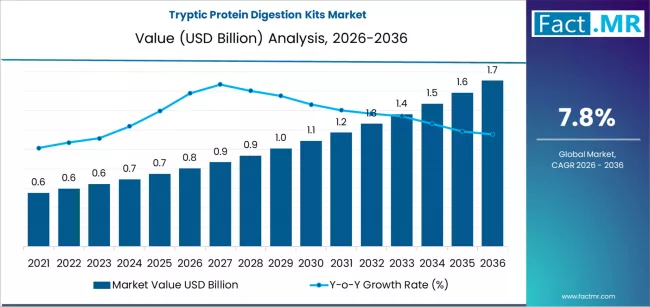
The global tryptic protein digestion kits market is poised for robust growth over the next decade, driven by technological innovation, expanding proteomics research, and rapid adoption in biopharmaceutical characterization workflows. The industry is projected to nearly double in value between 2026 and 2036, supported by increasing investment in life science research and rising demand for high‑precision proteomics workflows.
Market Overview & Growth Outlook
The global tryptic protein digestion kits market is expected to reach approximately USD 0.81 billion in 2026, growing at a compound annual growth rate (CAGR) of 7.8% through 2036. By 2036, market value is forecast to surpass USD 1.71 billion globally, highlighting strong long‑term demand for proteomics sample preparation solutions. This expansion is anchored in the indispensable role of trypsin — particularly sequencing‑grade trypsin reagents — as the gold standard protease for producing peptides compatible with high‑resolution mass spectrometry and advanced proteomics workflows.
Key Market Drivers
Proteomics & Discovery Research:
The shift toward large‑scale proteome mapping and disease biomarker discovery has escalated the need for reproducible, high‑quality protein digestion methods. As researchers seek deeper insights into cellular pathways and disease mechanisms, demand for reliable kits is rising.
Biopharmaceutical Characterization:
Rapid growth of complex biotherapeutics — including monoclonal antibodies, fusion proteins, and antibody‑drug conjugates — is driving demand for high‑precision digestion kits to support stringent regulatory and quality control requirements.
Automation & High‑Throughput Workflows:
Kits compatible with automated systems are gaining traction in core facilities, CROs, academic institutions, and industrial labs, where high sample throughput and workflow standardization are critical.
Segment Insights
-
Testing Kit Type: Sequencing‑grade trypsin reagents dominate product segmentation, capturing over 20.9% share in 2026, driven by their essential role in producing reproducible peptides for mass spectrometry.
-
Application: Discovery proteomics leads end‑use demand with an estimated 28.5% market share, reflecting expanding research programs in academia and industry.
-
End Users: Biopharmaceutical manufacturers are the largest institutional consumers (about 22.8% share), using kits extensively for therapeutic protein characterization and regulatory compliance testing.
Regional Growth Prospects
The market’s geographical growth reflects broader life-science investment trends:
-
India emerges as the fastest-growing national market, with a projected 10.6% CAGR, propelled by expanding biopharma capabilities and academic research funding.
-
Brazil follows closely at 10.2%, supported by improvements in research infrastructure.
-
China is forecast to grow at 9.7%, driven by rapid biotech expansion and government research investment.
-
Mature markets such as the USA, UK, France, and Germany are expected to register steady growth in the 6–7% range, underpinned by entrenched research and pharmaceutical sectors.
Competitive Landscape
The market features a mix of large life‑science conglomerates and specialized proteomics suppliers, leveraging innovation to capture share.
Leading Players Include:
-
Thermo Fisher Scientific Inc.
-
Promega Corporation
-
Merck & Co., Inc.
-
Waters Corporation
-
Agilent Technologies Inc.
These companies compete by enhancing enzyme purity, automation compatibility, and workflow integration, often bundling digestion kits with analytical platforms and software support services to deliver end‑to‑end solutions.
Challenges & Opportunities
Challenges:
Incomplete digestion, variable enzyme performance, and peptide modification artifacts remain technical hurdles that can impact data reproducibility and analytical confidence.
Opportunities:
The development of novel enzyme blends, automation‑ready formats, and integrated sample preparation systems presents significant growth potential, especially among high‑throughput laboratories and contract research organizations.
Industry Trends
Streamlined kits that combine reduction, alkylation, peptide cleanup, and digestion in a single workflow are gaining adoption, as labs seek to minimize hands-on time, reduce variability, and enable reproducible data across multi-site studies.
Market Outlook
Driven by sustained investment in proteomics, biologics research, and automation technologies, the tryptic protein digestion kits market is poised for steady and strategic growth through 2036. Consistent demand from both academic and industrial sectors underscores the long-term importance of high-performance sample preparation in the global life sciences ecosystem.
Browse Full Report : https://www.factmr.com/report/tryptic-protein-digestion-kits-market