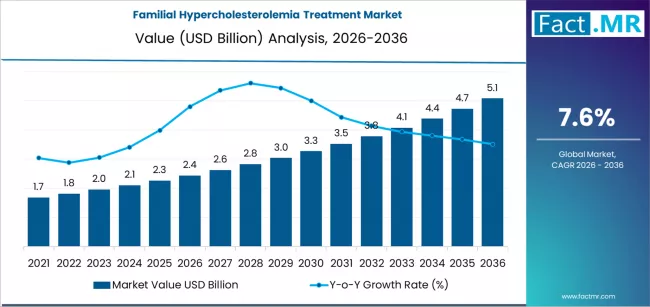
The global Familial Hypercholesterolemia (FH) Treatment Market is entering a pivotal decade of growth and innovation, with market dynamics shifting rapidly due to advancements in genetic diagnostics, targeted therapies, and rising healthcare access across key regions. The FH treatment market is projected to expand from USD 2.44 billion in 2026 to USD 5.08 billion by 2036, at a robust compound annual growth rate (CAGR) of 7.6% over the forecast period.
Market Expansion: Precision Medicine Drives Long-Term Growth
Familial hypercholesterolemia, a genetic disorder characterized by elevated LDL cholesterol levels and high cardiovascular risks, has long been underdiagnosed and undertreated worldwide. With increasing clinical awareness and better diagnostic infrastructure, this market is poised for sustained expansion. The projected near-doubling in total market value by 2036 underscores the critical need for improved disease detection and management.
Key factors driving this growth include:
-
Shift from reactive to preventive care: Healthcare systems globally are adopting proactive screening and early intervention strategies to reduce long-term cardiovascular complications.
-
Integration of genetic diagnostics: Precision genetic sequencing and cascade screening are becoming standard components of FH management pathways.
-
Advancement in targeted therapeutics: Innovations in PCSK9 inhibitors, RNA-based therapies, and next-generation cholesterol-lowering agents are redefining treatment paradigms.
Technological Evolution: From Diagnostics to Targeted Therapy
A major technological shift in the FH treatment landscape is the transition from conventional lipid-lowering drugs to precision diagnostics and targeted biologics. Genetic sequencing tests are expected to capture approximately 35.7% of the market share by 2026, underscoring their critical role in early and accurate diagnosis.
Enhanced Diagnostics:
-
Genetic Sequencing and Mutation Panels: These tests identify pathogenic variants in key FH genes (e.g., LDLR, APOB, PCSK9). Early genetic confirmation enables clinicians to stratify patients and initiate personalized treatment strategies.
-
Cascade Screening Protocols: Systematic screening of family members once an index case is detected reduces the diagnostic gap and ensures early intervention across generations.
Targeted Therapeutics:
-
PCSK9 Inhibitors: This class of monoclonal antibodies and RNA-based therapeutics has become a cornerstone of FH management due to superior LDL-C reduction profiles. PCSK9-targeted therapies, which include monoclonal antibodies and next-generation RNA interference drugs, are anticipated to grow steadily, driven by clinical efficacy and expanding indications.
-
Emerging Gene-Editing and RNA Technologies: Cutting-edge approaches such as gene editing and gene-silencing therapies are in advanced development, promising more durable and potentially curative treatment options for severe homozygous FH cases.
Digital health solutions, including integrated patient management platforms and telehealth monitoring, are improving long-term adherence and clinical outcomes for FH patients, particularly in remote or underserved regions.
Regional Demand: Diverse Growth Patterns Across Markets
Geographical analysis reveals distinct regional trends shaping the FH treatment market’s trajectory through 2036:
-
North America: Mature healthcare infrastructure, strong payer systems, and robust diagnostic networks support high adoption of advanced FH treatments and testing programs. The U.S. is expected to register steady growth due to proactive screening guidelines and early incorporation of precision therapeutics in clinical practice.
-
Europe: Structured public health programs and guideline-driven care pathways for cardiovascular disease management support market growth. Germany, France, and the UK are notable for systematic FH screening initiatives and specialist lipid clinic networks.
-
Asia-Pacific: The fastest growth rates are seen here, with countries like India (10.4% CAGR) and China (10.2% CAGR) projected to outpace developed economies, driven by rising cardiovascular disease awareness and expanding healthcare access.
-
Latin America & MEA: Emerging markets in Latin America and the Middle East & Africa are gradually expanding FH care infrastructure. Public-private partnerships and increasing healthcare expenditure are improving access to modern diagnostics and therapies.
Forecast Scenarios: Tailwinds and Challenges
While the overall growth trajectory remains strong, the pace of adoption will vary depending on regulatory landscapes, reimbursement policies, and healthcare ecosystem readiness.
-
Optimistic Scenario: Accelerated regulatory approvals for novel therapies and broader insurance coverage for genetic testing could amplify the market’s CAGR beyond current forecasts.
-
Likely Scenario: Continued steady adoption of precision diagnostics and PCSK9 inhibitors, supported by guideline updates and improved clinician awareness, aligns with the base forecast of 7.6% CAGR.
-
Conservative Scenario: Economic constraints or slower reimbursement uptake in cost-sensitive regions may temper growth, particularly for high-cost biologics and advanced therapeutic modalities.
Despite these scenarios, a consistent long-term trend is evident: clinical and technological innovation will remain the primary driver of market expansion, particularly as FH moves further into mainstream cardiovascular risk management.
Market Outlook and Strategic Imperatives
The competitive landscape is evolving, featuring diagnostics leaders and therapeutic innovators, including prominent players such as Invitae Corporation, F. Hoffmann-La Roche Ltd, Thermo Fisher Scientific Inc., QIAGEN N.V., and Abbott Laboratories.
Key strategies that will define market winners over the next decade include:
-
Expanding genetic testing accessibility and affordability
-
Partnerships with healthcare systems for cascade screening programs
-
Investment in next-generation lipid-lowering therapeutics
-
Enhanced patient engagement through digital platforms
Conclusion
The Familial Hypercholesterolemia Treatment Market is undergoing a paradigm shift toward precision medicine, early diagnosis, and personalized treatment strategies. Bolstered by strong technological advancements and diverse regional demand, the market’s projected growth through 2036 reflects not just increased revenue potential, but also expanded clinical opportunities to reduce the burden of cardiovascular disease globally. With stakeholders increasingly aligned around early detection and targeted care, FH treatment is positioned for transformative growth in the coming decade.
Browse Full Report : https://www.factmr.com/report/familial-hypercholesterolemia-treatment-market