The global Odor Neutralizing Agents for Landfills Market is projected to experience strong expansion over the next decade as solid waste volumes increase worldwide and communities demand more effective mitigation of landfill odors. Landfill operators, environmental agencies, and waste management service providers are increasingly adopting advanced odor control solutions to improve air quality, meet regulatory standards, and enhance public acceptance of waste disposal facilities.
Odor neutralizing agents are specialized compounds formulated to mitigate or eliminate unpleasant smells produced by the decomposition of organic waste in landfills. These agents work by chemically binding with odor-causing molecules, masking odors, or biologically degrading malodorous compounds. With the rising focus on environmental sustainability and community well‑being, demand for efficient and long‑lasting odor management solutions is gaining traction across municipal and commercial landfill operations.
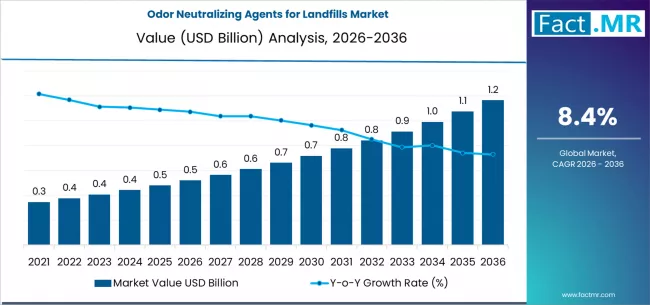
Market Outlook (2026–2036)
-
Market Value in 2026: USD 570 Million (estimated)
-
Market Value in 2036: USD 1.32 Billion (projected)
-
Forecast CAGR (2026–2036): ~8.5%
-
Leading Product Type: Biological Enzyme-Based Neutralizers
-
Dominant End User: Municipal Landfill Operations
The anticipated growth reflects increasing regulatory enforcement, heightened environmental awareness, expansion of landfill infrastructure, and strong emphasis on reducing community exposure to landfill odors.
To access the complete data tables and in-depth insights, request a Discount On The Report here: https://www.factmr.com/connectus/sample?flag=S&rep_id=13112
Market Overview
Odor emissions from landfills are among the most challenging environmental obstacles in waste management. As organic waste breaks down anaerobically, volatile sulfur compounds, ammonia, hydrogen sulfide, and organic acids are released, generating malodors that affect air quality and nearby communities. Traditional approaches such as passive covering and basic masking agents often provide limited effectiveness, especially during peak odor events prompted by seasonal changes, increased waste volume, or landfill expansion.
Odor neutralizing agents offer a more proactive solution by directly addressing the chemical causes of odor. These products include biological enzyme formulations that accelerate the breakdown of odor molecules, chemical neutralizers that react with malodorous compounds to render them non‑detectable, and advanced polymer‑based agents that encapsulate and isolate odor particles. The ability to tailor these solutions to specific landfill environments and waste compositions makes them increasingly attractive to landfill managers.
Key Market Drivers
1. Rising Waste Generation and Landfill Expansion
Urbanization, population growth, and economic development are driving increases in solid waste generation globally. As new landfill sites are established and existing facilities expand, odor control emerges as a critical operational priority to maintain environmental compliance and community acceptance.
2. Stricter Environmental Regulations
Government mandates related to air quality management and landfill emission standards are becoming more stringent. Operators are compelled to implement effective odor control strategies to comply with regulatory guidelines, avoid fines, and maintain permits, accelerating the adoption of advanced neutralizing agents.
3. Community Concerns and Public Health Focus
Landfill odors can significantly impact the quality of life for nearby residents, leading to complaints, legal challenges, and reputational risks for waste management companies. Effective odor neutralization improves community relations, supports public health goals, and enhances corporate social responsibility profiles for operators.
4. Technological Advancements in Odor Control
Ongoing innovation in odor neutralizing chemistries and delivery technologies enhances performance, durability, and ease of application. Biological formulations that harness enzymes and beneficial microbes are gaining popularity because they provide sustainable, biodegradable odor reduction without harmful residues.
Market Segmentation Insights
By Product Type:
-
Biological Enzyme-Based Odor Neutralizers
-
Chemical Neutralizers
-
Masking Agents and Fragrances
-
Polymer-Based Odor Absorbents
-
Combination/Formulated Solutions
By Formulation:
-
Liquid
-
Powder
-
Granular
-
Spray
By Application:
-
Active Landfill Cell Treatment
-
Landfill Cover Treatment
-
Gas Collection System Integration
-
Leachate Odor Management
-
Perimeter Air Quality Management
By End User:
-
Municipal Waste Management Authorities
-
Private Landfill Operations
-
Industrial Waste Facilities
-
Integrated Waste Service Providers
Regional Demand Dynamics
North America is expected to maintain a dominant position in the odor neutralizing agents market due to mature landfill infrastructure, stringent air quality regulations, and early adoption of advanced odor control practices. Large municipal landfills across the United States and Canada are increasingly investing in odor management technologies as part of comprehensive environmental compliance programs.
Europe also represents a significant market, with strong regulatory frameworks promoting landfill emission control and sustainable waste management practices. Countries with high population density and limited landfill space place greater emphasis on odor mitigation to minimize community impact.
Asia Pacific is anticipated to exhibit rapid growth, driven by expanding urban populations, increasing municipal solid waste generation, and growing awareness of environmental health issues. Emerging economies in the region are investing in landfill upgrades and modern waste management facilities, creating new demand for effective odor neutralization solutions.
Latin America and Middle East & Africa are expected to grow steadily as governments and private waste operators continue to strengthen landfill regulations and adopt modern waste handling practices.
Competitive Landscape
The odor neutralizing agents for landfills market features a mix of global chemical manufacturers, specialized environmental technology companies, and regional solution providers. Key players focus on developing high‑performance formulations with enhanced biodegradability, longer activity duration, and compatibility with existing landfill odor control systems.
Competition is driven by product innovation, portfolio diversification, technical support services, and strategic partnerships with waste management firms. Companies also emphasize field validation trials, customized odor mitigation strategies, and integrated solutions that combine neutralizers with monitoring and delivery systems.
Future Outlook
The odor neutralizing agents for landfills market is expected to witness sustained growth through 2036 as waste volumes rise and odor management continues to be a core concern for landfill operators and regulators alike. Enhanced formulations, better application technologies, and strong emphasis on environmental stewardship will support broader adoption of odor neutralizing solutions.
With growing focus on sustainable landfill operations and community relations, odor neutralizing agents will play an increasingly important role in ensuring air quality, regulatory compliance, and socially responsible waste management worldwide.
Browse Full Report: https://www.factmr.com/report/odor-neutralizing-agents-for-landfills-market