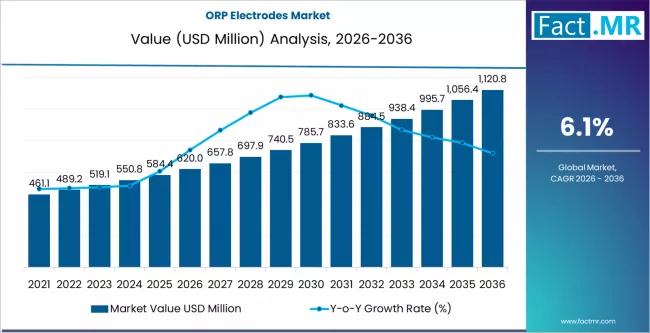
As industrial sectors pivot toward automated precision and stringent environmental compliance, the global Oxidation-Reduction Potential (ORP) electrodes market is positioned for significant expansion. According to a comprehensive industry analysis by Fact.MR, the market is valued at USD 620 million in 2026 and is projected to surge to USD 1,121 million by 2036, expanding at a steady compound annual growth rate (CAGR) of 6.1%.
The growth is primarily driven by the escalating demand for real-time water quality monitoring in municipal utilities and the rapid industrialization of the Asia-Pacific region. As regulatory bodies worldwide tighten standards for wastewater discharge and chemical processing, the reliance on ORP electrodes—critical sensors used to measure the “”cleanliness”” or oxidizing power of liquids—has transitioned from a secondary laboratory requirement to a primary industrial necessity.
Core Market Dynamics: Who, What, and Why
ORP electrodes are electrochemical sensors that measure the ability of a solution to act as an oxidizing or reducing agent. They are the frontline technology in:
- Water & Wastewater Treatment: Ensuring effective disinfection and dechlorination.
- Pharmaceutical & Biotech: Maintaining sterile environments for drug formulation.
- Food & Beverage Processing: Managing sanitization levels in production lines.
The surge in valuation is attributed to the “”How””: the integration of Internet of Things (IoT) and smart grid technologies into industrial water systems. By enabling remote monitoring and automated dosing, these sensors reduce manual error and operational downtime, making them indispensable for modern “”Smart Factories.””
Platinum Electrodes Maintain Dominance
A key takeaway from the report is the continued dominance of Platinum ORP electrodes, which currently command a 52% market share. Recognized for their superior chemical stability and durability, platinum sensors are the preferred choice for high-accuracy applications where gold or graphite alternatives may suffer from surface contamination or slower response times.
Regional Outlook: Asia-Pacific as the Primary Growth Engine
While North America and Europe remain high-value markets due to advanced healthcare and environmental infrastructure, the Asia-Pacific region is identified as the fastest-growing geographical segment. Rapid urbanization in India and China, coupled with massive investments in municipal water treatment facilities, is creating a high-volume demand for reliable sensing instrumentation.
Competitive Landscape and Innovation
The market remains technically demanding, with high entry barriers due to stringent regulatory standards and the need for precision engineering. Leading industry players identified in the report include:
- Endress+Hauser
- Hach (Danaher)
- Emerson (Rosemount)
- Yokogawa
- Thermo Fisher Scientific
- Mettler-Toledo
- ABB
- Hanna Instruments
These organizations are increasingly focusing on “”plug-and-play”” digital sensors that offer predictive maintenance capabilities, notifying operators before a sensor fails or requires recalibration.
Key Market Takeaways
- Market Valuation (2026E): USD 620 Million
- Forecasted Value (2036F): USD 1,121 Million
- Anticipated CAGR: 6.1%
- Leading Segment: Platinum ORP Electrodes (52% share)
- Primary Application: Water and Wastewater Treatment
Browse Full Report : https://www.factmr.com/report/orp-electrodes-market
About the Industry Report
This data is sourced from the latest “”ORP Electrodes Market Forecast and Outlook”” by Fact.MR, providing a granular analysis of electrode types, reference materials, end-user industries, and regional performance. The study serves as a strategic roadmap for investors, analysts, and manufacturing leaders navigating the complexities of the global electrochemical sensor landscape.