The global Ground Recorder System Market is projected to witness robust growth through 2036 as demand increases for precise vehicle, aircraft, industrial, and infrastructure data collection solutions. Ground recorder systems are specialized data acquisition, recording, and processing platforms that capture dynamic operating conditions, performance metrics, and system responses in real time. These systems are essential for diagnostics, safety analysis, performance optimization, and regulatory compliance across transportation, aerospace, defense, rail, automotive test laboratories, and civil infrastructure sectors.
Ground recorder systems are engineered to collect high-fidelity data from multiple sensors, including accelerometers, strain gauges, GPS modules, vibration transducers, and environmental sensors. By accurately capturing data over time, these systems support root cause analysis, lifecycle monitoring, predictive maintenance, and engineering validation activities. As organizations across industries embrace digital transformation and data-driven decision-making, ground recorder solutions are increasingly deployed to support system reliability, performance optimization, and operational safety.
Market Outlook (2026–2036)
-
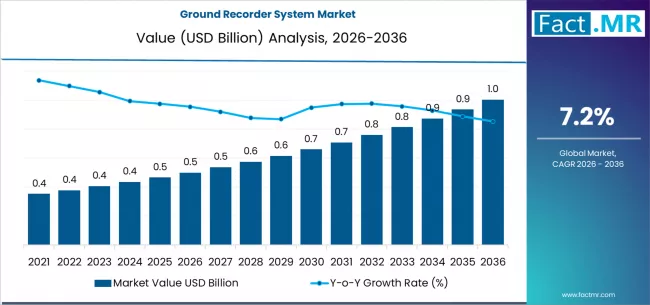
Market Value in 2026: USD 640 Million (estimated)
-
Market Value in 2036: USD 1.51 Billion (projected)
-
Forecast CAGR (2026–2036): ~9.5%
-
Leading Deployment Type: Portable and Ruggedized Ground Recorders
-
Dominant End-Use Segment: Defense and Aerospace Testing
The anticipated growth reflects increasing investment in data capture technologies that support condition monitoring, operational analytics, safe design validation, and compliance with stringent industry standards.
To access the complete data tables and in-depth insights, request a Discount On The Report here: https://www.factmr.com/connectus/sample?flag=S&rep_id=13204
Market Overview
Ground recorder systems serve as critical tools for capturing and archiving real-world operational data from vehicles, aircraft, trains, and industrial machinery. These systems are used extensively in research and development environments to test new designs, validate safety features, and improve product performance before deployment. Beyond R&D, ground recorders play a pivotal role in ongoing monitoring of fleets and infrastructure, enabling predictive maintenance and reducing the likelihood of catastrophic failures.
A ground recorder typically integrates with a network of sensors and data interfaces to collect multi-channel input data at high sampling rates. The captured information is stored locally or transmitted for real-time analysis, depending on system configuration. Advanced ground recorder systems incorporate signal conditioning, filtering, and timestamp synchronization to ensure data integrity and precision, even under harsh operating conditions.
Ground recorders are increasingly designed to be rugged, portable, and scalable, capable of withstanding extreme temperatures, vibration, dust, and moisture. These features make them suitable for field testing in automotive proving grounds, aerospace flightlines, railway test tracks, and remote industrial sites. Integration with analytics software, cloud platforms, and artificial intelligence tools further enhances their value, enabling users to transform raw data into actionable insights for performance improvement and risk mitigation.
Key Market Drivers
1. Rising Focus on Safety and Performance Validation
Industries such as automotive, aerospace, and rail are placing greater emphasis on rigorous testing and validation to ensure safety and performance. Ground recorder systems provide engineers with the detailed datasets needed to assess real-world behavior and refine designs accordingly.
2. Growth of Predictive Maintenance Programs
Enterprises are shifting from reactive maintenance to predictive frameworks that leverage recorded operational data. By identifying trends and early signs of degradation, organizations can reduce downtime, extend asset life, and avoid costly failures.
3. Increased Adoption of Connected and Autonomous Systems
The evolution of connected vehicles and autonomous platforms requires extensive data collection and analysis to ensure system reliability and safety. Ground recorders support these advanced systems by capturing multi-modal sensor data essential for algorithm calibration and performance verification.
4. Regulatory Compliance and Reporting Requirements
In many sectors, compliance with regulatory standards for safety, emissions, and operational transparency necessitates detailed recording and reporting of system performance data. Ground recorder systems help organizations meet these obligations with accurate and verifiable datasets.
Market Segmentation Insights
By Deployment Type:
-
Portable Ground Recorder Systems
-
Rack-Mounted and Fixed Station Recorders
-
Integrated Data Logger Solutions
By Sensor Interface:
-
Analog Sensor Integration
-
Digital Sensor and CAN Bus Interfaces
-
GPS and Inertial Sensor Integration
-
Multi-Channel Hybrid Systems
By End-Use Industry:
-
Defense and Aerospace Testing
-
Automotive R&D and Test Labs
-
Railway and Mass Transit Monitoring
-
Industrial Machinery and Predictive Maintenance
-
Civil Infrastructure and Structural Health Monitoring
By Data Storage Type:
-
Local Onboard Storage
-
Networked/Cloud-Enabled Storage
-
Hybrid Storage Solutions
Regional Demand Dynamics
North America is expected to hold a significant share of the market due to strong defense and aerospace sectors, advanced automotive testing infrastructure, and active adoption of predictive maintenance technologies. The United States, in particular, drives demand for ground recorder systems across military testing programs, commercial transportation validation, and research institutions.
Europe also represents a key market, supported by stringent safety regulations, well-established rail and automotive industries, and a growing focus on infrastructure monitoring and digital engineering practices. Countries with advanced R&D ecosystems are investing in ground recorder technologies to enhance product development cycles.
Asia Pacific is projected to exhibit rapid growth as industrialization accelerates and demand for data-driven asset management increases. Expanding automotive production, rising defense modernization programs, and infrastructure upgrades in countries such as China, India, Japan, and South Korea are creating new opportunities for ground recorder adoption.
Latin America and Middle East & Africa are expected to grow steadily as regional players invest in fleet modernization, condition monitoring, and compliance reporting requirements.
Competitive Landscape
The ground recorder system market is moderately competitive, featuring global instrumentation manufacturers, specialized electronics providers, and data analytics solution companies. Key players emphasize innovation in high-speed data acquisition, multi-channel sensor integration, ruggedized hardware design, and seamless software connectivity. Differentiation strategies include enhancing real-time data visualization tools, expanding cloud integration capabilities, and providing customized solutions for specific industry applications.
Partnerships with industry integrators, test facilities, and large OEMs help vendors extend market reach and tailor ground recorder packages to meet unique performance requirements. Technical support services, training programs, and aftermarket upgrades are also important components of competitive positioning.
Future Outlook
The Ground Recorder System Market is expected to maintain strong momentum through 2036 as industries continue to embrace data-centric approaches to testing, monitoring, and maintenance. With rising investments in digital transformation, predictive analytics, and connected fleet management, demand for advanced ground recorder solutions will expand across transportation, defense, industrial, and infrastructure applications.
Continued advancements in sensor technologies, data processing capabilities, and integrated software platforms will further enhance the value proposition of ground recorder systems. As organizations seek to unlock deeper insights from operational data, ground recorder technologies will remain at the forefront of performance optimization, risk mitigation, and engineering innovation worldwide.
Browse Full Report: https://www.factmr.com/report/ground-recorder-system-market