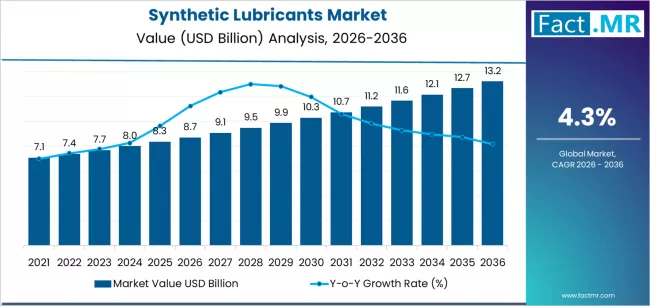
The market for synthetic lubricants is expected to grow by USD 4.5 billion over the course of the forecast period, from its estimated value of USD 8.7 billion in 2026 to USD 13.2 billion by 2036. The market is expected to increase at a compound annual growth rate (CAGR) of 4.3% between 2026 and 2036, translating into a total growth of 51.7%.
The synthetic lubricants market is witnessing robust growth globally, driven by increasing demand for high-performance lubrication solutions across automotive, industrial, aerospace, marine, and energy sectors. Synthetic lubricants are engineered fluids designed to deliver superior performance compared to conventional mineral-based lubricants, especially under extreme temperature, pressure, and operating conditions.
Their ability to enhance equipment efficiency, reduce friction and wear, extend drain intervals, and support sustainability goals has positioned synthetic lubricants as a preferred choice in modern industrial and mobility applications.
Quick Market Overview (2025–2035)
- Synthetic Lubricants Market Value (2026): USD 8.7 billion
- Synthetic Lubricants Market Forecast Value (2036): USD 13.2 billion
- Synthetic Lubricants Market Forecast CAGR: 4.3%
- Leading Base Oil Type in Synthetic Lubricants Market: Polyalphaolefin (38.7%)
- Key Growth Regions in Synthetic Lubricants Market: Asia Pacific, North America, Europe
- Key Players in Synthetic Lubricants Market: Exxon Mobil Corporation, Shell plc, Chevron Corporation, BP plc, TotalEnergies SE
To access the complete data tables and in-depth insights, request a Discount On The Report here: https://www.factmr.com/connectus/sample?flag=S&rep_id=12589
Market Overview
Synthetic lubricants are chemically engineered lubricating fluids formulated to provide consistent molecular structure and superior lubrication performance. Unlike conventional lubricants derived from crude oil, synthetic lubricants offer enhanced resistance to oxidation, better viscosity control, and improved stability over a wide temperature range.
They are widely used in engine oils, transmission fluids, hydraulic fluids, compressor oils, gear oils, and greases. As industries increasingly operate equipment under higher stress conditions and longer service cycles, the adoption of synthetic lubricants continues to accelerate.
Key Market Drivers
1. Rising Demand for High-Performance Automotive Lubricants
The automotive sector remains a major contributor to market growth.
-
Increasing production of passenger and commercial vehicles
-
Growing preference for fuel-efficient and low-emission vehicles
-
Need for superior lubrication in turbocharged and high-performance engines
Synthetic lubricants improve engine protection, enhance fuel economy, and support compliance with stringent emission standards.
2. Industrial Automation and Machinery Expansion
Rapid industrialization and automation are boosting lubricant demand.
-
Growing use of advanced machinery operating at high speeds and temperatures
-
Need for extended oil drain intervals to reduce downtime
-
Preference for lubricants that ensure consistent performance under heavy loads
Synthetic lubricants help reduce maintenance costs and improve equipment reliability.
3. Increasing Focus on Energy Efficiency and Sustainability
Synthetic lubricants contribute to energy conservation and environmental goals.
-
Reduced friction leading to lower energy consumption
-
Longer lubricant life minimizing waste generation
-
Compatibility with eco-friendly and low-toxicity formulations
Industries are increasingly shifting toward synthetic options to meet sustainability targets.
4. Growth in Renewable Energy and Power Generation
The expanding energy sector supports synthetic lubricant demand.
-
Wind turbines requiring long-life, high-stability lubricants
-
Power generation equipment operating under extreme conditions
-
Need for reliable lubrication to prevent costly failures
Synthetic lubricants offer superior protection and durability in energy applications.
Market Segmentation Analysis
By Product Type
-
Polyalphaolefins (PAO):
Widely used due to excellent thermal stability and oxidation resistance. -
Esters:
Preferred for high-temperature applications and biodegradability. -
Polyalkylene Glycols (PAG):
Used in compressors and specialty industrial applications. -
Silicone-Based Lubricants:
Applied in extreme temperature and specialty environments.
By Application
-
Automotive:
Engine oils, transmission fluids, and gear oils dominate usage. -
Industrial Machinery:
Used in hydraulics, compressors, turbines, and bearings. -
Aviation and Marine:
High-performance lubrication under extreme operating conditions. -
Energy and Power Generation:
Essential for wind, thermal, and hydro power equipment.
By End-use Industry
-
Automotive and transportation
-
Manufacturing and heavy industries
-
Energy and utilities
-
Aerospace and defense
-
Marine and offshore operations
Regional Market Insights
-
North America:
Strong demand driven by automotive innovation and industrial modernization. -
Europe:
Growth supported by strict emission regulations and sustainability initiatives. -
Asia-Pacific:
Fastest-growing region due to industrial expansion and rising vehicle ownership. -
Latin America and Middle East & Africa:
Gradual growth supported by infrastructure and energy investments.
Challenges and Market Restraints
1. Higher Cost Compared to Mineral Lubricants
-
Higher initial cost may limit adoption in price-sensitive markets
-
Cost-conscious consumers may prefer conventional lubricants
2. Limited Awareness in Emerging Markets
-
Lack of understanding about long-term cost benefits
-
Preference for traditional lubrication practices
3. Compatibility and Disposal Concerns
-
Compatibility issues with older equipment
-
Need for proper disposal and recycling practices
Emerging Trends and Opportunities
1. Increasing Adoption in Electric and Hybrid Vehicles
Synthetic lubricants support thermal management and component protection.
2. Development of Bio-Based Synthetic Lubricants
Rising focus on environmentally friendly formulations.
3. Growth of Long-Drain and Maintenance-Free Lubricants
Industries seeking reduced downtime and operational efficiency.
4. Expansion of Specialty and Custom-Formulated Lubricants
Tailored solutions for niche industrial applications.
Future Outlook
The synthetic lubricants market is expected to grow steadily through 2035, driven by advancements in automotive technology, industrial automation, and energy efficiency initiatives. As equipment becomes more complex and performance demands increase, synthetic lubricants will continue to replace conventional lubricants across multiple industries.
Manufacturers investing in innovation, sustainable formulations, and application-specific solutions will gain a competitive advantage. With growing awareness of long-term performance benefits and total cost savings, synthetic lubricants are set to play a critical role in the future of lubrication technology.
Browse Full Report: https://www.factmr.com/report/synthetic-lubricants-market