The global Subsoil Nutrient Lift Fertility Program Market is projected to experience robust expansion over the next decade as innovative soil management practices gain traction and growers increasingly focus on maximizing productivity through enhanced subsoil fertility. Designed to address nutrient imbalances below the topsoil layer, subsoil nutrient lift fertility programs help unlock yield potential by replenishing deep soil reserves and improving nutrient availability where traditional surface-applied fertilizers are less effective.
Subsoil nutrient lift fertility programs combine targeted nutrient packages, soil conditioners, and agronomic strategies that penetrate deeper soil horizons to correct deficiencies, stimulate root growth, and enhance water and nutrient uptake. As global agriculture faces mounting pressure to boost yields sustainably while preserving soil health, growers and agronomists are recognizing the value of subsoil-focused fertility interventions as part of comprehensive crop nutrition systems.
Market Outlook (2026–2036)
-
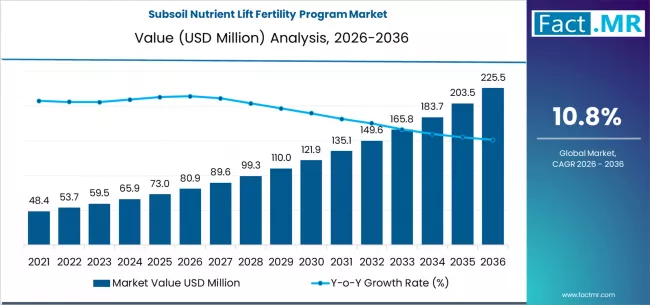
Market Value in 2026: USD 85.42 Million
-
Market Value in 2036: USD 312.96 Million
-
Forecast CAGR (2026–2036): 14.3%
-
Leading Technology Segment: Deep Placement Nutrient Delivery
-
Dominant Crop Segment: Cereals and Grains
-
Top Sales Channel: Ag-Retailers
The anticipated high compound annual growth rate reflects rising adoption across major crop categories, particularly cereals, oilseeds, and high-value horticultural crops, where deep soil nutrition plays a critical role in yield and quality responses.
To access the complete data tables and in-depth insights, request a Discount On The Report here: https://www.factmr.com/connectus/sample?flag=S&rep_id=13137
Market Overview
Traditional fertility programs typically focus on surface soil layers where nutrient availability is most visible. However, many soils suffer from deep-layer nutrient depletion that cannot be effectively corrected without targeted subsoil delivery systems. Subsoil nutrient lift fertility programs are engineered to overcome this challenge by combining specialized nutrient formulations with placement techniques that ensure deep penetration and sustained availability throughout the root zone.
By enhancing subsoil nutrient status, these programs improve root proliferation, water utilization efficiency, and resilience to environmental stress. This deeper nutrient replenishment supports not only short-term yield increases but also long-term soil health improvements that contribute to sustainable productivity gains.
Key Market Drivers
1. Increased Demand for Improved Nutrient Use Efficiency
Growers are prioritizing programs that deliver nutrients more precisely to where roots can access them, reducing wastage from surface losses and improving overall nutrient use efficiency. Subsoil targeted programs help unlock hidden yield potentials in soils with deep layer nutrient limitations.
2. Focus on Sustainable Crop Production
As sustainability goals become central to modern agriculture, farmers seek fertility strategies that improve soil health while minimizing environmental impact. Subsoil nutrient lift programs enhance nutrient cycling and reduce the need for repeated high-dose surface fertilizer applications.
3. Rising Adoption Across High-Value and Staple Crops
Cereals and grains, oilseeds, and specialty horticultural crops are leading adopters of subsoil fertility programs due to their high nutrient demands and sensitivity to soil fertility gradients. Improved root access to deep nutrients translates into stronger crop performance even under stress conditions.
4. Enhanced Agronomic Support Through Channel Partners
Ag-retailers, cooperatives, and crop advisors are playing a pivotal role in educating growers on subsoil fertility challenges and tailored program implementation, helping drive market penetration and proper program uptake.
Market Segmentation Insights
By Technology Type:
-
Deep Placement Nutrient Delivery
-
In-Soil Injection Systems
-
Microbial-Assisted Delivery
-
Controlled Release and Coated Nutrient Systems
By Crop Type:
-
Cereals and Grains
-
Oilseeds and Pulses
-
Fruits and Vegetables
-
Forage and Pasture Crops
By Sales Channel:
-
Ag-Retailers
-
Direct-to-Farmer
-
Cooperatives and Crop Advisers
Regional Demand Dynamics
Asia Pacific is anticipated to represent a significant share of the subsoil nutrient lift fertility program market, supported by large agricultural areas, intensive crop production systems, and growing emphasis on soil fertility management. North America and Europe also show strong market demand driven by advanced agronomic practices, precision nutrient management adoption, and robust advisory service frameworks. Emerging markets in Latin America and Africa are gradually adopting subsoil nutrient optimization as agricultural modernization expands.
Competitive Landscape
The competitive landscape includes major agricultural input suppliers, soil health specialists, and fertility program developers focusing on integrated subsoil nutrient solutions. Key players emphasize innovation in nutrient chemistry, deep placement delivery technologies, and agronomic service models that support tailored program design and field execution. Strategic collaborations with research institutions and advisory networks help validate program efficacy and strengthen market positioning.
Future Outlook
The Subsoil Nutrient Lift Fertility Program Market is expected to sustain strong growth through 2036 as the agriculture sector increases its focus on deep soil nutrient management and productivity optimization. Continued advancements in fertility program formulations, delivery technologies, and agronomic support systems will further enhance adoption and deliver measurable benefits in crop performance, soil health, and sustainable nutrient use.
Browse Full Report: https://www.factmr.com/report/subsoil-nutrient-lift-fertility-program-market