The soft tissue repair market is experiencing strong global growth, driven by rising sports injuries, an aging population, increasing trauma cases, and advancements in surgical and regenerative technologies. Soft tissue injuries involving ligaments, tendons, muscles, fascia, and connective tissues are among the most common orthopedic and medical conditions treated worldwide. As awareness increases and surgical techniques evolve, demand for effective repair solutions continues to grow.
Quick Stats (2025–2035)
-
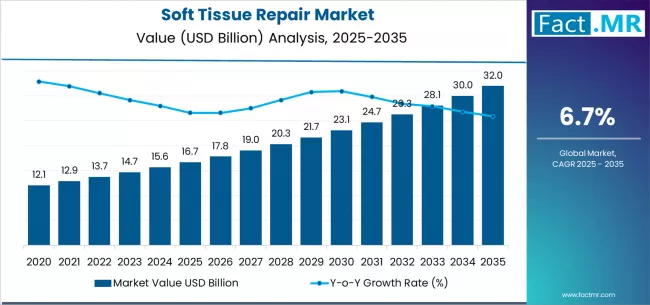
Market Size (2024): Around USD 14–15 billion globally
-
Projected Market Size by 2030: USD 22–23 billion
-
Estimated CAGR (2025–2030): ~6–7%
-
Largest Product Segment: Tissue matrices and biologic grafts
-
Leading Application Segment: Orthopedic and sports medicine
-
Top End-User: Hospitals remain the primary centers for soft tissue repair procedures
To access the complete data tables and in-depth insights, request a Discount On The Report here: https://www.factmr.com/connectus/sample?flag=S&rep_id=10115
Key Market Drivers
1. Rising Global Incidence of Sports Injuries
Growing participation in athletics, fitness activities, and recreational sports has dramatically increased soft tissue injuries such as tendon tears, ligament ruptures, and muscle damage. These conditions frequently require surgical repair, boosting demand for grafts, meshes, and fixation devices.
2. High Prevalence of Trauma and Accidental Injuries
Road accidents, occupational hazards, falls, and other trauma events contribute significantly to cases requiring surgical soft tissue reconstruction or repair. With urbanization and industrial activity rising worldwide, this driver continues to strengthen market demand.
3. Aging Population and Degenerative Conditions
Elderly populations face increased risks of tissue degeneration, reduced healing capacity, muscle loss, and ligament weakening. Age-related hernias, rotator-cuff tears, and tendon degeneration create a large patient base that requires soft tissue repair procedures.
4. Advancements in Medical and Regenerative Technologies
Innovations such as biologic scaffolds, hybrid meshes, bioresorbable materials, high-performance suture anchors, and minimally invasive surgical tools have improved surgical outcomes. These technologies encourage broader adoption by reducing recovery time and complications.
5. Growing Healthcare Spending and Awareness
Increasing investment in hospital infrastructure, orthopedic centers, and trauma care, especially in developing regions, supports higher procedure volumes. Rising awareness of early treatment and improved access to orthopedic specialists also boosts adoption.
Market Segmentation Insights
By Product Type
-
Tissue Matrices & Biologic Grafts:
The largest and fastest-growing product category. Their biocompatibility, low rejection risk, and strong regenerative potential drive wide adoption. -
Synthetic Meshes & Hybrid Materials:
Used extensively in hernia repair and abdominal wall reconstruction due to durability and strength. -
Sutures, Suture Anchors & Fixation Devices:
Critical in ligament and tendon repair, especially in orthopedic and sports medicine. -
Instruments & Accessories:
Includes delivery devices, arthroscopic tools, and surgical accessories essential for minimally invasive procedures.
By Application
-
Orthopedic & Sports Medicine:
Includes repairs related to ACL, rotator cuff, tendons, ligaments, and joint tissues. This is the leading and fastest-growing application segment. -
Hernia Repair:
One of the largest procedure categories globally due to widespread prevalence of inguinal, umbilical, and incisional hernias. -
Trauma & General Surgery:
Injuries from accidents or sudden tissue ruptures often require immediate reconstruction. -
Breast Reconstruction & Pelvic Repair:
Smaller but growing segments linked to aesthetic procedures, childbirth-related injuries, and reconstructive surgery.
By End-User
-
Hospitals:
Dominate due to the availability of surgical infrastructure and specialists capable of handling complex soft tissue procedures. -
Ambulatory Surgical Centers (ASCs):
Growing quickly due to lower costs, faster procedures, minimal recovery times, and increased adoption of minimally invasive repairs.
Challenges Affecting Market Growth
1. High Procedure Costs
Soft tissue repair surgeries—especially those involving biologics, regenerative scaffolds, and advanced implants—can be expensive, limiting access in low-income regions.
2. Reimbursement Barriers
Inconsistent coverage policies across regions can discourage patients from opting for surgical repair.
3. Post-Surgical Complications
Risks such as infection, graft failure, scar formation, and prolonged rehabilitation remain obstacles to wider procedure adoption.
4. Availability of Non-Surgical Alternatives
Physical therapy, regenerative injections, and non-invasive therapies can delay or reduce the need for surgery.
Opportunities Ahead (2025–2035)
1. Regenerative Medicine & Biologic Innovations
Significant opportunities lie in next-generation biologic grafts, stem-cell-enhanced scaffolds, and tissue-engineered matrices that support faster and more natural healing.
2. Growth in Minimally Invasive and Day-Care Surgeries
The rise of arthroscopy and laparoscopy enables quicker procedures and faster recovery, driving growth in ASCs.
3. Expansion into Emerging Markets
Asia-Pacific, Latin America, and parts of the Middle East represent high-growth regions with expanding trauma care and orthopedic services.
4. Technological Integration
Improvements in imaging, robotics, surgical navigation, and precision instruments allow surgeons to perform more accurate and efficient repairs.
Future Outlook
The soft tissue repair market is expected to grow steadily through 2035, driven by increased sports activity, aging demographics, and advancements in repair materials and techniques. As biologics become more sophisticated and minimally invasive procedures more common, patient outcomes will continue to improve, supporting broader adoption globally.
Browse Full Report: https://www.factmr.com/report/soft-tissue-repair-market