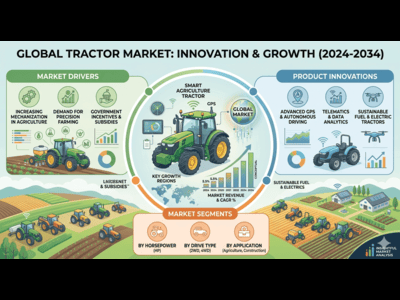
The global tractor market is entering a decade of sustained growth, projected to climb from US$ 80.36 billion in 2024 to a valuation of US$ 148.04 billion by 2034. According to the latest strategic analysis by Fact.MR, this 6.3% CAGR is being propelled by a fundamental shift toward new-age agricultural techniques and a global surge in large-scale infrastructure and mining projects.
As the world’s food consumption rises, farmers are increasingly adopting mechanization to achieve larger production volumes. Beyond the field, tractors are proving their versatility in non-agricultural sectors—becoming essential assets in road construction, brick kilns, and mining operations across both emerging and developed economies.
Quick Stats: Tractor Market at a Glance
- Market Value (2024E): US$ 80.36 Billion
- Projected Value (2034F): US$ 148.04 Billion
- Global Growth Rate:3% CAGR (2024–2034)
- Agricultural Segment (2034F): US$ 114.87 Billion (6.6% CAGR)
- Dominant Product Type: 2-wheel Drive (2WD) (82.6% market share)
- High-Growth Regional Market: East Asia (23.6% revenue share)
Strategic Drivers: Mechanization and Government Support
The transition from traditional farming to “Smart Agriculture” is the primary engine behind the market’s expansion.
Agricultural Evolution:
Tractors remain the mainstay of farming practices, with the agricultural segment expected to hold 77.6% of the market share by 2034. Modern tractors are no longer just for plowing; they are integrated with GPS, remote sensing, and robotics to improve accuracy in sowing and tilling. Manufacturers like New Holland are leading this charge, recently re-launching intelligent tractor series featuring Precision Land Management (PLM) for enhanced driver visibility and control.
Policy and Financing:
Governments in high-growth regions like India and Brazil are implementing supportive policies to provide farmers with easier access to credit. Subsidies on equipment costs and the emergence of contract farming are lowering the barrier to entry for smallholder farmers, allowing them to invest in advanced machinery that promises a high return on investment (ROI).
Regional Performance: East Asia and North America Lead
While East Asia dominates the manufacturing and adoption landscape, the United States remains a critical hub for high-value agricultural machinery investments.
| Country/Region | 2034 Forecast Value | Growth Catalyst |
| China | US$ 22.11 Billion | Massive support for smallholder mechanization and rapid adoption of GPS and robotics. |
| United States | US$ 21.11 Billion | High levels of farm mechanization and easy access to credit loans for equipment upgrades. |
| Japan | 7.1% CAGR | Significant focus on automation and high-efficiency machinery for aging farming populations. |
| South Korea | 6.7% CAGR | Strong integration of advanced technology in domestic agricultural equipment manufacturing. |
Category Insights: The Dominance of 2WD and Hydraulic Systems
- 2-wheel Drive (2WD) Tractors (US$ 122.28 Billion by 2034): This segment remains the world’s preference due to redesigns focusing on fuel efficiency and ease of use in confined areas. By 2034, 2WD tractors are projected to account for 6% of the global market.
- Hydraulic Mechanisms: To meet the demand for heavy fieldwork, companies are prioritizing hydraulic systems that offer superior fluid transmission and simple operability, providing an economical alternative for farmers seeking power and reliability.
Challenges: Affordability and the Skills Gap
Despite the optimistic outlook, the market faces hurdles. High R&D investments often lead to expensive finished products, making affordability a concern for end users. Additionally, the increasing sophistication of tractors introduces operational complexities, highlighting a critical need for operability training and knowledge transfer among farmers.
Analyst Opinion:
“We are witnessing the ‘Industrialization of the Farm.’ Tractors are evolving from simple workhorses into sophisticated digital platforms. The challenge for manufacturers over the next decade will be balancing this high-tech innovation with price sensitivity, ensuring that the next generation of automated tractors remains accessible to the average farmer.” — Senior Analyst, Fact.MR
Browse Full Report: https://www.factmr.com/report/510/tractors-market