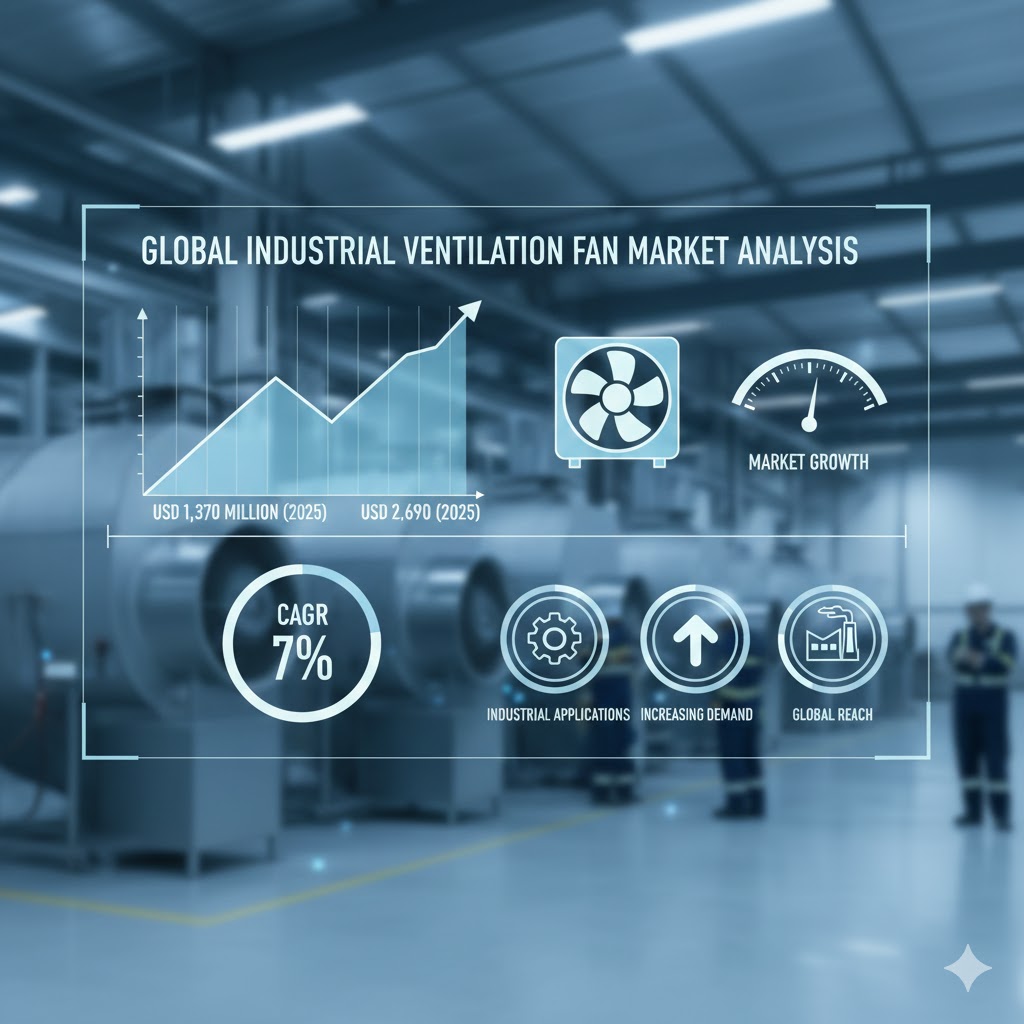
The global Industrial Ventilation Fan Market is poised for significant expansion over the 2026–2036 forecast period, fueled by rapid industrialization, regulatory mandates for air quality and worker safety, and the accelerating adoption of smart, energy-efficient ventilation technologies. The market is expected to grow at a compound annual growth rate (CAGR) of approximately 7%, delivering a nearly two‑fold increase in total market value by 2035.
Industrial ventilation fans are critical components across manufacturing, energy, processing, and heavy industrial sectors, serving functions such as dust and fume extraction, temperature regulation, and environmental compliance. As global industries shift toward higher automation, digitalization, and sustainability targets, next-generation ventilation solutions are becoming key strategic investments.
Market Growth & Revenue Forecasts (2026–2036)
Market analysis reveals that the industrial ventilation fan market, valued at approximately USD 1,370 million in 2025, is projected to reach around USD 2,690 million by 2035, reflecting a strong growth trajectory over the forecast horizon.
This rapid growth is anchored in several macro trends, including:
-
Industrial infrastructure expansion, particularly in Asia Pacific and emerging economies, driving sustained demand for ventilation systems.
-
Regulatory compliance requirements related to worker safety, emissions control, and energy efficiency, prompting widespread upgrades and retrofits.
-
Technological advancement in smart ventilation, IoT integration, and energy optimization.
Innovation Catalysts: Smart & Efficient Ventilation
Innovation is reshaping the industrial ventilation fan landscape. Recent product portfolios emphasize sensor-enabled control systems, real-time performance monitoring, cloud-based diagnostics, and predictive maintenance capabilities — features aligned with Industry 4.0 and smart factory initiatives. Connectivity and automation allow operators to optimize airflow dynamically, reduce energy consumption, and maximize uptime — bolstering both performance and sustainability outcomes.
Key innovation drivers include:
-
IoT and automation integration — Fans equipped with intelligent controllers and sensors that automatically adjust speed and performance based on environmental conditions.
-
Energy-efficient designs — Adoption of electronically commutated (EC) motors and variable frequency drives (VFDs) significantly reduces power use while enhancing airflow control.
-
Noise reduction & durability enhancements — Brushless motors, advanced blade aerodynamics, and ruggedized materials extend service life and improve operational comfort.
The increasing demand for smart ventilation solutions underscores an industry shift from traditional mechanical devices toward digitally connected, performance-optimized systems that deliver measurable energy savings and compliance benefits.
Regulatory Impact & Compliance Trends
Regulatory frameworks worldwide are exerting a defining influence on market dynamics. Stricter air quality and occupational safety mandates require industrial facilities to invest in advanced ventilation systems that meet evolving standards.
Across key regions:
-
In the United States, new energy conservation and workplace safety standards emphasize efficiency as well as contaminant control. Certification and compliance with performance metrics are influencing purchasing decisions.
-
The European Union mandates CE marking, RoHS, and EMC compliance, with specific certifications required for fans operating in explosive or hazardous environments.
-
In China, aggressive sustainability initiatives and carbon neutrality goals are steering adoption toward high-efficiency, low-emission ventilation solutions, with national standards guiding compliance.
Regulatory pressures also extend to workplace air quality norms, where agencies enforce tighter control limits for airborne particulates and hazardous fumes. These mandates are supporting market growth as companies upgrade legacy systems to align with contemporary environmental, health, and safety standards.
Application & End-Use Sector Dynamics
Industrial ventilation fans serve vital roles across multiple sectors, including automotive, chemicals, food processing, pharmaceuticals, electronics, metals, and oil & gas. Data suggests that mid-range flow fans (e.g., 250–500 CFM) and mid-capacity units strike an optimal balance between energy efficiency and performance, becoming a preferred choice across diverse industrial environments.
The oil & gas segment has emerged as particularly robust, driven by demanding process conditions, explosion-proof certifications, and the need to manage harsh air environments safely and reliably.
Regional Market Insights
-
Asia Pacific is anticipated to be the fastest-growing regional market, powered by robust industrial growth in China, India, and Southeast Asia. Rapid factory expansion and stringent air quality governance have elevated demand for next-generation fan systems.
-
North America maintains a strong market presence due to mature industrial sectors, advanced technological adoption, and high regulatory compliance levels.
-
Europe continues to invest heavily in ventilation modernization, driven by environmental protection laws and industrial decarbonization goals.
Competitive Landscape & Strategic Imperatives
The industrial ventilation fan market remains moderately fragmented, with global manufacturers and regional suppliers competing on innovation, performance, and regulatory compliance. Leading players are expanding capacity, enhancing R&D investments, and pursuing strategic acquisitions to strengthen regional footholds.
Recent market movements include:
-
Product line expansions featuring heavy-duty EC axial fans with reinforced housings.
-
AI-driven analytics platforms that provide predictive maintenance insights and air quality monitoring.
-
Strategic partnerships aimed at bolstering localized support and service networks.
Browse Full Report : https://www.factmr.com/report/industrial-ventilation-fan-market
Outlook & Business Impact
The Next-Generation Industrial Ventilation Fan Market is expected to deliver strong revenue growth, robust innovation adoption, and sustained regulatory influence through 2036. As industries globally prioritize safety, sustainability, and operational excellence, high-performance ventilation solutions will be central to achieving these objectives.
Continued investments in smart technologies, energy-efficient designs, and compliance-ready products will define leadership in this expanding market, creating opportunities for OEMs, integrators, and end-users alike.