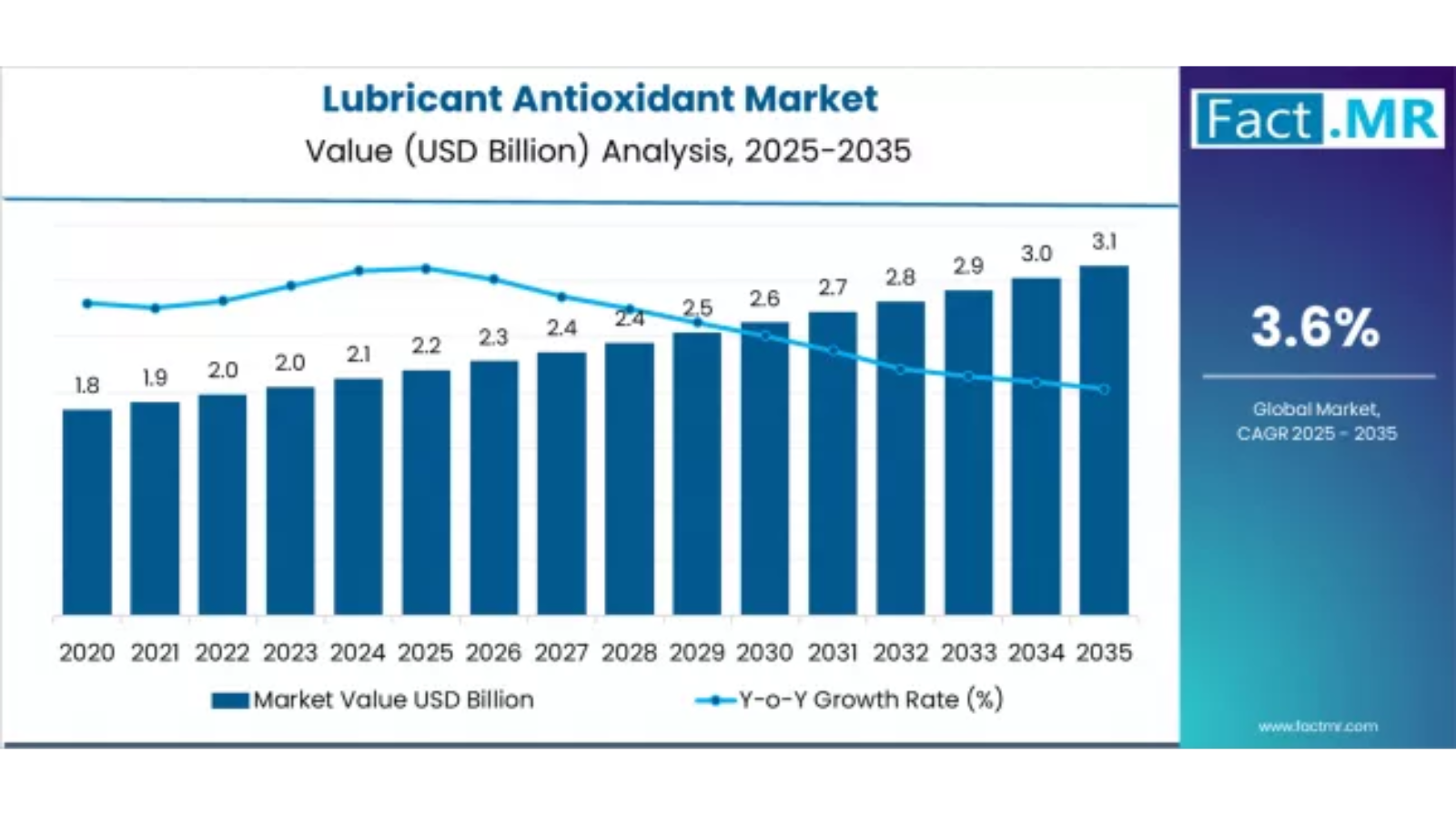
The global lubricant antioxidant market stands at the threshold of a decade-long expansion that is set to redefine lubricant additive technology and long-term engine protection solutions. According to Fact.MR, the market is projected to grow from USD 2.2 billion in 2025 to USD 3.1 billion by 2035, reflecting steady expansion at a CAGR of 3.6% over the forecast period.
This sustained growth highlights the accelerating adoption of advanced antioxidant additives aimed at improving lubricant stability, extending oil life, and enhancing equipment reliability across automotive, industrial, and specialty lubricant applications. As industries increasingly focus on operational efficiency, sustainability, and reduced maintenance costs, lubricant antioxidants are becoming indispensable components of modern lubrication systems.
Browse Full Report: https://www.factmr.com/report/3466/lubricant-antioxidants-market
Strategic Market Drivers
Automotive Industry Fuels Consistent Demand
The automotive sector remains the largest consumer of lubricant antioxidants, driven by the need to protect engines, transmissions, and drivetrains from oxidative degradation. Rising vehicle production, longer oil drain intervals, and the shift toward high-performance engines are strengthening demand for advanced antioxidant formulations.
In both passenger and commercial vehicles, antioxidants play a critical role in:
- Preventing sludge and varnish formation
- Enhancing thermal and oxidative stability
- Prolonging engine life and fuel efficiency
Industrial Machinery and Equipment Expansion
Rapid industrialization and growing investments in manufacturing infrastructure are boosting lubricant consumption across heavy machinery, turbines, compressors, and hydraulic systems. Lubricant antioxidants help maintain oil integrity under high temperatures and extreme operating conditions, making them essential for minimizing downtime and extending equipment lifespan.
Industries such as power generation, mining, construction, and metal processing are increasingly adopting high-performance lubricants fortified with antioxidant additives.
Shift Toward High-Performance and Synthetic Lubricants
The growing preference for synthetic and semi-synthetic lubricants is a major growth catalyst. These advanced lubricants rely heavily on high-quality antioxidant systems to maintain performance over extended service intervals, particularly in demanding automotive and industrial environments.
Regulatory Push for Sustainability and Efficiency
Environmental regulations aimed at reducing emissions and waste oil generation are encouraging the use of longer-lasting lubricants. Antioxidants enable extended oil drain intervals, reducing lubricant consumption and environmental impact—aligning well with global sustainability goals.
Regional Growth Highlights
North America: Automotive and Industrial Stability
North America remains a mature yet steady-growth market, supported by a strong automotive aftermarket, industrial maintenance activities, and high adoption of premium lubricants across manufacturing and energy sectors.
Europe: Regulation-Driven Innovation
Strict environmental and performance standards across the European Union are accelerating the adoption of advanced lubricant additives. Germany, France, and the U.K. lead demand due to their strong automotive manufacturing base and industrial automation focus.
East Asia: Manufacturing and Automotive Powerhouse
China, Japan, and South Korea dominate consumption through extensive automotive production, heavy industrial operations, and rapid adoption of advanced lubricant technologies. OEM-driven demand continues to strengthen antioxidant usage in factory-fill and aftermarket lubricants.
Emerging Markets: Industrialization and Vehicle Growth
India, Southeast Asia, Latin America, and the Middle East are witnessing rising demand due to:
- Expanding vehicle fleets
- Infrastructure development
- Growth in industrial machinery and power generation
Market Segmentation Insights
By Antioxidant Type
- Aminic Antioxidants – Widely used in high-temperature applications due to strong oxidative resistance.
- Phenolic Antioxidants – Dominant in automotive and industrial lubricants for long-term stability.
- Others (Blends & Specialty Antioxidants) – Growing adoption in high-performance and specialty lubricants.
By Application
- Automotive Lubricants – Largest segment driven by engine oils and transmission fluids.
- Industrial Lubricants – Strong demand in turbines, compressors, and hydraulic systems.
- Marine & Aviation Lubricants – Specialized applications requiring high oxidative stability.
- Greases & Specialty Lubricants – Niche but growing demand in extreme environments.
Challenges Impacting Market Growth
- Raw Material Price Volatility
Fluctuations in chemical feedstock prices affect antioxidant production costs. - Stringent Environmental Regulations
Compliance with evolving regulations requires continuous reformulation and R&D investment. - Shift Toward Alternative Technologies
Emerging additive chemistries and lubricant innovations may intensify competitive pressure.
Competitive Landscape
The lubricant antioxidant market is moderately consolidated, with key players focusing on formulation innovation, sustainability, and customized solutions for OEMs and industrial clients.
Key Companies Profiled
- BASF SE
- Lanxess AG
- Afton Chemical
- Infineum International
- Lubrizol Corporation
- Chevron Oronite
- SI Group
- Songwon Industrial
Companies are investing in next-generation antioxidant blends, low-toxicity additives, and formulations compatible with bio-based and synthetic lubricants.
Recent Developments
- 2024: Increased R&D investment in ashless and environmentally friendly antioxidant additives.
- 2023: Rising adoption of advanced antioxidant packages in extended-drain engine oils.
- 2022: Lubricant manufacturers reformulate products to meet stricter emission and durability standards.
Future Outlook: Steady Innovation and Performance Optimization
The lubricant antioxidant market is poised for sustained growth through 2035, supported by:
- Rising automotive and industrial lubricant demand
- Growth of synthetic and high-performance oils
- Emphasis on extended equipment life and efficiency
- Regulatory focus on sustainability and waste reduction
As lubricant formulations continue to evolve, antioxidants will remain a cornerstone of performance, protection, and durability—ensuring long-term growth and technological advancement across the global lubricant industry.