The global Geo-Specific Climate Risk Indexed Fertility Program market is emerging as one of the fastest-growing segments within climate-smart agriculture, driven by increasing climate variability, pressure on farm productivity, and the convergence of agronomy with data analytics and predictive modeling. As weather extremes become more frequent, fertility programs that dynamically align nutrient application with localized climate indices are moving from experimental solutions to mainstream agricultural practice.
Market Size and Growth Outlook
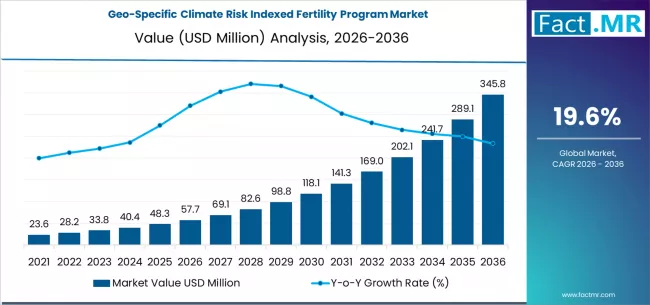
The global geo-specific climate risk indexed fertility program market is projected to expand from roughly $70–83 million in 2026 to over $415 million by 2036, achieving a compound annual growth rate (CAGR) of approximately 19–20%. This growth significantly outpaces traditional fertilizer markets, reflecting a structural shift toward precision and climate-resilient nutrient management.
The increasing inefficacy of uniform fertilizer schedules under erratic rainfall, droughts, and temperature extremes has driven adoption. Geo-specific indexed fertility programs use historical climate data, predictive weather modeling, soil health metrics, and crop response analytics to calibrate nutrient timing, dosage, and composition according to local climate risk exposure. This approach improves yields, reduces nutrient loss, and minimizes environmental impact.
Market Share and Competitive Landscape
The market is moderately concentrated, with global agribusinesses and agri-tech innovators leading adoption. Large players are investing heavily in integrated climate analytics and fertility solutions to strengthen competitive positioning. Standard programs account for the largest market share, representing nearly 40–50% of revenue, as they provide scalable solutions for mid-sized and large farms. Liquid formulations dominate the product segment with approximately 40–45% share, supported by compatibility with precision delivery systems and real-time climate adjustments.
High-Growth Segments and Regional Hotspots
From a regional perspective, Asia-Pacific and North America are the fastest-growing markets. Countries such as India and China are projected to see CAGRs above 18%, driven by climate vulnerability, government initiatives promoting sustainable agriculture, and the expansion of digital farm management tools. The United States and the Netherlands are also seeing strong growth due to advanced precision agriculture infrastructure and stricter environmental regulations.
Large corporate farms currently dominate adoption because of their capacity to absorb analytics and integration costs. However, adoption among smallholders is improving as program costs decrease and bundled offerings—including advisory services, insurance products, and government support—become more widely available. Index-based climate solutions are increasingly seen as essential for stabilizing farm incomes and mitigating climate risk.
Value Chain Insights
The value chain for geo-specific climate risk indexed fertility programs extends beyond fertilizer manufacturing. It integrates climate data providers, remote sensing and sensor technology firms, agronomic modeling specialists, software platforms, and distribution partners. The most value-intensive stage is data analytics, as precise climate indexing and predictive modeling directly determine program effectiveness.
Upstream, remote sensing, AI-based weather forecasting, and soil diagnostics are reducing the cost and complexity of localized climate modeling. Midstream players translate these insights into actionable fertility prescriptions, while downstream distribution increasingly leverages digital channels and agronomy service networks. This integrated value chain is lowering switching costs and accelerating market adoption.
Opportunity Mapping and Strategic Outlook
The most significant opportunities exist at the intersection of climate policy, digital agriculture, and nutrient stewardship. Government and institutional incentives for sustainable input use and climate adaptation are expected to drive demand for geo-specific fertility programs.
Integration with index-based insurance and climate finance models presents untapped growth potential. Fertility programs tied to weather-index triggers and risk-sharing mechanisms can provide bundled solutions that protect yields and farmer incomes, particularly in climate-sensitive regions.
Over the next decade, reducing analytics costs, increasing platform interoperability, and clarifying regulatory frameworks will be critical for market expansion. As climate volatility becomes a defining factor in agriculture, geo-specific climate risk indexed fertility programs are likely to transition from niche innovations to essential infrastructure for sustainable food production.
Browse Full Report: https://www.factmr.com/report/geo-specific-climate-risk-indexed-fertility-program-market
Conclusion
The global geo-specific climate risk indexed fertility program market is at a pivotal growth stage. With strong double-digit expansion, increasing regional adoption, and deeper integration across the value chain, the sector presents substantial opportunities for agribusinesses, technology providers, and policymakers focused on climate resilience and sustainable productivity. As farmers increasingly embrace data-driven approaches to nutrient management, these programs will become central to modern, climate-adaptive agriculture.