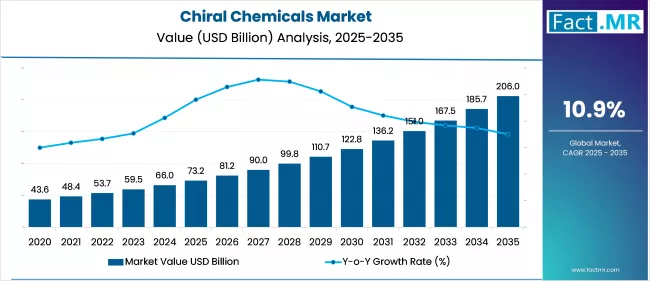
The global chiral chemicals market is entering a transformative era of growth, driven by an escalating demand for high-purity pharmaceutical ingredients and sustainable agrochemical solutions. According to the latest industry data, the market is valued at approximately $82.16 billion in 2026 and is projected to reach $211.75 billion by 2035, maintaining a robust compound annual growth rate (CAGR) of 11.1%.
This expansion reflects a fundamental shift in life sciences and specialty manufacturing. As regulatory bodies like the FDA and EMA tighten standards for molecular purity, the transition from racemic mixtures to single-enantiomer formulations has become a commercial and clinical imperative.
Strategic Market Drivers: Who, What, and Why
The momentum in the chiral sector is propelled by a convergence of technological innovation and clinical necessity:
- Who is leading the demand? The pharmaceutical industry remains the primary consumer, accounting for roughly 72% of total market volume. Major players and CDMOs (Contract Development and Manufacturing Organizations) are increasingly utilizing chiral intermediates to synthesize APIs for oncology, neurology, and antiviral therapies.
- What is driving the technology? Asymmetric synthesis has emerged as the dominant production technique, now representing over 49% of global output. This method is favored for its scalability and its ability to deliver high enantiomeric excess, which is critical for patient safety and drug efficacy.
- Why is the market expanding now? Beyond healthcare, the agrochemical sector (representing 19% of the market) is adopting chiral pesticides to reduce environmental footprints. By utilizing single-isomer formulations, manufacturers can achieve higher bioefficacy with lower chemical loads, aligning with global ESG (Environmental, Social, and Governance) mandates.
Regional Insights: The Shift Toward Asia-Pacific
While North America and Europe historically dominated the landscape due to mature R&D infrastructures, the Asia-Pacific region has emerged as the fastest-growing hub. China and India alone produced more than 25,000 metric tons of chiral chemicals in 2024. This growth is supported by:
- Significant government investment in biotechnology.
- The expansion of regional biopharmaceutical manufacturing capacities.
- Lower production costs coupled with a rising number of specialized chiral synthesis startups in South Korea and India.
Technological Breakthroughs and Sustainability
Modern chiral chemistry is shedding its reputation as a high-cost, waste-heavy discipline. The integration of biocatalysis—using enzymes to catalyze reactions—is reducing waste and energy consumption. Furthermore, the rise of digital flow chemistry allows for real-time monitoring and continuous production, significantly shortening the time-to-market for new drug intermediates.
“”The integration of green chemistry principles is no longer optional,”” says an industry analyst. “”The market is rewarding companies that can deliver 99%+ enantiomeric purity while minimizing environmental impact through biocatalytic and modular manufacturing processes.””
Browse Full Report : https://www.factmr.com/report/5397/chiral-chemicals-market
Future Outlook: Personalized Medicine and Beyond
Looking ahead to 2030 and beyond, the rise of personalized medicine is expected to be a primary catalyst. With over 2,100 personalized therapies currently requiring chiral building blocks, the demand for “”precision molecules”” is set to outpace traditional chemical production.
Investors and stakeholders are closely watching key market leaders, including BASF SE, Johnson Matthey, Codexis, and Daicel Corporation, as they expand facilities and form strategic partnerships to secure the global supply chain of these critical “”left-handed”” and “”right-handed”” molecules.
About the Chiral Chemicals Market Report This press release summarizes current market intelligence regarding the synthesis, application, and regional distribution of chiral compounds. It is intended for industry professionals, investors, and analysts tracking the intersection of specialty chemicals and life sciences.
“