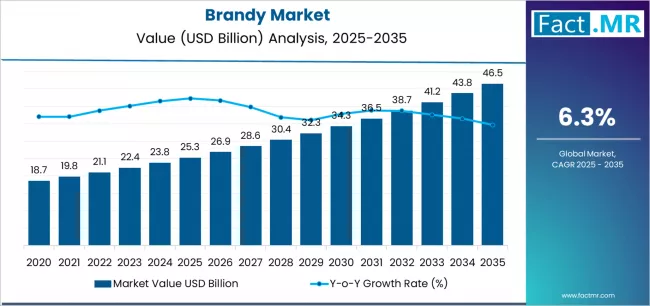
The global brandy market is entering a dynamic growth phase, supported by increasing consumer preference for premium alcoholic beverages and the expanding influence of cocktail culture worldwide. The market is valued at USD 25.3 billion in 2025 and is projected to reach USD 46.5 billion by 2035, registering a CAGR of 6.3% during the forecast period.
This growth trajectory reflects a broader shift in consumer behavior toward high-quality, aged spirits that offer heritage, craftsmanship, and differentiated taste experiences. Brandy, particularly cognac and premium variants, is increasingly positioned as a symbol of sophistication and lifestyle elevation.
Get Access of Report Sample: https://www.factmr.com/connectus/sample?flag=S&rep_id=11928
Premiumization and Lifestyle Shifts Driving Market Growth
The rising global middle class and increasing disposable incomes are key drivers behind the growing demand for brandy. Consumers are moving beyond value-based consumption toward premium and super-premium categories, seeking authenticity and heritage in their beverage choices.
Key growth drivers include:
- Increasing demand for premium and aged spirits
- Expansion of cocktail culture and mixology trends
- Rising urbanization and evolving social drinking habits
- Growing influence of luxury hospitality and fine dining
- Strong gifting culture in emerging markets
The market is expected to grow nearly 1.8X over the next decade, highlighting brandy’s resilience and adaptability in a competitive global spirits landscape.
Emerging Trends: Craft Innovation and Flavor Diversification
The brandy market is undergoing transformation through innovation in product offerings and branding strategies. While traditional grape-based brandies continue to dominate, new formats are attracting younger consumers.
Key trends shaping the market include:
- Rising popularity of flavored and infused brandies
- Growth of craft distilleries and small-batch production
- Increasing focus on terroir-driven storytelling and provenance
- Expansion of premium and ultra-premium categories
- Integration of brandy into modern cocktail menus
Flavored brandy, in particular, is gaining traction as brands experiment with botanicals and fruit infusions to broaden appeal among new consumer segments.
Regional Insights: Asia-Pacific Leads Growth, Europe Anchors Heritage
Asia-Pacific is emerging as the fastest-growing region, driven by rapid premiumization and expanding middle-class populations in countries such as China and India. China alone is projected to grow at a CAGR of 7.3%, while India follows closely at 6.8%.
North America continues to benefit from a strong cocktail culture and growing appreciation for craft spirits, while Europe remains the traditional stronghold of brandy production, particularly in France and Spain, where heritage and quality define consumption patterns.
Segment Insights: Regular Brandy and Economy Pricing Dominate Volume
Regular brandy accounts for approximately 76.6% of total market share, reflecting strong consumer preference for traditional flavors and established brands.
At the same time, the economy price segment leads with around 41.7% share, highlighting the importance of affordability in driving mass-market consumption. However, premium segments are expected to deliver higher value growth due to increasing consumer willingness to pay for quality and brand prestige.
Competitive Landscape: Heritage Brands and Global Expansion Strategies
The brandy market is moderately consolidated, with established global players leveraging heritage, innovation, and distribution strength to maintain competitive advantage.
Key companies include: Jas Hennessy & Co., Rémy Martin, Courvoisier, Martell Cognac, Torres, E&J Gallo, Christian Brothers, St-Rémy, Germain-Robin, Vecchia Romagna
Strategic priorities shaping the competitive landscape include:
- Investment in premium aging and product differentiation
- Expansion into emerging high-growth markets
- Strengthening brand storytelling and heritage positioning
- Collaborations with luxury hospitality and retail channels
Analyst Perspective: Brandy Evolves into a Premium Lifestyle Category
Industry analysts emphasize that brandy is transitioning from a traditional spirit to a premium lifestyle product. The convergence of heritage, craftsmanship, and modern consumption trends is redefining its global positioning.
“Brandy is no longer confined to legacy consumption patterns—it is being rediscovered by a new generation through cocktails and premium experiences,” notes a senior industry analyst.
Challenges: Regulatory Pressures and Market Competition
Despite strong growth prospects, the market faces challenges such as:
- Stringent alcohol regulations and taxation policies
- Intense competition from other premium spirits categories
- Trade uncertainties in key markets
For instance, regulatory scrutiny in major markets like China could impact imports and pricing dynamics for European producers.
Future Outlook: Strong Growth Anchored in Premiumization
Between 2029 and 2035, the market is expected to witness accelerated expansion, driven by ultra-premium product development, sustainable production practices, and deeper penetration into emerging economies.
Key opportunity areas include:
- Ultra-premium and aged brandy segments
- Expansion of cocktail and mixology applications
- Growth in travel retail and duty-free channels
- Sustainable and traceable production practices
As global consumers increasingly seek authenticity, quality, and experiential value, brandy is set to strengthen its position as a key category within the premium spirits market.
Browse Full Report : https://www.factmr.com/report/brandy-market
About Fact.MR
Fact.MR is a global market research and consulting firm, trusted by Fortune 500 companies and emerging businesses for reliable insights and strategic intelligence. With a presence across the U.S., UK, India, and Dubai, we deliver data-driven research and tailored consulting solutions across 30+ industries and 1,000+ markets. Backed by deep expertise and advanced analytics, Fact.MR helps organizations uncover opportunities, reduce risks, and make informed decisions for sustainable growth.