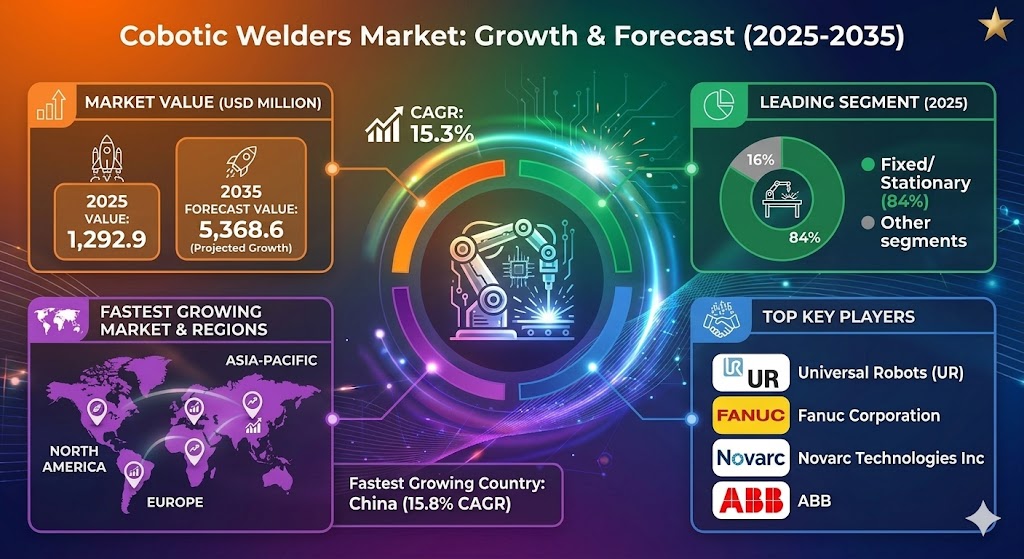
As manufacturing industries embrace automation while maintaining the need for human expertise, the cobotic welders market is gaining significant traction. Collaborative robots, or cobots, are transforming traditional welding processes by working alongside human operators to enhance productivity, safety, and precision. Unlike conventional industrial robots, cobotic welders are designed to be flexible, easy to program, and safe for direct human interaction. This shift toward collaborative automation reflects the growing demand for efficient and adaptable manufacturing solutions in an increasingly competitive landscape.
Market Overview:
Cobotic welders combine robotic automation with human intelligence, enabling manufacturers to streamline welding operations without replacing skilled labor. These systems are equipped with advanced sensors, machine vision, and intuitive programming interfaces, allowing them to perform complex welding tasks with high accuracy and consistency. By reducing manual effort and minimizing errors, cobotic welders help improve overall production efficiency and product quality.
The market is driven by the increasing need for automation in small and medium-sized enterprises (SMEs), which often face challenges such as labor shortages and rising operational costs. Cobots offer a cost-effective solution by requiring less space, lower upfront investment, and minimal programming expertise compared to traditional robotic systems. Additionally, their ability to handle repetitive and hazardous tasks makes them a valuable asset in modern manufacturing environments.
Manufacturers are continuously innovating to enhance the capabilities of cobotic welders, focusing on improved payload capacity, enhanced precision, and seamless integration with existing production systems. The incorporation of advanced software and connectivity features is further enabling real-time monitoring and optimization of welding processes.
Regional Insights:
North America holds a prominent position in the cobotic welders market, driven by early adoption of advanced manufacturing technologies and a strong focus on automation. Industries in this region are leveraging cobots to address labor shortages and improve operational efficiency.
Europe is also witnessing substantial growth, supported by its well-established industrial base and emphasis on innovation. The region’s focus on workplace safety and sustainable manufacturing practices is encouraging the adoption of collaborative welding solutions.
The Asia-Pacific region is emerging as a key growth area, fueled by rapid industrialization and increasing investments in automation technologies. Countries in this region are adopting cobotic welders to enhance production capabilities and remain competitive in the global market. The expanding manufacturing sector and rising demand for high-quality products are further driving market growth.
Key Trends & Forecast:
One of the most significant trends in the cobotic welders market is the growing adoption of Industry 4.0 technologies. Cobots are increasingly being integrated with IoT platforms, enabling real-time data collection, analysis, and process optimization. This connectivity allows manufacturers to monitor performance, identify inefficiencies, and implement predictive maintenance strategies.
Another key trend is the increasing focus on user-friendly interfaces and simplified programming. Modern cobotic welders are designed to be easily programmed using intuitive software, allowing operators with minimal technical expertise to set up and manage welding tasks. This accessibility is expanding the adoption of cobots across a wider range of industries.
The demand for flexible and scalable automation solutions is also shaping the market. Cobotic welders can be quickly reconfigured to perform different tasks, making them ideal for dynamic production environments with varying requirements. This flexibility is particularly beneficial for SMEs that need adaptable solutions to meet changing market demands.
Advancements in artificial intelligence and machine learning are further enhancing the capabilities of cobotic welders. These technologies enable improved precision, adaptive welding techniques, and continuous process optimization, resulting in higher-quality outputs and reduced material waste.
Applications & End-Use Outlook:
Cobotic welders are widely used across various industries, each benefiting from their collaborative capabilities. In the automotive sector, these systems are employed for tasks such as assembly, body welding, and component fabrication. Their ability to deliver consistent and precise welds is critical in maintaining product quality and safety standards.
The metal fabrication industry is another major end-user, utilizing cobotic welders for a wide range of applications, including structural welding and custom manufacturing. The flexibility of cobots allows manufacturers to handle both high-volume production and specialized projects with ease.
In the construction and heavy machinery sectors, cobotic welders are used to improve efficiency and reduce manual labor in welding operations. Their ability to work in challenging environments and perform repetitive tasks enhances productivity and safety.
Additionally, industries such as aerospace, shipbuilding, and electronics are adopting cobotic welding solutions to achieve higher precision and efficiency in their manufacturing processes. The growing demand for lightweight and high-performance materials is further driving the need for advanced welding technologies.
Conclusion:
The cobotic welders market is redefining the future of welding by combining the strengths of human expertise and robotic automation. With increasing adoption across industries, these systems are playing a crucial role in enhancing productivity, ensuring safety, and improving product quality.
As technological advancements continue to drive innovation, cobotic welders are expected to become an integral part of modern manufacturing. Businesses that leverage these advanced solutions can gain a competitive edge by optimizing their operations and adapting to evolving market demands. Access to comprehensive market insights can help stakeholders make informed decisions and capitalize on the opportunities in this rapidly growing market.
Browse Full Report – https://www.factmr.com/report/cobotic-welders-market