The global automatic pet feeder market is undergoing a structural transformation as technology, sustainability, and evolving pet-owner behavior converge to redefine automated pet care. Once primarily viewed as a convenience product, automatic and smart pet feeders are now central to the fast-growing pet tech ecosystem. This shift is driven by pet humanization, digital lifestyles, and data-enabled health management. By 2036, the market is expected to reflect not only growth in size but also a fundamental evolution in product value propositions.
Market Growth Outlook to 2036
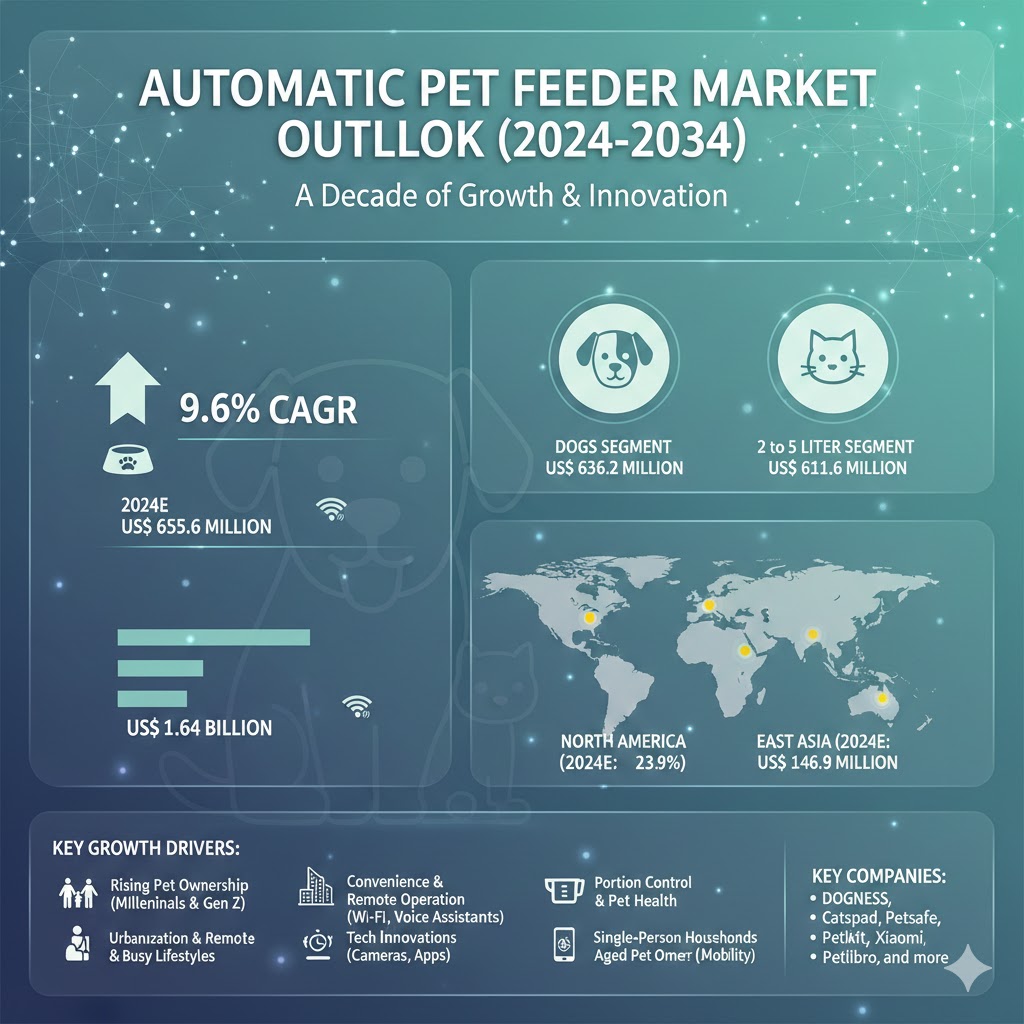
Market projections indicate sustained double-digit growth throughout the next decade. The automatic pet feeder market was valued at approximately USD 7.6 billion in 2024 and is projected to reach nearly USD 17.8 billion by 2035, reflecting a compound annual growth rate (CAGR) of just over 8%. Smart and connected feeders, which integrate mobile apps, sensors, and AI, currently account for USD 2.34 billion of the market and are expected to exceed USD 6.9 billion by 2034. This growth is closely aligned with the broader pet tech sector, which is forecast to expand from USD 19.1 billion in 2026 to nearly USD 53 billion by 2035, positioning automated feeders as foundational within connected pet care solutions.
Innovation Trends Reshaping Product Design
Innovation is shifting the competitive landscape from basic automation toward intelligent, data-driven feeding ecosystems. Smart feeders with mobile connectivity, real-time alerts, and voice assistant integration are increasingly standard in developed markets, especially North America. AI-enabled personalization—such as adaptive portion control based on pet size, activity level, and feeding history—is emerging as a key differentiator. Manufacturers are also integrating cameras, biometric pet recognition, and health-monitoring capabilities, transforming feeders into health management tools rather than standalone devices.
Sustainability as a Core Market Driver
Sustainability is becoming a decisive purchasing factor as consumers increasingly prioritize environmental impact. Manufacturers are responding with recyclable plastics, stainless steel components, and modular designs that extend product lifecycles. Energy-efficient motors, hybrid power systems, and reduced packaging waste are becoming mainstream, particularly in Europe and parts of Asia-Pacific. By 2036, sustainability credentials are expected to move from a secondary consideration to a core requirement, influencing purchasing decisions across both premium and mass-market segments.
Competitive Positioning and Regional Dynamics
Competitive positioning is shifting from price-focused strategies to ecosystem integration. Leading players are emphasizing proprietary apps, subscription-based food delivery services, and partnerships with veterinary and pet nutrition brands to enhance long-term customer engagement. Asia-Pacific currently dominates global production and sales volumes due to manufacturing scale and rising urban pet ownership. North America generates the highest revenue, supported by strong adoption of smart home technologies and premium pet care spending. Europe is emerging as a hub for sustainability-driven innovation, with regulatory standards shaping product development strategies.
Browse Full Report : https://www.factmr.com/report/automatic-pet-feeder-market
Strategic Implications Toward 2036
By 2036, the automatic pet feeder market will be defined by convergence—between hardware and software, feeding and health monitoring, and convenience and sustainability. Companies that successfully integrate innovation with eco-design and data-driven services are expected to outperform traditional hardware-only competitors. With global pet ownership projected to rise and remote care becoming normalized, automatic pet feeders are set to evolve from niche accessories into essential infrastructure for modern pet households. This transformation will redefine competitive advantage across the pet tech value chain, positioning automated feeders as key enablers of pet health, convenience, and sustainability.