The 3D printing in aerospace and defense market is rapidly evolving as additive manufacturing technologies reshape how critical components are designed, produced, and maintained. With increasing demand for lightweight, high-performance parts and faster production cycles, aerospace and defense organizations are turning to 3D printing to enhance operational efficiency and innovation. This technology enables the creation of complex geometries that were previously impossible with traditional manufacturing methods, making it a cornerstone of modern industrial transformation.
Market Overview:
3D printing, also known as additive manufacturing, involves building components layer by layer using digital design data. In aerospace and defense, this technology is used to manufacture aircraft parts, engine components, structural elements, and even tools and prototypes. The market includes a range of materials such as metals, polymers, and composites, each tailored to meet specific performance requirements.
One of the key advantages of 3D printing is its ability to reduce material waste and production time. Traditional subtractive manufacturing methods often result in significant material loss, whereas additive manufacturing uses only the required material. This efficiency is particularly valuable in aerospace and defense applications, where materials are often expensive and highly specialized.
Additionally, 3D printing supports on-demand manufacturing, reducing the need for large inventories and enabling faster response to maintenance and repair requirements. This capability is especially critical in defense operations, where timely availability of components can impact mission readiness.
Regional Insights:
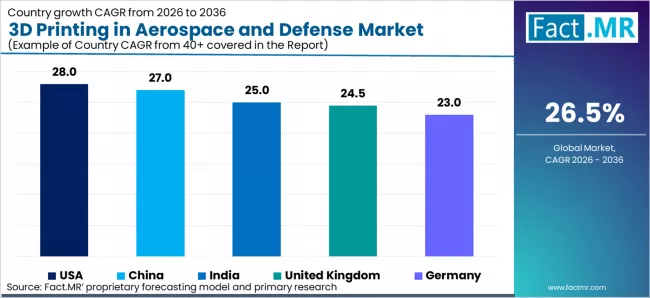
North America holds a leading position in the 3D printing in aerospace and defense market, driven by strong investments in advanced manufacturing technologies and the presence of major aerospace and defense companies. The region benefits from a well-established innovation ecosystem and significant government support for research and development.
Europe is also a key market, with a strong focus on technological advancement and sustainability. The region’s aerospace industry is активно adopting 3D printing to improve fuel efficiency and reduce emissions through lightweight component design. Collaborative efforts between industry players and research institutions further accelerate innovation.
The Asia-Pacific region is emerging as a promising market, fueled by growing defense budgets, expanding aerospace manufacturing capabilities, and increasing adoption of advanced technologies. Countries such as China, India, and Japan are investing in additive manufacturing to strengthen their domestic production capabilities and reduce reliance on imports.
Key Trends & Forecast:
A major trend shaping the market is the increasing use of metal 3D printing technologies. Metal additive manufacturing allows for the production of highly durable and heat-resistant components, making it ideal for critical aerospace applications such as engine parts and structural components.
Another significant trend is the integration of 3D printing with digital design and simulation tools. Advanced software enables engineers to optimize designs for performance and manufacturability, resulting in more efficient and reliable components. This digital integration enhances the overall production process and supports innovation.
The adoption of lightweight materials is also driving market growth. By using 3D printing to create lightweight yet मजबूत structures, aerospace manufacturers can improve fuel efficiency and reduce operational costs. This is particularly important in an industry where weight reduction directly impacts performance and sustainability.
Furthermore, the concept of decentralized manufacturing is gaining traction. 3D printing enables production to be carried out closer to the point of use, reducing transportation costs and lead times. This approach is especially beneficial for defense applications, where rapid deployment and flexibility are critical.
Sustainability is another key focus area, with 3D printing contributing to reduced waste and energy consumption. As environmental concerns continue to grow, the adoption of eco-friendly manufacturing practices is expected to increase.
Applications & End-Use Outlook:
The applications of 3D printing in aerospace and defense are diverse and expanding. In aerospace, the technology is widely used for producing aircraft components such as brackets, housings, and interior parts. Engine manufacturers are also leveraging 3D printing to create complex أجزاء with improved performance characteristics.
In the defense sector, 3D printing is used for manufacturing equipment, spare parts, and custom tools. The ability to produce components on demand is particularly valuable in remote or challenging environments, where traditional supply chains may be محدود.
Maintenance, repair, and overhaul (MRO) operations represent another important application area. 3D printing enables quick production of replacement parts, reducing downtime and improving operational efficiency. This capability is critical for both commercial and military aircraft.
Space exploration is also benefiting from 3D printing technologies. The ability to manufacture components in space or in remote locations opens up new possibilities for long-duration missions and reduces the need for extensive запас supply chains.
End-users in this market include aerospace manufacturers, defense organizations, and maintenance service providers. These stakeholders are increasingly investing in additive manufacturing to enhance their capabilities and remain competitive in a rapidly evolving industry.
Conclusion:
The 3D printing in aerospace and defense market is poised for substantial growth as technological advancements continue to unlock new possibilities in manufacturing. The ability to produce complex, lightweight, and high-performance components with greater efficiency is driving widespread adoption across the industry.
As organizations seek to improve operational efficiency, reduce costs, and enhance sustainability, 3D printing is becoming an essential tool in their manufacturing strategies. Companies that embrace innovation and invest in advanced additive manufacturing technologies will be well-positioned to capitalize on the opportunities in this dynamic and transformative market.
Browse Full Report – https://www.factmr.com/report/3d-printing-in-aerospace-and-defense-market