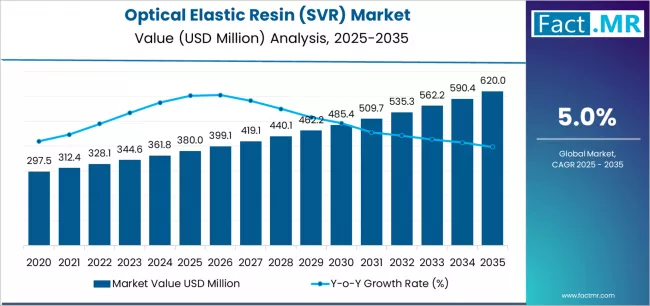
The global optical elastic resin (SVR) market is expected to witness robust growth over the next decade as demand rises for advanced optical components, flexible displays, and precision imaging products. In 2025, the optical elastic resin (SVR) market is valued at USD 895.0 million, and it is projected to reach USD 1,720.0 million by 2035, reflecting an absolute increase of USD 825.0 million during the forecast period. This growth corresponds to a compound annual growth rate (CAGR) of approximately 7.1% between 2025 and 2035, driven by technological advancements in consumer electronics, automotive optics, and smart device displays.
Optical elastic resins, also known as SVR (silicon-based viscoelastic resins), are specialized polymer materials used to enhance optical clarity, flexibility, and durability in a range of applications. These include precision lenses, light guides, flexible displays, touch panels, and optical bonding layers where high transparency and mechanical resilience are critical.
Quick Market Snapshot (2025–2035)
-
Market Value (2025): USD 895.0 million
-
Market Forecast Value (2035): USD 1,720.0 million
-
Market Forecast CAGR: 7.1%
-
Leading Application: Flexible Displays and Precision Optics
-
Key End Users: Consumer Electronics, Automotive, Healthcare Devices
-
Primary Growth Regions: Asia Pacific, North America, Europe
-
Key Drivers: Expansion of advanced display technologies, increasing use in optical bonding, rising automotive sensor and camera adoption
To access the complete data tables and in-depth insights, request a Discount On The Report here: https://www.factmr.com/connectus/sample?flag=S&rep_id=8560
Market Overview
Optical elastic resins are increasingly integrated into modern electronic and optical systems due to their superior optical properties, including high light transmittance, low haze, and excellent adhesion to diverse substrates. Their ability to maintain performance under mechanical stress makes them ideal for flexible and foldable display applications that are gaining popularity in consumer electronics. In addition, these resins are used in optical bonding applications to improve display contrast, touch sensitivity, and overall durability.
In automotive sectors, optical elastic resins support advanced driver assistance systems (ADAS), camera lenses, and head-up displays (HUDs), where clarity and environmental robustness are essential. In healthcare and imaging devices, these materials contribute to precise optical performance in diagnostic systems and medical displays.
Key Demand Drivers
Growth in Consumer Electronics
The rapid evolution of consumer electronics, particularly smartphones, tablets, and wearable devices, is a major driver of demand for optical elastic resins. As manufacturers push the boundaries of flexible and high-resolution displays, SVR materials play a key role in ensuring optical performance and durability.
Advancement of Automotive Optics
Automotive applications, including ADAS, cameras, and HUDs, require high-precision optical components. Optical elastic resins enhance lens performance, environmental resistance, and assembly robustness, supporting the growth of advanced vehicular optical systems.
Demand for Flexible and Foldable Displays
Flexible display technologies, including OLED and micro-LED panels, rely on materials that maintain clarity and mechanical flexibility. Optical elastic resins enable flexible bonding and encapsulation, contributing to the broader adoption of foldable and curved screens.
Expansion in Healthcare and Imaging Devices
Medical imaging and diagnostic systems benefit from optical materials that offer high transparency, stability, and compatibility with various substrates. Optical elastic resins help improve image quality and device reliability in critical healthcare applications.
Market Segmentation Insights
By Product Form
-
Liquid Optical Elastic Resins: Widely used in optical bonding and display assembly due to high processability.
-
Pre-Formed Optical Elastomers: Used in specific molding and precision optical applications.
-
Customized Formulations: Tailored solutions for specialized optical and flexible display needs.
By Application
-
Flexible Displays: Strong growth driven by consumer electronics trends.
-
Precision Optics: Includes lenses, light guides, and optical bonding.
-
Automotive Optical Components: ADAS, cameras, head-up displays, and sensors.
-
Healthcare Devices: Imaging systems, diagnostic displays, and optical modules.
By End User
-
Consumer Electronics Manufacturers: Leading segment due to high adoption in displays.
-
Automotive OEMs and Tier 1 Suppliers: Growing use in advanced optics for safety and infotainment systems.
-
Healthcare and Medical Device Companies: Application in high-clarity imaging systems.
-
Industrial and Specialty Markets: Includes robotics and machine vision components.
Regional Demand Dynamics
Asia Pacific
Asia Pacific is expected to lead the optical elastic resin market due to strong electronics manufacturing hubs, rapid adoption of advanced display technologies, and growing automotive production. Countries like China, Japan, South Korea, and India are driving demand through investments in high-tech consumer electronics and automotive sectors.
North America
North America holds a significant share of the market, supported by innovation in display technologies, strong automotive optics demand, and established healthcare systems that integrate advanced imaging solutions.
Europe
Europe exhibits steady growth driven by automotive innovation, industrial automation, and consumer preference for high-performance electronic devices. The region’s focus on quality, safety, and regulatory compliance contributes to sustained demand for optical materials.
Competitive Landscape
The optical elastic resin market is competitive, featuring a mix of global specialty chemical manufacturers and advanced materials companies. Key market players focus on product innovation, customization, quality assurance, and collaborative partnerships with electronics, automotive, and healthcare device manufacturers.
Innovation areas include enhancing optical clarity, improving mechanical flexibility for foldable applications, and developing formulations optimized for specific end-use requirements. Companies are also emphasizing supply chain resilience and sustainability in materials selection and production processes.
Future Outlook
The optical elastic resin (SVR) market is anticipated to maintain substantial growth through 2035 as demand for high-performance optical materials rises across diverse sectors. Continued advancements in flexible display technology, increased integration of optical components in automotive and medical devices, and the focus on lightweight, durable materials will sustain long-term market momentum.
As manufacturers seek materials that combine optical excellence with mechanical reliability, optical elastic resins will play a pivotal role in enabling next-generation electronic, automotive, and healthcare applications worldwide.
Browse Full Report: https://www.factmr.com/report/optical-elastic-resin-market