The global neutral floor cleaners market is emerging as a resilient and steadily expanding segment within the broader cleaning chemicals industry. Driven by rising hygiene standards, surface protection requirements, and sustainability-oriented procurement, neutral pH floor cleaners are increasingly preferred across commercial, institutional, and residential applications. Between 2026 and 2036, the market is projected to demonstrate consistent growth, supported by regulatory pressure on harsh chemicals and evolving end-user expectations for safer, multi-surface solutions.
Market Size and Growth Outlook (2026–2036)
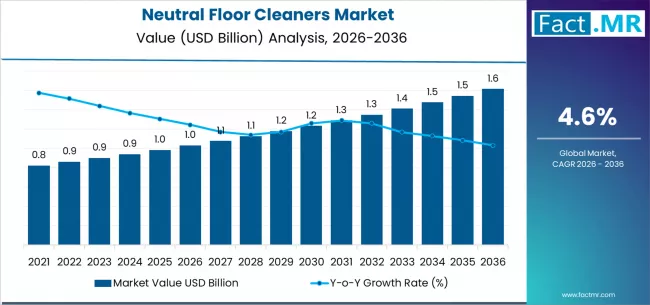
The global neutral floor cleaners market is estimated to be valued at approximately USD 1.0 billion in 2026 and is forecast to reach USD 1.6 billion by 2036, expanding at a compound annual growth rate (CAGR) of 4.6% over the forecast period. This positions neutral floor cleaners as a stable, medium-growth niche within the global floor cleaning chemicals ecosystem.
While overall floor cleaning products represent a much larger market—estimated at over USD 5 billion globally—neutral pH formulations account for a significant share due to their compatibility with sensitive surfaces such as marble, vinyl, hardwood, and coated industrial flooring. It is projected that nearly 60% of modern floor cleaners will be pH-neutral by 2030, highlighting the structural shift away from acidic or alkaline formulations.
Growth during 2026–2030 is expected to be strongest in commercial and institutional settings, including offices, healthcare facilities, retail spaces, and hospitality properties. From 2031 onward, market expansion is likely to moderate slightly as penetration in mature economies stabilizes, while emerging markets continue to contribute incremental volume.
Key Demand Drivers
Several structural drivers underpin the long-term growth outlook for neutral floor cleaners:
-
Surface Preservation and Lifecycle Cost Reduction
Neutral pH cleaners reduce surface corrosion and finish degradation, lowering long-term maintenance and replacement costs. This is particularly relevant in commercial buildings with high-value flooring assets. -
Regulatory and Environmental Compliance
Stricter chemical safety regulations and green procurement policies, especially in developed markets, are accelerating adoption of low-toxicity, low-VOC neutral cleaners. -
Post-Pandemic Hygiene Awareness
Although disinfectant demand surged during the pandemic, facility managers are now balancing hygiene with occupational safety, favoring neutral cleaners for routine maintenance while reserving aggressive chemicals for targeted disinfection. -
Growth of Commercial Real Estate and Public Infrastructure
The expansion of office spaces, retail outlets, healthcare facilities, and public buildings has created a broad demand base for floor care solutions, including neutral cleaners.
Market Segmentation and Share Analysis
By formulation type, surfactant-based neutral cleaners dominate the market with approximately 42% share, owing to their effective soil removal, low residue, and compatibility with automated cleaning equipment. Enzyme-based and bio-based neutral formulations are gaining traction, particularly in healthcare and education sectors, but remain a smaller portion of total volume.
In terms of format, concentrated and bulk solutions account for around 28–30% of market share, driven by cost efficiency and reduced packaging waste in professional cleaning operations. Ready-to-use formats remain popular in residential and small commercial settings but face margin pressure.
Regionally, North America and Europe collectively represent over 50% of global demand, supported by stringent safety standards and high cleaning frequency. However, Asia-Pacific and Latin America, notably China and Brazil, are expected to deliver above-average growth rates through 2036 due to expanding commercial infrastructure and rising hygiene awareness.
Competitive Landscape
The neutral floor cleaners market is moderately consolidated, with global chemical and professional hygiene companies holding strong positions. Key players operate within the broader cleaning chemicals space, focusing on:
-
Product differentiation through sustainability claims, such as biodegradable surfactants and reduced water toxicity.
-
Concentrate and dosing system integration, targeting large facilities and contract cleaning providers.
-
Regional customization, adapting formulations to local water hardness, regulations, and flooring types.
Innovation is also evident in adjacent segments, such as probiotic and bioenzyme-based cleaners, which—while still niche—signal future pathways for neutral floor care products aligned with green chemistry trends.
Future Growth Outlook (2031–2036)
Looking ahead, the neutral floor cleaners market is expected to maintain steady, non-cyclical growth rather than rapid expansion. Demand will increasingly be driven by replacement cycles, sustainability mandates, and the professionalization of cleaning services rather than volume spikes.
Key opportunities include:
-
Healthcare and eldercare facilities, where surface safety and chemical exposure are critical.
-
Green building certifications, which favor neutral and low-impact cleaning agents.
-
Emerging markets, where commercial cleaning standards are converging with global best practices.
By 2036, neutral floor cleaners are likely to be positioned less as a specialty product and more as the default solution for routine floor maintenance, embedded within standardized cleaning protocols worldwide.
Browse Full Report : https://www.factmr.com/report/neutral-floor-cleaners-market
Conclusion
Between 2026 and 2036, the neutral floor cleaners market is set to grow from USD 1.0 billion to USD 1.6 billion, reflecting its role as a stable, essential segment of the global cleaning chemicals industry. While not characterized by explosive growth, its long-term outlook is underpinned by regulatory alignment, surface protection benefits, and the global shift toward safer and more sustainable cleaning solutions. For manufacturers and investors alike, the market offers predictable demand, innovation potential, and strong alignment with future cleaning industry standards.