The neural actuators market is advancing rapidly as medical technology, robotics, and neuroscience converge to create solutions that restore and enhance human capabilities. Neural actuators are devices designed to interface with the nervous system, enabling precise control of prosthetics, rehabilitation robotics, and brain-computer interface (BCI) applications. These technologies are transforming healthcare by offering advanced assistive solutions for neurological disorders, physical disabilities, and cognitive impairments.
Market Overview
Neural actuators include electromechanical, electrochemical, optogenetic, and soft robotic systems that respond to neural signals or external stimuli. Integrated with AI and brain-computer interface platforms, these devices facilitate real-time interpretation of neural activity to control prosthetic limbs, robotic exoskeletons, or therapeutic devices. They are widely applied in hospitals, rehabilitation centers, research institutions, and emerging home-care settings.
The market is fueled by increasing prevalence of neurological disorders, rising demand for assistive and restorative technologies, and advancements in robotics and materials science. Soft robotics, bio-hybrid materials, and precise electromechanical systems are enhancing safety, comfort, and functionality, making neural actuators more accessible and effective for patient care.
Regional Insights
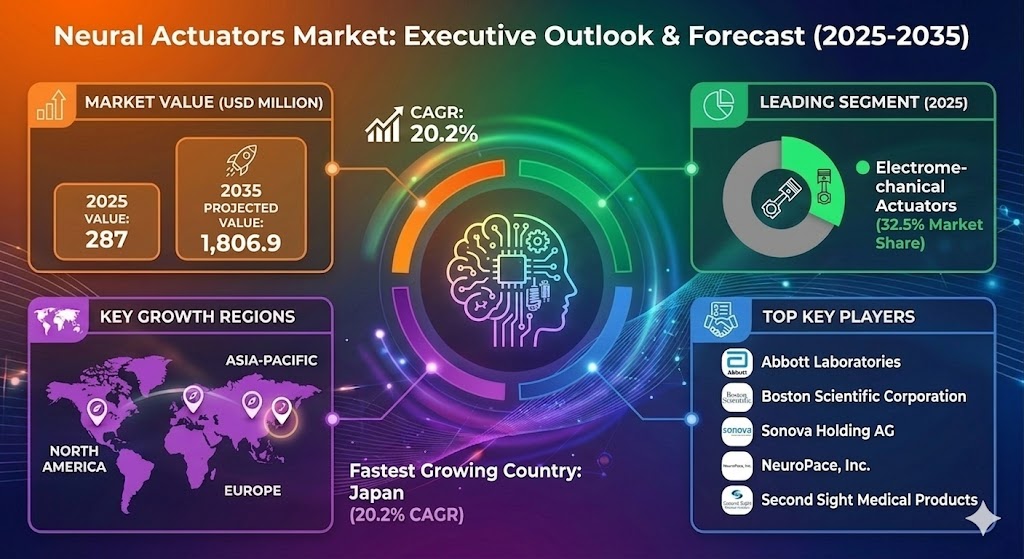
North America leads the neural actuators market, driven by strong healthcare infrastructure, extensive R&D investment, and presence of leading neurotechnology firms. Europe follows, benefiting from an aging population, established medical research facilities, and growing demand for neurorehabilitation solutions. Asia-Pacific is experiencing significant growth, supported by government healthcare initiatives, robotics expertise, and increasing awareness of assistive technologies in countries like Japan, China, and South Korea. Other regions are gradually adopting neural actuators as awareness and infrastructure for neurotechnology expand.
Key Trends & Forecast
- Integration with Brain-Computer Interfaces – Neural actuators combined with BCIs enable real-time control of prosthetics and exoskeletons, improving mobility and independence.
- Soft Robotics & Bio-Hybrid Materials – These innovations enhance patient safety, comfort, and device adaptability, particularly for long-term use.
- AI-Enabled Signal Processing – Artificial intelligence improves actuator responsiveness and personalization, decoding neural signals more accurately.
- Expansion into Home-Care & Rehabilitation – Devices are increasingly designed for outpatient and home-based neurorehabilitation, extending patient care beyond clinics.
- Commercialization & Funding Support – Venture capital, government grants, and private investments accelerate development, clinical testing, and market introduction of new devices.
These trends highlight the market’s focus on precision, personalization, and accessibility, driving adoption across clinical and research applications.
Applications & End-Use Outlook
Healthcare & Rehabilitation
Neural actuators are critical in treating patients with neurological disorders such as Parkinson’s disease, spinal cord injuries, and stroke-related impairments. They enable precise movement restoration, neural modulation, and assistive care through devices like robotic exoskeletons, neuroprosthetics, and targeted therapeutic systems. Rehabilitation centers use these technologies to accelerate patient recovery and enhance functional independence.
Prosthetics & Assistive Devices
Modern prosthetic systems leverage neural actuators to provide intuitive control, responding to electrical or neural signals. Soft robotic actuators and modular designs enhance adaptability for diverse users, while AI integration allows personalized responses and improved user experience. These systems support daily activities and restore mobility to individuals with limb loss or impaired motor function.
Research & Clinical Applications
Neural actuators facilitate neuroscience research, enabling real-time experimentation with neural networks and motor control. Hospitals and research institutions use these devices to study brain-computer interfaces, motor rehabilitation, and neural modulation therapies, expanding scientific understanding and therapeutic options.
Robotics & Advanced Technology
Industrial and medical robotics are increasingly integrated with neural actuators to provide precise, human-like motion and responsiveness. Applications include surgical robotics, robotic exoskeletons for mobility assistance, and advanced rehabilitation devices that react dynamically to neural commands.
Challenges
The neural actuators market faces challenges including high development and manufacturing costs, technical complexity of integrating devices with the human nervous system, and long clinical testing periods. Safety, biocompatibility, and immune response concerns must be carefully addressed. Additionally, low awareness and limited access to these advanced technologies in developing regions restrict adoption, while regulatory hurdles can delay market entry for new devices.
Competitive Landscape
Key players in the neural actuators market include Abbott Laboratories, Boston Scientific Corporation, Sonova Holding AG, NeuroPace, Inc., and Second Sight Medical Products. These companies focus on innovation, clinical integration, and strategic partnerships to expand market reach. Developments in AI-enabled neural decoding, modular prosthetic systems, and soft robotic actuators are driving competitive differentiation and creating opportunities for new entrants.
Conclusion
The neural actuators market is transforming healthcare, rehabilitation, and assistive technology by providing precise, responsive, and intelligent devices that restore and enhance human capabilities. Integration with AI, soft robotics, and brain-computer interfaces enables personalized, effective, and safe solutions for patients with neurological disorders and physical impairments. As technological advancements and global adoption continue, neural actuators will play a crucial role in shaping the future of neurotechnology, rehabilitation, and assistive care.
Browse Full Report – https://www.factmr.com/report/neural-actuators-market