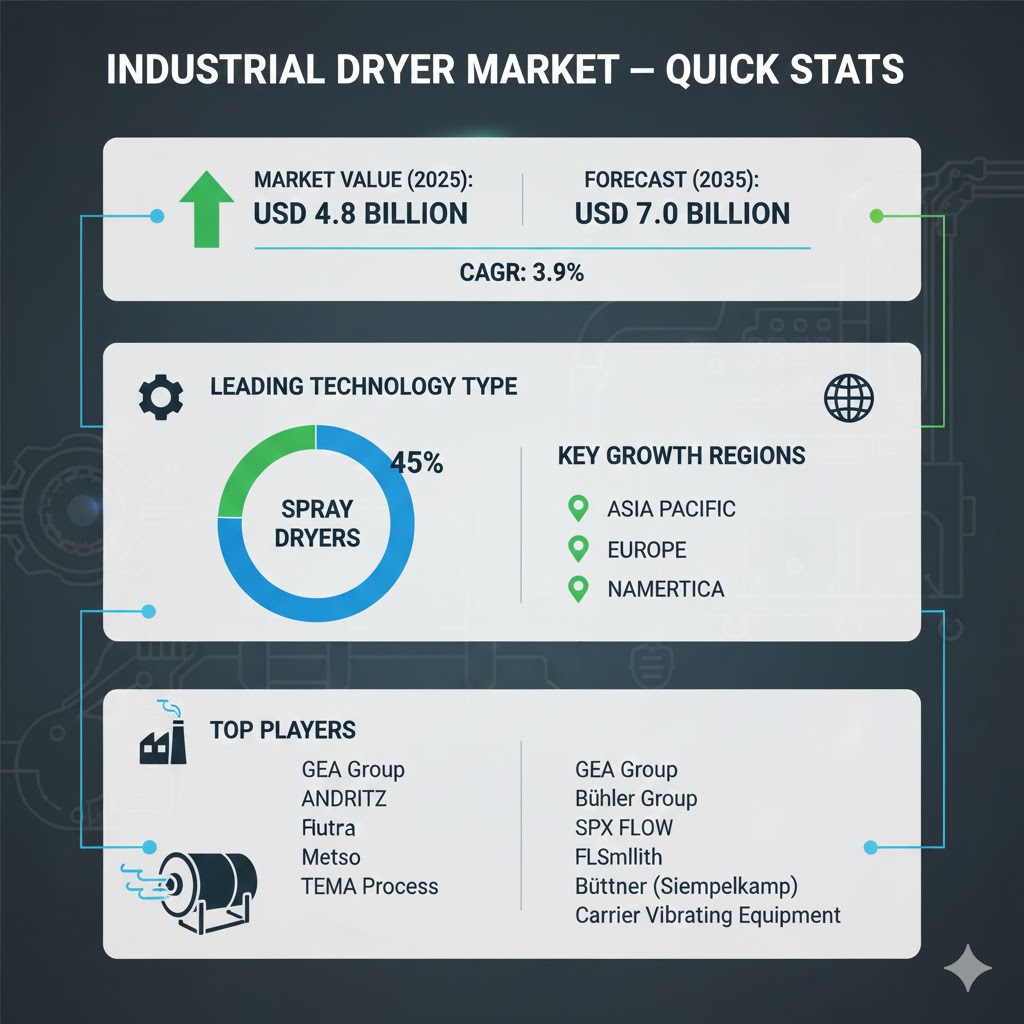
The global industrial dryer market is demonstrating consistent and resilient growth, driven by rising industrialization, increased focus on energy efficiency, and expanding demand from food processing, pharmaceutical, and chemical manufacturing sectors. Market projections indicate that the industry is expected to grow from approximately USD 4.8 billion in 2025 to over USD 7.0 billion by 2035, reflecting a compound annual growth rate (CAGR) of 3.9% over the forecast period.
Industrial dryers play a critical role in modern manufacturing by enabling precise moisture removal, improving product quality, extending shelf life, and ensuring compliance with increasingly stringent regulatory standards. As manufacturers seek greater operational efficiency and sustainability, industrial drying technologies are becoming indispensable across both developed and emerging markets.
Food and Beverage Industry Anchors Market Demand
The food and beverage sector remains the largest contributor to industrial dryer demand, accounting for nearly one-third of total market value. Rapid growth in processed and packaged foods, dairy products, and functional ingredients has significantly increased the need for reliable drying solutions. Industrial dryers help food producers maintain consistency, enhance product safety, and meet global export standards while minimizing waste and energy consumption.
Advanced drying techniques such as spray drying and fluidized bed drying are widely adopted in food applications due to their ability to handle large volumes while preserving nutritional and sensory properties.
Pharmaceutical and Biotech Applications Drive High-Value Growth
Pharmaceutical and biotechnology industries represent another major growth driver, contributing more than 20% of total market demand. These sectors require highly controlled drying environments to maintain product stability, potency, and purity.
Freeze drying, in particular, has gained strong traction due to its essential role in the production of vaccines, injectable drugs, biologics, and specialty therapeutics. As global healthcare investment increases and pharmaceutical pipelines expand, demand for precision drying equipment continues to rise.
Energy Efficiency and Sustainability Shape Buying Decisions
Energy efficiency has become a defining factor in industrial dryer adoption. Modern systems now achieve efficiency rates between 85% and 95%, significantly reducing operating costs compared to older technologies. Manufacturers are increasingly investing in dryers that support lower emissions, heat recovery, and reduced environmental impact.
Sustainability initiatives and regulatory pressures across regions are accelerating the replacement of legacy systems with next-generation dryers that align with corporate environmental, social, and governance (ESG) goals.
Spray Dryers Lead Technology Adoption
Among available technologies, spray dryers dominate the market, representing approximately 31% of total installations. Their versatility, scalability, and ability to produce uniform, high-quality powders make them the preferred choice across food, chemical, and pharmaceutical industries.
Other technologies, including rotary dryers, freeze dryers, and fluidized bed dryers, continue to gain adoption in specialized applications, offering manufacturers tailored solutions based on material characteristics and production requirements.
Asia-Pacific Emerges as the Fastest-Growing Region
Regional analysis highlights Asia-Pacific as the fastest-growing market for industrial dryers. Countries such as India and China are witnessing accelerated adoption due to expanding food processing industries, increased pharmaceutical manufacturing, and ongoing industrial modernization.
India is projected to record growth exceeding 5% annually, supported by government initiatives in food infrastructure and rising export demand. China follows closely, driven by large-scale industrial upgrades and efficiency mandates. Southeast Asia and Latin America are also showing strong momentum as manufacturing capacity expands across multiple sectors.
Meanwhile, North America and Europe continue to see stable demand through equipment upgrades, automation integration, and strict regulatory compliance in food and pharmaceutical manufacturing.
Competitive Landscape Focused on Innovation and Service
The industrial dryer market is moderately consolidated, with leading manufacturers competing on technological innovation, customization capabilities, and global service networks. Key players are investing in smart monitoring systems, automation, and predictive maintenance technologies to enhance operational reliability and customer value.
Strategic partnerships, regional expansion, and application-specific product development are central to maintaining competitive advantage in this evolving market.
Challenges and Strategic Opportunities
Despite strong growth prospects, the market faces challenges including high upfront capital costs, technical complexity, and the need for skilled operation and maintenance. Smaller manufacturers may face adoption barriers, highlighting opportunities for modular systems, financing solutions, and service-based business models.
Companies that address these challenges through innovation, training support, and scalable designs are well positioned to capture long-term market share.
Browse Full Report : https://www.factmr.com/report/industrial-dryer-market
Outlook: A Market Defined by Efficiency and Innovation
Looking ahead, the industrial dryer market is expected to benefit from continued advances in automation, digital controls, and sustainable design. Integration with Industry 4.0 systems will enable real-time monitoring, improved process control, and reduced downtime.
As global industries focus on productivity, quality assurance, and environmental responsibility, industrial dryers will remain a cornerstone technology supporting modern manufacturing ecosystems through 2035 and beyond.