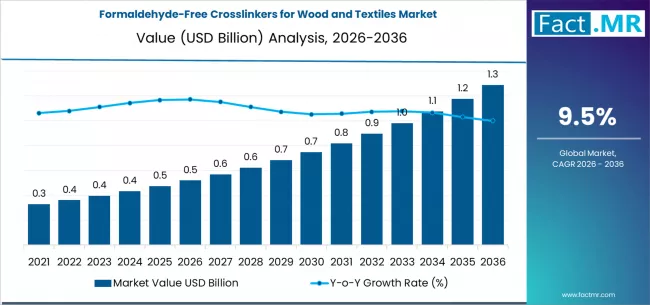
The global formaldehyde-free crosslinkers for wood and textiles market is witnessing strong and sustained growth as industries accelerate the transition toward safer, eco-friendly, and regulatory-compliant materials. According to a recent analysis by Fact.MR, the market is projected to expand from USD 0.52 billion in 2026 to USD 1.29 billion by 2036, registering a robust CAGR of 9.5% over the forecast period.
This expansion is primarily driven by stringent environmental regulations, growing awareness of health hazards associated with formaldehyde emissions, and rising adoption of sustainable chemical solutions across wood processing and textile manufacturing industries.
Browse Full Report: https://www.factmr.com/report/formaldehyde-free-crosslinkers-for-wood-and-textiles-market
Strategic Market Drivers
Stringent Regulations Accelerate Market Adoption
Global regulatory bodies are enforcing strict limits on formaldehyde emissions due to their carcinogenic nature and adverse health effects. Policies such as EPA TSCA Title VI, EU REACH regulations, and OEKO-TEX® standards are compelling manufacturers to replace conventional formaldehyde-based resins with non-toxic crosslinking solutions.
This regulatory shift is significantly boosting demand for formaldehyde-free crosslinkers in both wood panels and textile finishing applications.
Rising Demand for Sustainable Wood-Based Products
The construction and furniture industries are increasingly adopting low-emission and green building materials. Formaldehyde-free crosslinkers are gaining traction in the production of:
- Plywood
• Particleboard
• Medium-density fiberboard (MDF)
• Decorative laminates
These solutions improve bonding strength, durability, and moisture resistance while ensuring compliance with indoor air quality standards.
Expansion of Eco-Friendly Textile Processing
In the textile sector, formaldehyde-free crosslinkers are widely used to enhance wrinkle resistance, dimensional stability, and fabric durability without compromising consumer safety.
Growing demand for organic, skin-safe, and sustainable apparel, along with rising exports of certified textiles, is accelerating adoption across home textiles, apparel, and technical fabrics.
Advancements in Green Chemistry
Innovations in bio-based polymers, polycarboxylic acids, and non-toxic resin systems are improving the performance efficiency of formaldehyde-free crosslinkers. Enhanced compatibility with natural and synthetic fibers is expanding their application scope while maintaining environmental compliance.
Regional Growth Highlights
North America: Regulatory Compliance and Green Construction
North America remains a prominent market due to strict indoor air quality standards and rising investments in sustainable housing and furniture manufacturing. The U.S. leads adoption across engineered wood products and eco-certified textiles.
Europe: Sustainability Mandates Drive Innovation
Europe’s leadership in environmental stewardship is accelerating demand for formaldehyde-free solutions. Countries such as Germany, Italy, France, and the Nordics are witnessing strong growth due to eco-labeling requirements and circular economy initiatives.
East Asia: Manufacturing Scale Meets Regulatory Pressure
China, Japan, and South Korea dominate production and consumption owing to their large-scale wood panel, furniture, and textile manufacturing bases. Increasing regulatory enforcement on emissions is driving rapid market conversion.
Emerging Markets: Industrialization and Export Compliance
India, Southeast Asia, and Latin America are experiencing rising demand due to:
- Expansion of furniture and textile exports
• Compliance with international safety standards
• Growing green manufacturing investments
Market Segmentation Insights
By Product Type
- Polycarboxylic Acid-Based Crosslinkers – Widely used due to low toxicity and high efficiency
• Isocyanate-Based Crosslinkers – Strong bonding performance in wood applications
• Other Bio-Based Crosslinkers – Gaining momentum due to sustainability advantages
By Application
- Wood & Wood Panels – Largest segment driven by green construction demand
• Textiles & Fabrics – Fastest-growing due to apparel safety standards
• Technical Textiles – Rising adoption in medical and industrial fabrics
By End Use Industry
- Furniture & Interior Products
• Apparel & Home Textiles
• Construction Materials
• Automotive Interiors
Challenges Impacting Market Growth
Higher Production Costs
Formaldehyde-free crosslinkers are typically more expensive than traditional alternatives, impacting adoption in cost-sensitive regions.
Performance Optimization Requirements
Achieving equivalent durability and bonding strength without formaldehyde requires advanced formulation technologies, increasing R&D costs.
Competitive Landscape
The market is moderately fragmented, with key players focusing on green chemistry innovation, regulatory compliance, and strategic partnerships with textile and wood manufacturers.
Key Companies Profiled
- Archroma
• BASF SE
• Huntsman Corporation
• Henkel AG & Co. KGaA
• DyStar Group
• Solvay S.A.
• Covestro AG
• Lanxess AG
Companies are investing in bio-based formulations, low-temperature curing technologies, and water-based systems to enhance sustainability and performance.
Recent Developments
- 2024: Launch of bio-based crosslinkers for zero-emission wood panels
• 2023: Increased adoption of formaldehyde-free textile finishes to meet global apparel certifications
• 2022: Strategic collaborations between chemical manufacturers and green furniture brands
Future Outlook: Sustainable Chemistry at the Core of Growth
The next decade will witness accelerated growth driven by:
- Stricter global emission regulations
• Rising consumer awareness of indoor air quality
• Expansion of green building and sustainable textiles
• Advances in bio-based chemical technologies
• Global push toward non-toxic manufacturing ecosystems
As industries increasingly prioritize health, sustainability, and regulatory compliance, the formaldehyde-free crosslinkers for wood and textiles market is poised for strong and sustained growth through 2036.