The Drop Shape Analyzer (DSA) market is emerging as a high-value segment within the broader surface and interfacial science instrumentation industry, driven by rising demand for precision wettability, surface energy, and interfacial tension analysis across pharmaceuticals, advanced materials, semiconductors, batteries, and specialty chemicals.
Between 2026 and 2036, the market is expected to benefit from sustained R&D investment, stricter quality control standards, and the expansion of high-performance materials, positioning Drop Shape Analyzers as a critical analytical tool with strong long-term ROI potential.
Market Valuation and Size Outlook
While Drop Shape Analyzers are not always reported as a standalone category, they fall primarily within the optical tensiometer and shape-measuring device markets.
The global tensiometer market, which includes drop shape analyzers as a core product type, was valued at approximately USD 158 million in 2024 and is projected to reach USD 245 million by 2030, expanding at a CAGR of 7–8%. Optical tensiometers—the category where drop shape analyzers dominate—account for roughly 37% of total revenue, highlighting the commercial relevance of DSA-based measurement techniques.
In parallel, the shape-measuring devices market is forecast to grow from USD 1.3 billion in 2022 to USD 1.9 billion by 2029, at a CAGR of 4–5%, supported by increased adoption of precision imaging and analytical measurement systems in industrial and research environments.
Based on proportional revenue contribution and pricing benchmarks, industry analysts estimate that Drop Shape Analyzers will represent a high-single-digit percentage of the optical tensiometer market by 2030, translating into a USD 40–55 million addressable market, with strong upside through 2036.
Growth Drivers Shaping the Market (2026–2036)
1. Expansion of Advanced Materials and Surface Engineering
Drop Shape Analyzers play a critical role in evaluating surface wettability, adhesion, and coating performance, all of which are central to advanced manufacturing. Rapid innovation in battery electrodes, thin-film coatings, biomedical implants, and nanomaterials is increasing demand for precise surface characterization tools.
The broader particle and surface analysis instrumentation market is growing steadily at 5–6% CAGR, reflecting rising R&D complexity and the need for high-accuracy analytical data.
2. Pharmaceutical and Biotech Quality Control
Pharmaceutical formulation, especially in injectables, biologics, and drug-delivery systems, requires tight control of surface and interfacial properties. Drop Shape Analyzers are increasingly used to study drug–excipient interactions, packaging compatibility, and coating uniformity, supporting regulatory compliance and batch consistency.
This trend aligns with the strong growth of analytical instrumentation spending across pharma R&D, which remains one of the highest-ROI end-user segments globally.
3. Shift Toward Automated and AI-Enabled Measurement
From 2026 onward, the market will increasingly favor automated Drop Shape Analyzers with AI-driven image analysis, reducing operator bias and improving reproducibility. Vendors integrating real-time data analytics, machine learning-based droplet recognition, and cloud connectivity are expected to capture premium pricing and higher margins.
ROI Potential and Investment Attractiveness
High Instrument Value and Recurring Revenue
Drop Shape Analyzers typically command USD 25,000–80,000 per unit, depending on configuration. Beyond initial hardware sales, manufacturers benefit from software upgrades, calibration services, consumables, and maintenance contracts, generating recurring revenue streams.
Compared with general lab equipment, DSAs offer above-average gross margins, particularly for vendors with proprietary software and application-specific modules.
Strong Utilization Rates
Unlike low-usage capital equipment, Drop Shape Analyzers are frequently deployed in routine QC and iterative R&D workflows, resulting in high utilization rates and faster payback periods for end users—often 12–24 months in industrial settings.
Favorable Replacement Cycle
As digital imaging and automation standards evolve, laboratories upgrade instruments every 6–8 years, supporting a stable replacement market through 2036.
Regional Growth Outlook
Asia-Pacific: Fastest-Growing Market
Asia-Pacific dominates the tensiometer market with over 45% revenue share, driven by expanding manufacturing capacity, government-backed R&D investment, and rapid growth in electronics and materials science industries. China, Japan, South Korea, and India are expected to be the fastest-growing DSA markets through 2036.
North America and Europe: Technology and Innovation Hubs
North America and Europe remain critical for high-end research, pharmaceutical innovation, and instrument development, with strong demand for advanced Drop Shape Analyzers featuring enhanced automation and compliance with global regulatory standards.
Competitive Landscape and Strategic Positioning
Key players active in surface and interfacial analysis—such as KRÜSS, Biolin Scientific, DataPhysics Instruments, and Anton Paar—are expanding their DSA portfolios through software innovation and modular system design. Competitive differentiation is increasingly based on measurement accuracy, ease of use, data analytics capability, and application-specific solutions rather than hardware alone.
Strategic partnerships with research institutes and industrial labs are also emerging as a key growth lever.
Long-Term Growth Prospects (2026–2036)
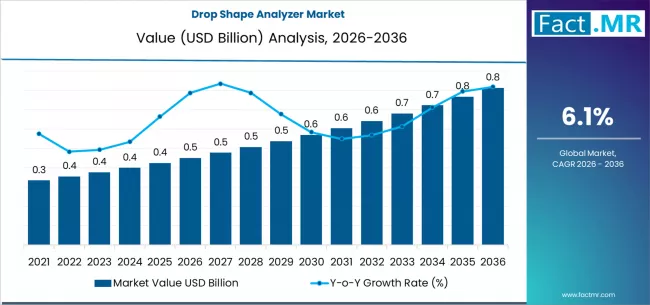
Looking ahead, the Drop Shape Analyzer market is expected to achieve a sustained CAGR of 6–8% between 2026 and 2036, outperforming many traditional lab instrumentation categories. Growth will be fueled by:
-
Rising complexity of materials and formulations
-
Automation and AI-enabled measurement adoption
-
Expansion of high-value manufacturing and pharma R&D
-
Increasing emphasis on surface science in sustainability and performance optimization
For investors, manufacturers, and technology suppliers, Drop Shape Analyzers represent a defensive yet innovation-driven market, combining stable demand with long-term upside.
Browse Full Report : https://www.factmr.com/report/drop-shape-analyzer-market
Conclusion
The Drop Shape Analyzer market is transitioning from a niche research tool to a mission-critical analytical instrument across multiple industries. With strong valuation fundamentals, attractive ROI characteristics, and a clear innovation roadmap, the market is well-positioned for robust, long-term growth through 2036.