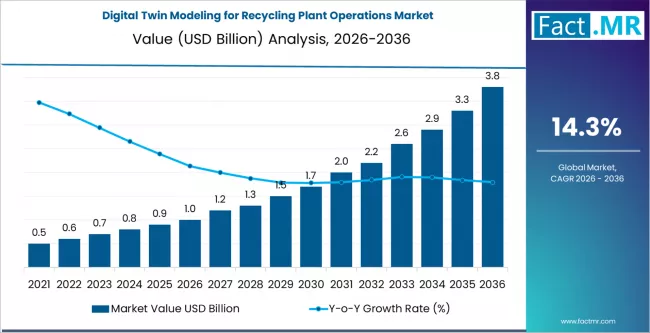
The global landscape of waste management is undergoing a profound digital transformation as recycling facilities increasingly pivot toward high-fidelity simulation and real-time optimization. According to a comprehensive market analysis by Fact.MR, the Digital Twin Modeling for Recycling Plant Operations Market is projected to grow from USD 1 billion in 2026 to USD 3.8 billion by 2036, expanding at a compound annual growth rate (CAGR) of 14%.
This surge in adoption is fueled by the critical need for operational resilience, predictive maintenance, and enhanced throughput in Material Recovery Facilities (MRFs) and specialized plastics recycling plants. As the circular economy gains legislative and corporate momentum, digital twins—virtual replicas of physical assets and processes—have emerged as the definitive tool for bridging the gap between physical operations and digital intelligence.
Bridging the Physical-Digital Gap in Waste Management
Modern recycling plants face unique challenges, including high input variability and the need for precision sorting. Digital twin technology addresses these by integrating physics-based models with Artificial Intelligence (AI) to create adaptive representations of plant behavior.
“Digital twins are no longer just conceptual tools for aerospace or high-end manufacturing,” states the report. “In the recycling sector, they provide a ‘single source of truth’ that allows operators to simulate ‘what-if’ scenarios, optimize energy consumption, and reduce equipment downtime without interrupting physical production.”
Key Market Insights and Data Highlights
- Data Dominance: Sensor, throughput, and quality data currently lead the market with a 50% share, as these inputs are essential for real-time monitoring of conveyors, sorters, and granulators.
- Regional Growth Leaders: * United States: Projected to grow at a 13% CAGR, driven by rapid adoption of smart waste technologies and a mature IT ecosystem.
- India: Anticipated to be the fastest-growing market with a 15.8% CAGR, reflecting the nation’s aggressive expansion of recycling infrastructure and sustainability initiatives.
- Technology Trends: The market is seeing a shift toward Cloud-native and Edge-connected twins, enabling seamless data processing and remote collaboration across large-scale recycling parks.
Operational Excellence and Sustainability
The deployment of digital twins is yielding measurable returns for early adopters. Industry data suggests that the implementation of these models can lead to an average 15% improvement in operational efficiency and up to a 25% increase in system performance. Furthermore, organizations utilizing digital twins have reported a 16% improvement in sustainability metrics, primarily through optimized resource allocation and reduced carbon footprints.
By identifying bottlenecks and predicting maintenance needs before failures occur, digital twins minimize the risk of costly “”vendor lock-in”” and equipment fatigue. This predictive capability is particularly vital for MRFs and emerging plastic recycling facilities where equipment uptime directly correlates to profitability.
Market Segmentation and Competitive Landscape
The market is categorized by:
- Twin Type: Asset twins, process twins, and plant-wide simulations.
- End-Use: Large recycling parks, precision-focused MRFs, and specialized plastics plants.
- Deployment: Increasing preference for hybrid models combining on-premise edge computing with scalable cloud platforms.
Leading innovators such as Yokogawa and SUPCON are at the forefront, focusing on control system integration and closed-loop feedback mechanisms that link digital models directly to operational parameters.
Browse Full report : https://www.factmr.com/report/design-for-recycling-packaging-market
Future Outlook
As the cost of sensor networks decreases and AI capabilities mature, the barrier to entry for digital twin adoption is lowering. The next decade will see a transition from “”claimed twins”” (simple digital shadows) to “”actual twins”” that offer autonomous decision-making capabilities. For investors and industry leaders, digital twin modeling represents the next frontier in achieving the efficiency required to meet global 2030 sustainability targets.
About the Report The findings are based on a specialized study of the Digital Twin Modeling for Recycling Plant Operations Market, providing a 10-year forecast and deep-dive analysis into regional trends, technological shifts, and competitive dynamics.