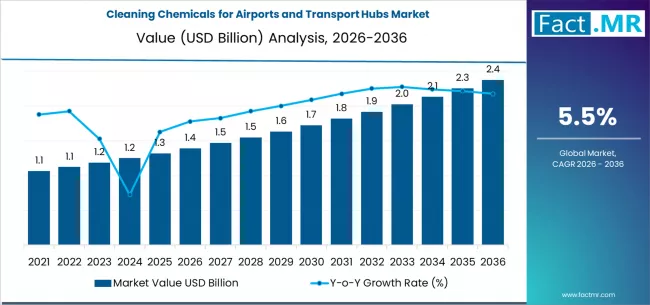
The global cleaning chemicals for airports and transport hubs market is set for steady expansion over the next decade, driven by heightened hygiene awareness, increasing passenger traffic, and stringent cleanliness regulations across public infrastructure facilities. According to a recent analysis by Fact.MR, the market is projected to grow from USD 1.39 billion in 2026 to USD 2.37 billion by 2036, reflecting a 70.5% increase and registering a compound annual growth rate (CAGR) of 5.5% during the forecast period.
The growing emphasis on sanitation, infection control, and facility aesthetics across airports, metro stations, railway terminals, and bus depots is significantly accelerating demand for advanced cleaning chemicals worldwide.
Browse Full Report: https://www.factmr.com/report/cleaning-chemicals-for-airports-and-transport-hubs-market
Strategic Market Drivers
Rising Global Passenger Traffic Boosts Demand
With the recovery and long-term growth of air and public transportation, airports and transport hubs are handling record passenger volumes. High footfall environments require frequent, large-scale cleaning, driving consistent demand for specialized cleaning chemicals that ensure safety, hygiene, and operational efficiency.
Post-Pandemic Focus on Hygiene & Infection Control
The COVID-19 pandemic permanently elevated sanitation standards across transportation infrastructure. Airports and transit authorities now prioritize:
- Hospital-grade disinfectants
- Antimicrobial surface cleaners
- Rapid-action sanitizers
This shift continues to support long-term demand for high-performance cleaning chemical solutions.
Expansion of Facility Management Contracts
The facility management contracts segment is projected to account for 44.0% of the market in 2026, as airports and transport hubs increasingly outsource cleaning operations to professional service providers. These contracts ensure recurring demand for bulk cleaning chemicals tailored to large, complex facilities.
Government Regulations & Safety Compliance
Stringent global and regional regulations related to public health, occupational safety, and environmental sustainability are pushing operators to adopt certified, compliant, and eco-friendly cleaning chemicals, further strengthening market growth.
Advancements in Eco-Friendly & High-Efficiency Formulations
Manufacturers are investing in:
- Low-VOC and biodegradable formulations
- Non-corrosive and surface-safe cleaners
- Concentrated products for reduced water and chemical usage
These innovations align with sustainability goals and reduce long-term operational costs.
Regional Growth Highlights
North America: Strong Aviation Infrastructure & Hygiene Regulations
North America leads the market due to well-established airport infrastructure, high air passenger traffic, and strict health and safety regulations. The U.S. remains a major contributor, supported by continuous airport modernization projects.
Europe: Sustainability & Public Transport Expansion
European countries are witnessing rising adoption of environmentally friendly cleaning chemicals, driven by EU sustainability mandates and extensive public transport networks across Germany, France, the U.K., and Nordic nations.
East Asia: Rapid Urbanization & Transport Infrastructure Growth
China, Japan, and South Korea are experiencing robust demand due to expanding metro systems, high-speed rail networks, and growing international air travel.
Emerging Markets: Infrastructure Development Fuels Demand
India, Southeast Asia, Latin America, and the Middle East are seeing rising market traction owing to:
- New airport construction and expansions
- Growth in urban transit systems
- Increasing public-private partnerships in transport infrastructure
Market Segmentation Insights
By Product Type
- Disinfectants & Sanitizers – High demand due to infection control needs
- Floor & Surface Cleaners – Widely used across terminals and platforms
- Glass & Metal Cleaners – Essential for aesthetics and visibility
- Degreasers – Used in maintenance and service areas
By Application Area
- Airport Terminals
- Railway Stations
- Metro & Subway Stations
- Bus Terminals
- Cargo & Maintenance Areas
By End User
- Airport Authorities
- Transport Authorities
- Facility Management Service Providers
- Private Cleaning Contractors
Challenges Impacting Market Growth
Environmental & Regulatory Constraints
Increasing restrictions on chemical compositions require manufacturers to reformulate products, increasing R&D costs.
High Operational Costs
Large-scale cleaning operations require continuous chemical supply, labor, and equipment, posing cost challenges for smaller transport hubs.
Product Compatibility Issues
Ensuring chemicals are safe for diverse surfaces—glass, metal, electronics, flooring—adds complexity to product development.
Competitive Landscape
The cleaning chemicals for airports and transport hubs market is moderately competitive, with companies focusing on:
- Sustainable product innovation
- Bulk supply contracts
- Custom formulations for high-traffic environments
Key Companies Profiled
- Ecolab Inc.
- Diversey Holdings
- Solenis
- 3M Company
- BASF SE
- Clorox Professional Products
- Reckitt
- Spartan Chemical Company
Recent Developments
- 2024: Increased adoption of green-certified cleaning chemicals across international airports
- 2023: Expansion of long-term facility management contracts with integrated hygiene solutions
- 2022: Rising use of hospital-grade disinfectants in transport hubs worldwide
Future Outlook: Sustained Growth Driven by Safety & Sustainability
Over the next decade, the market will benefit from:
- Rising global air and public transport traffic
- Long-term hygiene standard enforcement
- Growth of outsourced facility management services
- Adoption of eco-friendly and high-efficiency cleaning solutions
As airports and transport hubs continue to prioritize passenger safety, regulatory compliance, and sustainability, the global cleaning chemicals market is poised for stable and long-term growth through 2036.