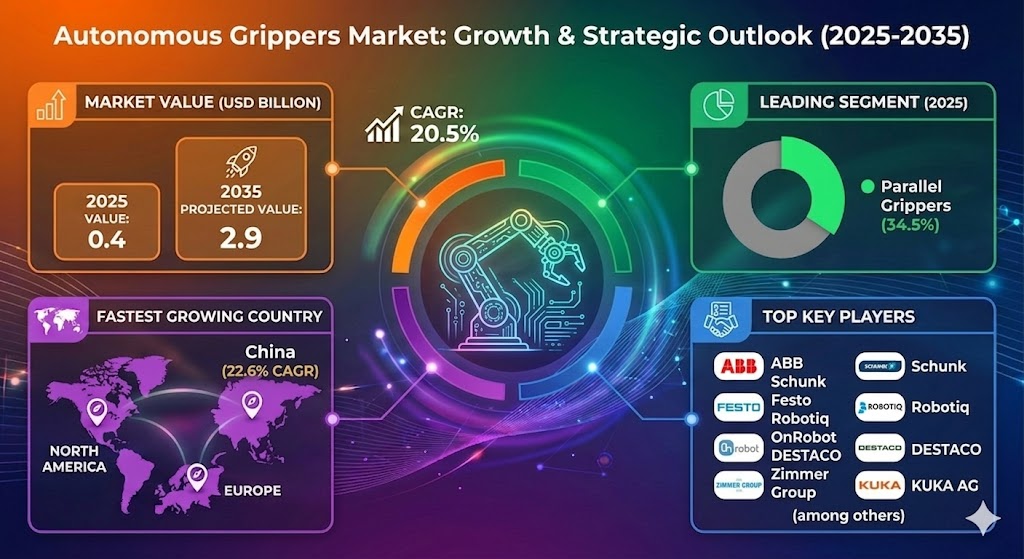
The autonomous grippers market is witnessing remarkable growth as industries increasingly adopt automation to enhance operational efficiency. Autonomous grippers, a critical component of robotic systems, enable precise, adaptive, and reliable handling of objects across diverse industrial settings. With advancements in artificial intelligence, machine vision, and sensor technologies, these grippers are transforming production, logistics, and warehousing processes.
Market Overview
Autonomous grippers are designed to handle objects with precision, flexibility, and minimal human intervention. They include a variety of types such as parallel grippers, three-finger or dexterous grippers, vacuum grippers, and magnetic grippers. These solutions are pivotal for tasks ranging from material handling and assembly to packaging and quality inspection. Their adaptability and integration with collaborative robots allow industries to optimize workflows, reduce downtime, and improve throughput across multiple sectors.
The market growth is fueled by rising demand for smart manufacturing, labor shortages, and the need for ergonomic workplace solutions. Technological innovations, including AI-driven object recognition and adaptive gripping mechanisms, further strengthen the market by enabling grippers to handle diverse shapes, sizes, and materials effectively.
Regional Insights
North America leads in the adoption of autonomous grippers, driven by a strong R&D ecosystem and the early integration of Industry 4.0 strategies. Europe follows closely, leveraging precision engineering, regulatory support, and worker safety initiatives to advance collaborative automation. Meanwhile, Asia-Pacific is emerging as a key player due to rapid industrialization, smart plant development, and significant manufacturing growth in countries like China, Japan, and South Korea. Latin America and the Middle East & Africa are gradually adopting these solutions to boost industrial efficiency and competitiveness.
Key Trends
Several trends are shaping the autonomous grippers market:
- Integration with Collaborative Robots – The rise of cobots has increased the demand for grippers that can operate safely alongside humans while handling complex tasks.
- AI and Machine Vision Adoption – Grippers with AI capabilities can detect, recognize, and adapt to objects in real-time, enhancing accuracy and reliability.
- Modular and Flexible Designs – Customizable grippers support rapid reconfiguration and multi-product handling, catering to flexible manufacturing and e-commerce needs.
- Energy Efficiency and Sustainability – Innovations focus on reducing power consumption and CO2 emissions while maintaining high performance.
- Industry-Specific Applications – From automotive to healthcare, autonomous grippers are tailored to meet the unique demands of each sector.
Applications & End-Use Outlook
Manufacturing and Material Handling
In manufacturing, autonomous grippers streamline assembly lines by handling raw materials, intermediate components, and finished products. Their ability to integrate with AI and vision systems ensures high precision and minimal error, improving productivity in electronics, automotive, and machinery sectors. In material handling and warehousing, these grippers facilitate sorting, packaging, and automated storage, optimizing logistics workflows and reducing operational bottlenecks.
Automotive Industry
The automotive sector extensively uses autonomous grippers to handle components ranging from lightweight electronic modules to heavy structural parts. Grippers support electric vehicle production by managing battery cells and composite materials, while robotic vision integration enables automated quality checks and precise assembly. Collaborative grippers enhance workplace safety by allowing humans and robots to work in shared spaces.
Healthcare and Precision Electronics
Healthcare applications demand sterile and precise handling, which autonomous grippers provide, especially in medical device manufacturing and laboratory automation. Similarly, precision electronics assembly benefits from the accuracy and repeatability of these grippers, reducing defects and downtime.
E-commerce and Logistics
The rise of e-commerce has created a need for rapid and flexible order fulfillment. Autonomous grippers ensure fast, accurate handling of packages of varying shapes and weights, enhancing operational efficiency and meeting consumer demand for timely deliveries.
Challenges
Despite strong growth, the autonomous grippers market faces certain challenges. High initial investment and limited awareness among small and medium enterprises slow adoption. Operational challenges include consistency in gripping diverse objects, sensor calibration, maintenance needs, and cybersecurity risks for connected devices. Additionally, market fragmentation and uneven technical expertise across regions hinder global standardization and scalability.
Competitive Landscape
Key players in the autonomous grippers industry include ABB, Schunk, Festo, Robotiq, OnRobot, DESTACO, Zimmer Group, and KUKA AG. These companies are focusing on product innovation, AI-enabled technologies, modular designs, and strategic partnerships to strengthen market presence. Recent developments highlight the launch of energy-efficient solutions and compatibility with multiple collaborative robot platforms, catering to growing industrial automation demands.
Conclusion
The autonomous grippers market is poised for sustained growth as industries prioritize automation, flexibility, and efficiency. By integrating advanced AI, machine vision, and collaborative technologies, autonomous grippers are reshaping industrial operations across sectors. Companies leveraging these solutions can achieve higher throughput, reduced downtime, and safer workplaces, positioning themselves for long-term competitiveness in the era of smart manufacturing.
Browse Full Report – https://www.factmr.com/report/autonomous-grippers-market