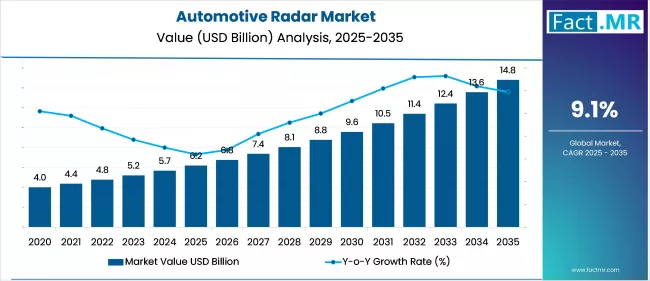
The automotive radar market is experiencing dynamic growth, driven by the increasing adoption of advanced driver-assistance systems (ADAS) and the global shift toward safer, more autonomous vehicles. Radar systems are critical for enabling features such as collision avoidance, adaptive cruise control, lane-keeping assistance, and blind-spot detection. These systems provide reliable performance in diverse weather and lighting conditions, making them indispensable for modern vehicles. This article explores market trends, growth drivers, regional insights, and technological innovations shaping the automotive radar landscape.
Market Overview:
Automotive radar systems offer precise object detection, facilitating both safety and autonomous driving functions. The market is witnessing robust growth due to rising regulatory mandates, consumer awareness of vehicle safety, and the integration of radar in electric and connected vehicles. Increasing investments in autonomous technology and intelligent transportation systems are further fueling demand for radar solutions across vehicle segments.
Key Growth Drivers:
The adoption of radar technology is primarily driven by the need for enhanced vehicle safety and compliance with government regulations. Automakers are integrating radar-based systems to support ADAS features, which significantly reduce accidents and improve road safety. Technological advancements, including high-resolution radar, 4D imaging radar, digital beamforming, and radar-on-chip solutions, are making radar modules more compact, energy-efficient, and cost-effective. These innovations allow radar integration in mid-range and entry-level vehicles, expanding market reach.
The rise of electric vehicles (EVs) has also boosted radar adoption, as manufacturers seek to differentiate their models with advanced safety and driver-assist features. Over-the-air (OTA) software updates in radar systems enhance performance and reduce maintenance costs, adding to their appeal among automakers and consumers.
Regional Insights:
North America leads the automotive radar market, supported by early ADAS adoption and strict safety regulations. The United States has mandated radar-supported features such as automatic emergency braking and lane departure warnings in new vehicles, driving demand. Europe is another significant market, where stringent safety standards and vehicle electrification initiatives are accelerating radar deployment. Countries like Germany, France, and the U.K. are at the forefront, driven by strong automotive manufacturing and R&D investments.
In the Asia-Pacific region, rising vehicle production, urbanization, and government initiatives promoting ADAS adoption are major growth factors. China is emerging as a dominant market, while Japan and South Korea continue to advance radar integration in both conventional and electric vehicles. Latin America, the Middle East, and Africa represent nascent markets with growing potential, as awareness of vehicle safety and premium feature adoption increase.
Technological Trends:
Automotive radar is evolving rapidly with the development of higher-frequency systems that offer greater detection range, accuracy, and object discrimination. Innovations such as sensor fusion, combining radar with LiDAR, cameras, and ultrasonic sensors, are enhancing ADAS and autonomous driving capabilities. Compact and modular radar designs allow easy integration across vehicle types, while 4D radar provides improved spatial resolution for complex driving scenarios.
Challenges:
Despite the promising growth, the market faces challenges such as high costs of advanced radar systems and integration complexities. Urban environments pose signal interference issues due to multiple radar-equipped vehicles operating in close proximity, affecting ADAS performance. Additionally, calibration and sensor fusion with other vehicle systems require sophisticated engineering and increase production complexity.
Conclusion:
The automotive radar market is poised for significant growth as safety regulations tighten, consumer demand rises, and technological innovations advance. Radar systems are integral to the development of autonomous vehicles and modern ADAS, providing reliable performance in all conditions. While challenges such as cost and signal interference remain, ongoing innovations and increasing adoption across global markets ensure a robust future for the automotive radar industry. Manufacturers, technology providers, and automotive stakeholders are well-positioned to capitalize on this expanding market, steering the future of safe and autonomous driving.
Browse Full Report – https://www.factmr.com/report/23/automotive-radar-market