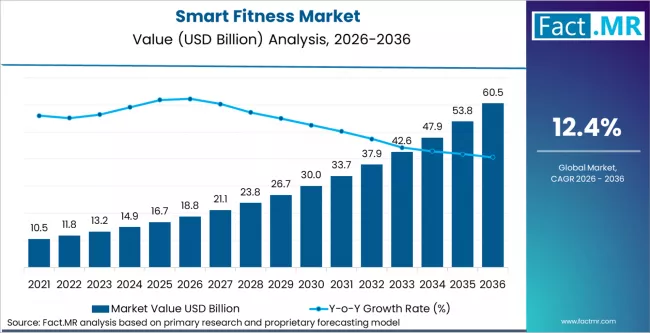
The global Smart Fitness Market is projected to reach a valuation of USD 18.8 billion in 2026, expanding significantly to USD 60.4 billion by 2036. This growth represents a steady CAGR of 12.4% over the ten-year forecast period. As digital ecosystems become central to health monitoring, the market is evolving from basic exercise tools into integrated, data-driven platforms for personalized wellness.
Smart Fitness Market Quick Stats
-
Market size 2026? The market is estimated to be valued at USD 18.8 billion.
-
Market size 2036? The market is projected to reach USD 60.4 billion.
-
CAGR? The market will grow at a compound annual growth rate of 12.4% from 2026 to 2036.
-
Leading product segment and share? Smart Fitness Equipment is the leading product category, projected to hold a 46.1% market share in 2026.
-
Leading app segment and share? Nutrition-Tracking Apps are expected to capture 54.8% of the app market share by 2026.
-
Leading end use? The market serves diverse sectors including Corporates, Individuals, and Gyms & Health Clubs.
-
Key growth regions? South Asia (led by India), East Asia (led by China), Oceania (led by Australia), North America (led by USA), and Europe (led by Germany).
-
Top companies? Fitbit, Inc., Apple Inc., Samsung Electronics Co., Ltd., Garmin Ltd., and Xiaomi Corporation.
Market Momentum (YoY Path)
The Smart Fitness Market is set for consistent value appreciation over the next decade. Starting at USD 18.8 billion in 2026, the market is expected to climb to USD 23.8 billion by 2028 and USD 30.1 billion by 2030. By 2031, the value is projected to hit USD 33.9 billion, rising further to USD 42.9 billion in 2033. By the end of the forecast period in 2036, the market will reach its peak valuation of USD 60.4 billion.
Why the Market is Growing
Expansion in the Smart Fitness Market is fueled by rising health awareness and the adoption of wellness-focused lifestyles. Key drivers include the widespread integration of AI and IoT technologies into fitness equipment, alongside a growing demand for personalized experiences and data-driven insights. Additionally, the expansion of corporate wellness programs and the transition toward connected home fitness ecosystems are providing significant structural support for market growth.
Segment Spotlight
1) Product Type: Smart Fitness Equipment
Smart Fitness Equipment, which includes connected treadmills, stationary bikes, and strength-training machines, is projected to hold 46.1% of the market share by 2026. These products are gaining traction by offering interactive, real-time performance monitoring and seamless integration with digital platforms to optimize user routines.
2) Apps: Nutrition-Tracking
Nutrition-tracking apps are expected to dominate the app segment with a 54.8% share by 2026. These tools allow users to monitor caloric intake and nutrient balance. Their popularity is driven by their ability to pair with wearable devices, providing a holistic view of a user’s health and weight management progress.
3) End Use: Consumer Adoption
The market is increasingly driven by individuals seeking measurable progress and convenience. Whether through home fitness platforms or connected gym systems, users are replacing traditional, non-connected equipment with smart solutions that offer remote coaching and personalized training insights.
Drivers, Opportunities, Trends, and Challenges
Drivers: The primary catalyst for the Smart Fitness Market is the shift toward health-tech integration. Consumers are moving away from standalone trackers in favor of integrated systems that deliver real-time feedback and long-term adherence to fitness goals through AI-enabled coaching.
Opportunities: High-growth markets like India and China present significant opportunities due to expanding smartphone penetration and government fitness initiatives. Providers can capture margin expansion by investing in AI-enabled platforms and cross-device interoperability.
Trends: There is a clear trend toward connected fitness ecosystems. Value creation is shifting from the hardware itself to the software and data analytics that monitor performance and enhance user engagement across both commercial and residential settings.
Challenges: Market adoption may be hindered by the high cost of advanced smart devices. Furthermore, privacy concerns regarding the management of sensitive user health data remain a critical restraint that providers must address through certified security standards.
Country Growth Outlook (CAGR)
| Country | CAGR (2026-2036) |
| India | 15.3% |
| China | 13.4% |
| Australia | 12.9% |
| USA | 11.9% |
| Germany | 11.0% |
Browse Full Report : https://www.factmr.com/report/smart-fitness-market
Competitive Landscape
The Smart Fitness Market is moderately concentrated, with dominant players including Fitbit, Inc., Apple Inc., Samsung Electronics Co., Ltd., Garmin Ltd., and Xiaomi Corporation holding a significant share of shipments. Competition is centered on sensor accuracy, battery life, and the richness of health analytics. Leading companies leverage strong R&D and expansive software ecosystems to maintain a device-to-cloud advantage, focusing on user experience rather than price competition alone.