The global agricultural input industry is entering a pivotal transformation, driven by sustainability mandates, nutrient-use efficiency targets, and increasing pressure to optimize livestock operations. Central to this evolution is slurry-to-precision fertilizer conversion chemistry—a technology that upgrades livestock slurry from a low-value waste stream into a standardized, high-performance fertilizer for precision agriculture systems. Between 2026 and 2036, this market is expected to move from early adoption to mainstream deployment, offering compelling valuation growth and attractive return-on-investment (ROI) profiles.
Market Valuation Outlook (2026–2036)
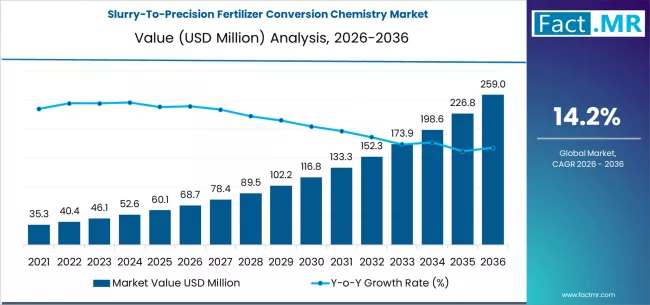
The global slurry-to-precision fertilizer conversion chemistry market is projected to be valued at USD 68.7 million in 2026, expanding to approximately USD 259 million by 2036, reflecting a compound annual growth rate (CAGR) of 14.2% over the forecast period.
This growth significantly outpaces the broader global fertilizers market, which is projected to grow at a CAGR of about 3.6% over the same period. Cereals are expected to dominate application demand, accounting for roughly 46% of market share in 2026, while granular precision formulations will represent nearly 48% of the product segment, due to compatibility with variable-rate spreaders and precision planting equipment.
Strategic Context: Precision Agriculture Tailwinds
The long-term outlook for slurry-derived precision fertilizers is reinforced by the broader expansion of precision agriculture chemicals. Precision fertilizers are increasingly important in digital farm management systems, providing standardized nutrient delivery that aligns with variable-rate application, fertigation, and chemigation systems.
This trend positions slurry-to-precision fertilizer conversion chemistry as a technology that meets growing demand for efficiency and traceability in nutrient management, particularly in large-scale, nutrient-intensive cropping systems.
ROI Potential: Economics at Farm and Industry Levels
From an ROI perspective, slurry-to-precision fertilizer conversion chemistry provides a dual-layer value proposition:
-
Cost Avoidance & Waste Management Savings
Livestock producers face rising costs for slurry storage, transport, and regulatory compliance. Conversion chemistry reduces disposal volumes and transforms slurry into a saleable or on-farm usable product. In regions with strict nutrient runoff regulations, avoided penalties and reduced hauling costs significantly improve payback periods. -
Yield Uplift & Input Efficiency Gains
Precision-converted slurry fertilizers deliver nutrients in plant-available, predictable ratios. Enhanced nutrient-use efficiency can reduce total fertilizer application rates while maintaining or improving yields. For integrated livestock-crop operations, ROI timelines of 2–4 years are achievable depending on herd size, crop mix, and regional fertilizer pricing. For commercial fertilizer blenders and ag-retailers, differentiated “circular economy” product positioning enables premium pricing.
Regional Growth Hotspots
Europe remains a critical early-adoption region due to nutrient management regulations and high livestock density. Key markets such as the Netherlands and Germany are expected to experience rapid growth, while the United States shows strong expansion potential.
Asia-Pacific represents a long-term growth opportunity, driven by intensive livestock production and rising adoption of precision agriculture tools. Growth in this region is projected to accelerate beyond 2030, positioning it as a future hotspot for adoption and revenue expansion.
Competitive and Investment Landscape
While the market remains small in absolute terms, it is strategically important. Major fertilizer producers and technology developers are investing in R&D partnerships, pilot projects, and modular conversion units to capture early technological leadership.
The segment offers:
-
High CAGR exposure in a niche but growing segment
-
Strong ESG alignment, supporting green finance and sustainability funding
-
Scalable technology platforms, deployable across regions and livestock systems
Long-Term Growth Prospects (2030–2036)
Beyond 2030, market growth is expected to accelerate as carbon accounting, nutrient circularity metrics, and regenerative agriculture practices become integral to agricultural policy and supply chains. Slurry-to-precision fertilizer conversion chemistry directly supports these objectives by reducing synthetic fertilizer dependence and closing nutrient loops.
By 2036, the market is projected to reach USD 259 million, with adoption expanding from early innovators to mainstream agricultural input portfolios, establishing this segment as a critical bridge between livestock sustainability and precision crop nutrition.
Browse Full Report: https://www.factmr.com/report/slurry-to-precision-fertilizer-conversion-chemistry-market
Conclusion
The slurry-to-precision fertilizer conversion chemistry market represents a convergence of sustainability, technology, and profitability in modern agriculture. With a projected 14.2% CAGR from 2026 to 2036, attractive ROI dynamics, and strong alignment with precision farming trends, this segment is poised for long-term growth—transforming agricultural waste into a high-value input for efficient, climate-smart farming systems.