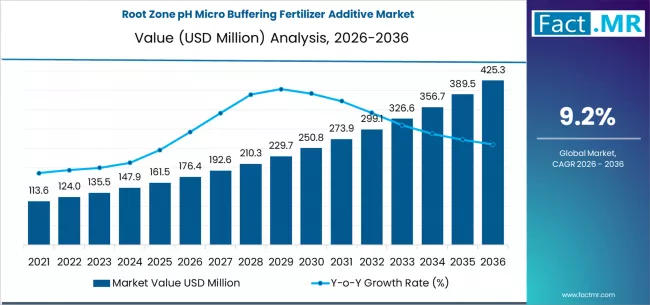
The global root zone pH micro buffering fertilizer additive market is poised for strong and sustained growth over the next decade, driven by rising demand for precision agriculture solutions, increasing awareness of soil health, and the need to optimize nutrient availability in variable soil conditions. According to a new analysis by Fact.MR, the market is projected to expand from USD 176.40 million in 2026 to USD 425.32 million by 2036, registering a robust CAGR of 9.2% during the forecast period.
This rapid expansion reflects the growing importance of managing soil pH at the rhizosphere level, one of the most critical yet highly variable factors influencing nutrient uptake, crop productivity, and fertilizer efficiency.
The shift toward high-efficiency crop nutrition systems, rising adoption of specialty fertilizers, and increasing focus on sustainable farming practices are significantly accelerating demand for root zone pH micro buffering fertilizer additives worldwide.
Browse Full Report: https://www.factmr.com/report/root-zone-ph-micro-buffering-fertilizer-additive-market
Strategic Market Drivers
Precision Agriculture Fuels Market Expansion
The global transition toward precision and data-driven agriculture is elevating the need for advanced soil management inputs. Root zone pH micro buffering additives help stabilize pH fluctuations around plant roots, enabling optimal nutrient absorption and reducing fertilizer losses.
Their use is expanding rapidly across:
- High-value crops
- Greenhouse cultivation
- Controlled environment agriculture (CEA)
- Drip and fertigation systems
As farmers seek higher yields with reduced environmental impact, micro buffering technologies are becoming essential components of modern nutrient programs.
Rising Soil Degradation and Nutrient Imbalance Concerns
Intensive farming practices, excessive fertilizer use, and climate-driven soil variability have intensified issues related to soil acidification and alkalinity. These challenges directly limit nutrient availability, even when fertilizers are adequately applied.
Root zone pH micro buffering additives offer targeted pH regulation, improving:
- Nutrient solubility
- Root health
- Fertilizer use efficiency (FUE)
- Crop resilience under stress conditions
Growth in Specialty Fertilizers and Sustainable Inputs
Increasing demand for specialty fertilizers, including micronutrients, biofertilizers, and controlled-release formulations, is strengthening the adoption of pH micro buffering additives. These products enhance the performance of both conventional and organic fertilizers.
Government initiatives promoting sustainable agriculture, reduced nutrient runoff, and soil health restoration are further encouraging manufacturers and growers to integrate micro buffering solutions into crop nutrition strategies.
Advancements in Formulation and Compatibility
Ongoing innovation in formulation chemistry has improved the compatibility of pH micro buffering additives with:
- Liquid fertilizers
- Water-soluble fertilizers
- Fertigation systems
- Foliar nutrition programs
Enhanced stability, ease of application, and crop-specific formulations are expanding their use across diverse farming systems.
Regional Growth Highlights
North America: Precision Farming Leadership
North America remains a major market due to high adoption of precision agriculture technologies and advanced nutrient management practices. The U.S. market is supported by:
- Widespread use of fertigation
- High-value crop production
- Strong focus on soil health optimization
Europe: Sustainability-Driven Adoption
Strict environmental regulations, nutrient management directives, and widespread use of specialty fertilizers are driving demand across Europe. Countries such as Germany, France, Spain, and the Netherlands are key adopters, particularly in horticulture and greenhouse farming.
East Asia: Intensive Agriculture and Soil Optimization
China, Japan, and South Korea are witnessing rising adoption due to intensive cropping systems, soil degradation challenges, and government-led initiatives to improve fertilizer efficiency and reduce environmental impact.
Emerging Markets: High Growth Potential
Markets such as India, Southeast Asia, Latin America, and Africa present significant growth opportunities, supported by:
- Expanding commercial agriculture
- Rising awareness of soil pH management
- Growth in horticulture and cash crops
- Increasing adoption of modern irrigation systems
Market Segmentation Insights
By Form
- Liquid Additives – Dominant due to ease of integration with fertigation systems.
- Granular Additives – Growing use in conventional soil applications.
By Crop Type
- Cereals & Grains – Large volume usage.
- Fruits & Vegetables – Fastest-growing segment due to high nutrient sensitivity.
- Oilseeds & Pulses
- Plantation Crops
- Turf & Ornamentals
By Application Method
- Fertigation
- Soil Application
- Seed Treatment
- Foliar Nutrition (Supportive Role)
Challenges Impacting Market Growth
Cost Sensitivity in Developing Markets
Higher costs compared to conventional soil conditioners can limit adoption among small-scale farmers.
Awareness and Technical Knowledge Gaps
Limited understanding of rhizosphere-level pH management may slow penetration in traditional farming regions.
Crop- and Soil-Specific Requirements
Effectiveness varies based on soil type, crop, and climate, requiring customized application strategies.
Competitive Landscape
The root zone pH micro buffering fertilizer additive market is moderately fragmented, with manufacturers focusing on:
- Advanced formulation chemistry
- Crop-specific solutions
- Compatibility with precision irrigation systems
- Sustainable and eco-friendly ingredients
Key Companies Profiled
- BASF SE
- Yara International
- Nutrien Ltd.
- ICL Group
- The Mosaic Company
- Haifa Group
- UPL Ltd.
- FMC Corporation
- Coromandel International
- Valagro
Companies are investing in soil health R&D, biological integration, and precision-compatible formulations to strengthen their market position.
Recent Developments
- 2024: Introduction of advanced micro-buffer formulations compatible with smart fertigation systems
- 2023: Expansion of pH-buffered fertilizer solutions for horticulture and greenhouse crops
- 2022: Increased adoption of soil health-enhancing additives aligned with sustainability mandates
Future Outlook: Precision Nutrition Shapes the Next Decade
The coming decade will witness accelerated adoption of root zone pH micro buffering fertilizer additives, driven by:
- Expansion of precision agriculture
- Rising demand for sustainable nutrient management
- Growth in high-value crop cultivation
- Climate-driven soil variability
- Emphasis on maximizing fertilizer efficiency
As global agriculture shifts toward precision, sustainability, and yield optimization, the root zone pH micro buffering fertilizer additive market is well-positioned for strong, long-term growth through 2036.