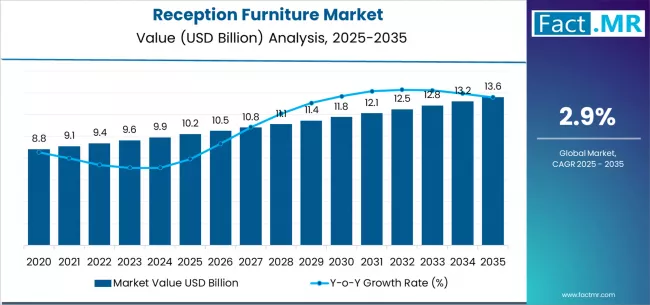
The global reception furniture market is entering a steady expansion phase, driven by rising emphasis on first-impression branding, workplace modernization, and space-optimized commercial interiors. According to a new analysis by Fact.MR, the market is projected to grow from USD 10,200.0 million in 2025 to USD 13,600.0 million by 2035, registering a CAGR of 2.9% over the forecast period.
This growth reflects increasing investments in corporate infrastructure, hospitality development, healthcare expansion, and public-sector facilities—where reception areas serve as critical touchpoints for customer experience and brand identity.
Browse Full Report: https://www.factmr.com/report/reception-furniture-market
Strategic Market Drivers
Corporate Office Expansion & Workplace Transformation
The evolution of modern workplaces toward collaborative, flexible, and brand-aligned environments is significantly boosting demand for contemporary reception furniture. Organizations are prioritizing reception desks, seating, and storage solutions that balance aesthetics, ergonomics, and functionality.
The rise of co-working spaces, IT parks, and global capability centers is further accelerating demand for modular and customizable reception furniture solutions.
Hospitality & Commercial Real Estate Growth
Hotels, resorts, business lounges, and serviced offices increasingly view reception areas as experiential spaces. Premium materials, minimalist designs, and smart layouts are gaining traction as hospitality operators aim to elevate guest experience and visual appeal.
Rapid urbanization and commercial real estate development across emerging economies continue to support market expansion.
Healthcare & Institutional Infrastructure Development
Hospitals, clinics, educational institutions, and government buildings are investing in durable, hygienic, and ergonomic reception furniture to manage high footfall and improve visitor comfort.
Growing healthcare infrastructure in developing regions is a key contributor to long-term demand stability.
Design Innovation & Space Optimization
Manufacturers are focusing on:
- Modular reception desks
- Compact storage-integrated furniture
- Sustainable and eco-friendly materials
- Smart layouts for small and medium office spaces
Advancements in material engineering and design customization are enabling better space utilization without compromising aesthetics.
Regional Growth Highlights
North America: Mature Office & Corporate Infrastructure
North America remains a leading market due to continuous renovation of corporate offices, strong hospitality presence, and emphasis on employee and visitor experience. The U.S. dominates regional demand with sustained investments in commercial interiors.
Europe: Design Excellence & Sustainability Focus
European countries such as Germany, the U.K., France, and Italy are driving demand through strong interior design culture and sustainability regulations. Eco-certified materials and minimalist designs are key growth enablers.
East Asia: Commercial Expansion & Urban Development
China, Japan, and South Korea are witnessing rising demand driven by commercial construction, business parks, and hospitality expansion, particularly in urban centers.
Emerging Markets: Infrastructure & Service Sector Growth
India, Southeast Asia, Latin America, and the Middle East are emerging as high-potential markets supported by:
- Rapid urbanization
- Growing IT & service industries
- Expansion of healthcare and education infrastructure
Market Segmentation Insights
By Product Type
- Reception Desks & Counters – Largest segment due to universal requirement across commercial spaces
- Seating Furniture – Growing demand for ergonomic visitor seating
- Storage Units & Accessories – Supporting organization and space efficiency
By Material
- Wood-Based Furniture – Dominant due to aesthetics and durability
- Metal & Glass – Rising adoption in modern and corporate interiors
- Composite & Sustainable Materials – Gaining traction due to eco-conscious design trends
By End Use
- Corporate Offices – Leading segment driven by branding and office expansion
- Hospitality – Strong growth in hotels and serviced spaces
- Healthcare – Consistent demand from hospitals and clinics
- Educational & Government Institutions – Stable long-term adoption
Challenges Impacting Market Growth
Price Sensitivity
Budget constraints in small offices and public institutions limit adoption of premium and customized furniture solutions.
Raw Material Cost Volatility
Fluctuating prices of wood, metal, and engineered materials impact manufacturing costs and pricing strategies.
Space Constraints in Urban Offices
Smaller office layouts require highly customized solutions, increasing design complexity and cost.
Competitive Landscape
The reception furniture market is moderately fragmented, with manufacturers focusing on design innovation, customization capabilities, sustainable materials, and project-based contracts.
Key Companies Profiled
- Steelcase Inc.
- Haworth Inc.
- Herman Miller, Inc.
- HNI Corporation
- Kinnarps AB
- Godrej Interio
- Kimball International
- Teknion Corporation
- Okamura Corporation
- Global Furniture Group
Companies are investing in modular systems, eco-friendly materials, and digitally enabled design solutions to strengthen market positioning.
Recent Developments
- 2024: Increased adoption of modular and space-saving reception desks in co-working environments
- 2023: Hospitality chains upgrade reception areas with premium, brand-aligned furniture
- 2022: Rising demand for sustainable and FSC-certified reception furniture across Europe
Future Outlook: Functional Design Meets Brand Experience
Over the next decade, the reception furniture market will evolve toward:
- Brand-centric and experience-driven design
- Modular and flexible furniture systems
- Sustainable and recyclable materials
- Smart space utilization for compact offices
As organizations increasingly recognize reception areas as strategic brand assets rather than functional spaces alone, the global reception furniture market is set for steady, long-term growth through 2035.