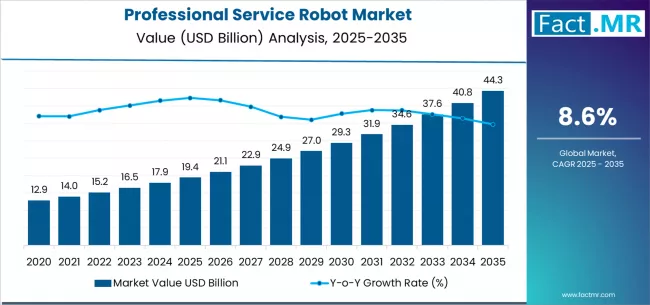
The professional service robot market is rapidly evolving as industries increasingly adopt automation technologies to improve efficiency, productivity, and service delivery. Professional service robots are designed to perform specialized tasks in commercial and industrial environments, supporting human workers in activities that require precision, speed, and consistency. From healthcare and logistics to agriculture and security, these robots are becoming essential tools for organizations aiming to enhance operational capabilities while reducing manual workload. As robotics technology advances and artificial intelligence becomes more integrated into robotic systems, the demand for professional service robots continues to grow worldwide.
Market Overview:
Professional service robots are advanced robotic systems developed to perform tasks outside traditional manufacturing environments. Unlike industrial robots that are primarily used in production lines, professional service robots are designed to assist in fields such as healthcare, defense, logistics, agriculture, inspection, and cleaning services.
These robots are capable of performing complex operations that may involve navigation, object recognition, monitoring, and automated decision-making. Many modern service robots integrate technologies such as artificial intelligence, machine learning, sensors, and advanced imaging systems to carry out tasks more effectively.
Organizations across various sectors are adopting these robots to address labor shortages, improve operational efficiency, and enhance service quality. For instance, in healthcare facilities, robots can assist with patient monitoring, medication delivery, and sanitation tasks. In logistics and warehouse environments, robots help automate material handling and inventory management processes.
The rapid growth of digital technologies and smart infrastructure is also contributing to the increased deployment of professional service robots. As businesses continue to digitize their operations, robotic solutions are being integrated with other advanced technologies such as data analytics, cloud computing, and Internet of Things platforms to create more intelligent service ecosystems.
Regional Insights:
The professional service robot market shows strong growth potential across multiple regions due to rising automation adoption and technological advancements.
North America is one of the leading regions in the adoption of professional service robots. The presence of advanced technology companies, strong research and development capabilities, and high demand for automation solutions in healthcare, logistics, and defense sectors support market growth in the region. Organizations are increasingly implementing robotic systems to improve operational efficiency and maintain competitive advantage.
Europe is another prominent market, supported by strong investments in robotics innovation and automation technologies. Many European countries emphasize industrial modernization and digital transformation, which encourages the integration of robotics into various service sectors. The region also has strict safety and efficiency standards that encourage the use of advanced robotic solutions.
The Asia-Pacific region is emerging as a major growth hub for professional service robots. Rapid industrialization, expanding healthcare infrastructure, and increasing adoption of automation technologies are contributing to the region’s market expansion. Countries such as Japan, China, and South Korea are recognized as global leaders in robotics development and deployment. These nations are investing heavily in robotic technologies to support industries ranging from manufacturing to healthcare and logistics.
Other regions, including Latin America and the Middle East, are gradually adopting professional service robots as businesses and governments explore automation solutions to improve productivity and operational performance.
Key Trends & Forecast:
Several technological advancements and industry developments are shaping the future of the professional service robot market.
One of the most significant trends is the integration of artificial intelligence and machine learning into robotic systems. AI-powered robots are capable of learning from their environments, recognizing patterns, and adapting to new situations. This capability allows service robots to perform tasks more accurately and efficiently across different industries.
Another key trend is the development of collaborative robots designed to work alongside human employees. These robots are built with advanced sensors and safety mechanisms that enable safe interaction with workers. Collaborative robots help organizations enhance productivity while maintaining a safe working environment.
Autonomous navigation technology is also advancing rapidly. Many professional service robots are equipped with advanced sensors, cameras, and mapping systems that allow them to move independently in complex environments. This technology is particularly useful in applications such as warehouse logistics, hospital assistance, and facility management.
Additionally, improvements in battery technology and energy efficiency are enhancing the performance and operational lifespan of service robots. Longer battery life allows robots to perform tasks continuously without frequent recharging, increasing productivity and reliability.
The rising adoption of robotics in emerging sectors such as agriculture, hospitality, and security services is another important trend. Robots are now being used for crop monitoring, hotel guest services, and surveillance activities, demonstrating their expanding role across different industries.
Applications & End-Use Outlook:
Professional service robots are used across a wide range of industries due to their ability to automate specialized tasks.
Healthcare Sector:
Healthcare facilities are increasingly deploying robots for patient care support, hospital logistics, and sanitation tasks. Robots can assist medical staff by transporting supplies, disinfecting hospital rooms, and monitoring patient conditions.
Logistics and Warehousing:
In logistics operations, robots are widely used for inventory management, order fulfillment, and material handling. Automated robots improve efficiency in warehouses and distribution centers by reducing manual labor and accelerating operational processes.
Agriculture:
Agricultural robots are used for tasks such as crop monitoring, harvesting, and soil analysis. These robots help farmers improve productivity and optimize resource utilization in agricultural operations.
Defense and Security:
Security and defense organizations deploy robots for surveillance, monitoring, and hazardous environment operations. Robots can operate in situations that may be dangerous for human personnel, enhancing safety and mission effectiveness.
Hospitality and Service Industry:
Hotels, restaurants, and customer service facilities are increasingly adopting robots for tasks such as guest assistance, food delivery, and facility management. These robots enhance customer experience while improving operational efficiency.
Inspection and Maintenance:
Robots are also used in inspection activities for infrastructure, energy facilities, and industrial equipment. They help detect issues in complex environments and support preventive maintenance strategies.
Conclusion:
The professional service robot market is expanding as organizations across industries seek innovative automation solutions to improve operational performance. Advances in artificial intelligence, autonomous navigation, and sensor technologies are enabling robots to perform increasingly sophisticated tasks in diverse environments.
As industries continue to embrace digital transformation and smart technologies, professional service robots are expected to play a crucial role in reshaping service delivery and operational processes. Businesses and stakeholders looking to stay ahead in the rapidly evolving robotics industry can benefit from comprehensive market insights that highlight emerging trends, technological developments, and strategic opportunities in the professional service robot market.
Browse Full Report – https://www.factmr.com/report/professional-service-robot-market