The motorcycle market continues to play a vital role in global transportation, offering an efficient, affordable, and flexible mobility solution for millions of consumers. From urban commuters seeking to navigate congested roads to adventure enthusiasts exploring long-distance travel, motorcycles cater to a wide range of lifestyle and practical needs.
As cities expand and traffic density increases, two-wheelers are gaining recognition for their ability to provide convenient mobility while consuming less space and fuel compared to larger vehicles. At the same time, technological advancements and evolving consumer preferences are transforming motorcycles into smarter, safer, and more performance-driven machines.
Market Overview
Motorcycles encompass a diverse category of two-wheeled vehicles designed for commuting, recreational riding, and commercial applications. The market includes standard motorcycles, sport bikes, cruisers, touring models, scooters, and emerging electric variants, each serving distinct rider requirements.
Growing urbanization, expanding road infrastructure, and the need for cost-effective transportation are contributing to sustained demand. In many developing economies, motorcycles serve as a primary mode of transport due to their accessibility and practicality.
Manufacturers are increasingly focusing on improving engine efficiency, reducing emissions, and enhancing rider comfort. Modern motorcycles now feature advanced braking systems, digital displays, smartphone connectivity, and improved suspension technologies, reflecting the industry’s commitment to innovation.
Key Growth Drivers
One of the primary drivers of the motorcycle market is the rising demand for economical personal transportation. Motorcycles typically require lower upfront investment and maintenance, making them an attractive option for first-time vehicle buyers and young consumers.
Rapid population growth in urban areas has intensified traffic congestion, encouraging commuters to choose two-wheelers for faster travel and easier parking. Additionally, the expansion of delivery services and e-commerce logistics has boosted the adoption of motorcycles for commercial use.
Another significant factor is the growing popularity of leisure riding. Consumers are increasingly viewing motorcycles as lifestyle products that offer freedom, adventure, and personalization opportunities. This trend has fueled demand for premium models and accessories.
Environmental awareness is also shaping the market, with electric motorcycles gaining attention as governments promote cleaner mobility solutions and stricter emission standards.
Technology Trends and Innovation
Technological progress is redefining the riding experience. Many modern motorcycles now incorporate smart features such as navigation support, ride analytics, traction control, and customizable riding modes. These innovations enhance both safety and performance.
Electric motorcycles represent one of the most notable developments in the industry. Advances in battery technology are improving range and charging efficiency, making electric models more practical for daily use. As charging infrastructure expands, adoption is expected to rise further.
Connectivity is another emerging trend, with manufacturers integrating mobile applications that allow riders to monitor vehicle health, track routes, and receive maintenance alerts. Lightweight materials and aerodynamic designs are also being adopted to improve efficiency and handling.
Safety innovations, including anti-lock braking systems, stability control, and advanced lighting technologies, are becoming increasingly standard across multiple motorcycle segments.
Regional Insights
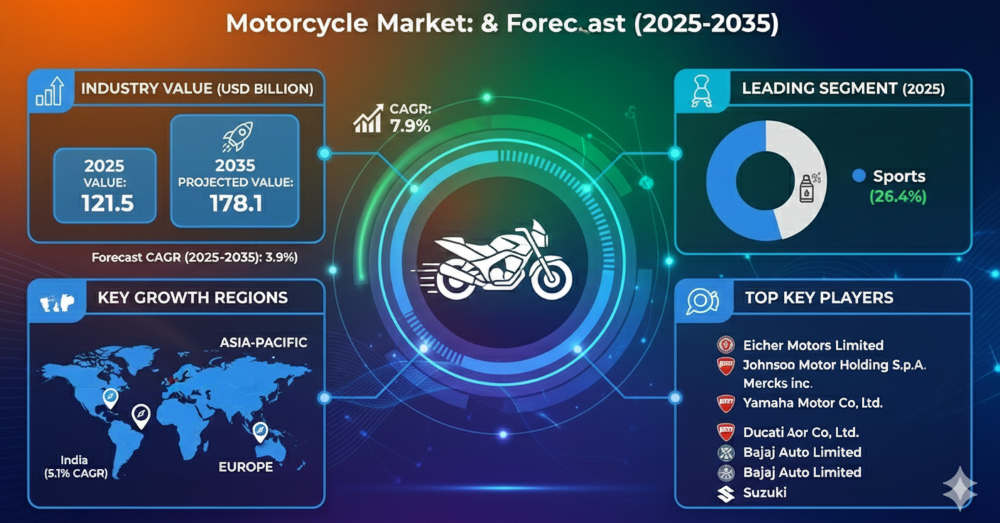
Asia-Pacific dominates the motorcycle market due to high population density, strong demand for affordable transportation, and robust manufacturing capabilities. Motorcycles are deeply embedded in daily life across many countries in the region, serving both personal and commercial mobility needs.
Europe demonstrates steady growth, supported by a strong culture of recreational riding and increasing interest in premium motorcycles. The region is also witnessing a gradual shift toward electric two-wheelers as sustainability becomes a priority.
North America maintains a solid presence, particularly in the heavyweight and touring motorcycle segments. Consumers often view motorcycles as lifestyle purchases, driving demand for high-performance and technologically advanced models.
Meanwhile, emerging markets in Latin America, the Middle East, and Africa are experiencing growing adoption as economic development improves access to personal transportation.
Applications & End-Use Outlook
Motorcycles are widely used for daily commuting, offering a practical solution for navigating crowded urban environments. Their agility and fuel efficiency make them especially valuable for short-distance travel.
Commercial applications are expanding rapidly, particularly in last-mile delivery, courier services, and ride-sharing operations. Businesses rely on motorcycles to improve delivery speed and operational flexibility.
The recreational segment continues to thrive as riders seek touring and adventure experiences. Motorcycle clubs, organized rides, and motorsports culture further support this trend, strengthening community engagement around the product.
The aftermarket ecosystem also plays an important role, with demand for replacement parts, customization kits, and safety gear contributing to overall market activity.
Competitive Landscape
The motorcycle market features a mix of global manufacturers and regional players competing through innovation, design, pricing strategies, and brand reputation. Companies are investing heavily in research and development to introduce models that align with changing consumer expectations.
Strategic collaborations, expanded production facilities, and the adoption of advanced manufacturing techniques are helping manufacturers remain competitive. Many brands are also exploring digital sales platforms to enhance customer reach and engagement.
Customization options and limited-edition models are becoming popular strategies for attracting enthusiasts and building brand loyalty.
Future Outlook
The future of the motorcycle market is closely linked to evolving mobility trends. As urban transportation challenges persist, motorcycles are expected to remain a practical and efficient solution.
Electrification will likely play a transformative role, supported by regulatory initiatives and technological progress. At the same time, advancements in connectivity and rider-assistance technologies will continue to elevate safety and convenience.
Manufacturers that prioritize sustainability, innovation, and user-centric design will be well-positioned to adapt to changing market dynamics.
Conclusion
The motorcycle market stands at the intersection of practicality, performance, and technological advancement. By offering versatile mobility solutions for both personal and commercial use, motorcycles continue to shape transportation ecosystems worldwide.
As the industry embraces electric powertrains, smart features, and enhanced safety systems, motorcycles are evolving beyond basic transport into sophisticated mobility platforms. Understanding market trends, regional developments, and emerging technologies can help stakeholders identify opportunities and navigate the road ahead with confidence.
Browse Full Report – https://www.factmr.com/report/7/motorcycle-market