Global Hemostatic Gel Market Forecast 2026-2036: Strategic Shift Toward Synthetic Biomimetics and Rapid-Action Delivery
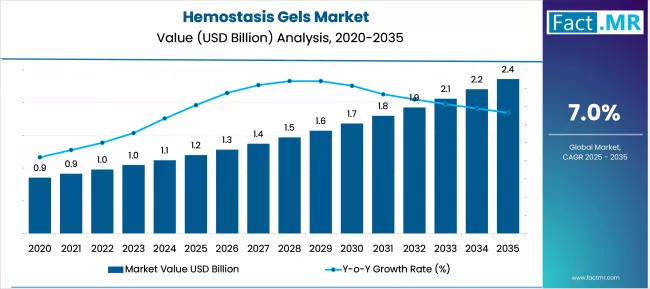
The global medical landscape is undergoing a critical transformation in surgical and trauma care as hemostatic gel technologies evolve from traditional passive adjuncts to high-performance, autonomous Industry 4.0 medical devices. According to the latest industry analysis for the 2026-2036 forecast period, the hemostatic gel market is projected to expand significantly, driven by a compound annual growth rate (CAGR) of 6.5%, reaching an estimated valuation of $2.59 billion by 2032 and continuing its upward trajectory through 2036.
The Evolution of Hemostasis: Who, What, and Why
Hemostatic gels are advanced flowable matrices and hydrogels designed to achieve rapid blood coagulation in surgical and emergency settings. Unlike traditional gauzes or sponges, these gels—often delivered via pre-filled syringes—conform to irregular wound geometries, providing a mechanical and chemical barrier that stops moderate-to-severe bleeding in seconds.
The primary adoption is being seen in minimally invasive surgeries (MIS), which now account for over 51% of the market share. As surgeons increasingly transition to robotic and laparoscopic platforms, the demand for one-handed delivery systems that can navigate narrow trocars has become a critical market driver.
Key Market Dynamics: 2026-2036
Industry leaders, including Baxter International, Johnson & Johnson (Ethicon), and Cresilon, are pivoting toward plant-based and synthetic polymers to mitigate risks associated with animal-derived (bovine/porcine) thrombin.
-
When: The 2026–2036 window marks a decade of Smart Hemostasis, where gels are being integrated with AI-driven risk-prediction modules to assist surgeons in real-time bleeding management.
-
Where: While North America maintains the largest revenue share (approx. 42%), the Asia-Pacific region is identified as the fastest-growing market due to rapid healthcare infrastructure development in India and China.
-
How: Innovation is focusing on sequential-crosslinking chemistries, allowing gels to polymerize within 15 seconds even on moist, moving tissue—a feat previously unattainable with legacy fibrin sealants.
Data-Backed Insights and Sector Analysis
The shift toward value-based procurement is forcing a reassessment of hemostatic products. Hospitals are no longer viewing these as commodities but as strategic tools to reduce:
-
Operating Room (OR) Time: High-efficiency gels can save an average of 15–20 minutes per complex procedure.
-
Transfusion Rates: Rapid sealing reduces the need for expensive and risk-laden blood product transfusions.
-
Hospital Stays: Effective intraoperative hemostasis correlates directly with reduced postoperative complications and faster discharge.
| Market Segment | Projected CAGR (2026-2036) | Primary Driver |
| Synthetic/Matrix Gels | 7.84% | Biocompatibility & Supply Resilience |
| Trauma & Emergency | 6.20% | Pre-hospital Hemorrhage Control |
| General & Cardiovascular | 5.50% | Aging Geriatric Population |
Technological Innovation: The Rise of Plant-Based Solutions
The 2025 launch of products like TRAUMAGEL®—the first plant-based gel cleared for moderate-to-severe bleeding—has set a new benchmark for the 2026-2036 decade. By utilizing refined plant polymers, these next-generation gels eliminate the need for preparation (thawing or mixing), allowing first responders and trauma surgeons to apply treatment immediately upon contact with the wound.
The ability to control severe bleeding in a matter of seconds is the defining metric for the next generation of surgical care, states industry consensus. We are moving away from products that merely ‘assist’ clotting to those that ‘command’ it.
Future Outlook and Investor Relevance
As we move toward 2036, the market is expected to witness a consolidation of players as regulatory hurdles for biologically derived materials increase. Investors are closely watching the Biomimetic segment, where lab-grown proteins and self-assembling peptide hydrogels offer a path to high-margin, high-efficacy solutions that avoid the supply chain vulnerabilities of animal-sourced materials.
About the Market Report
This analysis incorporates data from the 2026 Global Hemostats Outlook, featuring contributions from analysts at Mordor Intelligence, Research and Markets, and Fortune Business Insights. It provides a comprehensive view of the competitive landscape, including major players like Pfizer, BD, and Stryker.
Browse Full Report : https://www.factmr.com/report/hemostasis-gels-market
– Contact Us –
11140 Rockville Pike, Suite 400, Rockville,
MD 20852, United States
Tel: +1 (628) 251-1583 | sales@factmr.com
About Fact.MR
Fact.MR is a global market research and consulting firm, trusted by Fortune 500 companies and emerging businesses for reliable insights and strategic intelligence. With a presence across the U.S., UK, India, and Dubai, we deliver data-driven research and tailored consulting solutions across 30+ industries and 1,000+ markets. Backed by deep expertise and advanced analytics, Fact.MR helps organizations uncover opportunities, reduce risks, and make informed decisions for sustainable growth.