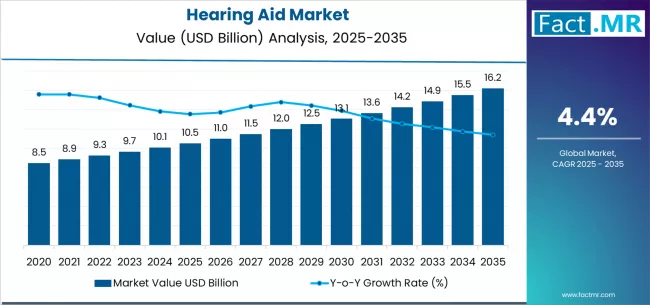
The global hearing aid market is poised for steady growth over the next decade, supported by the rising prevalence of hearing impairment, rapid advancements in digital hearing technologies, and increasing awareness of early hearing loss treatment. According to a new analysis by Fact.MR, the market is projected to expand from USD 10,540.7 million in 2025 to USD 16,220.5 million by 2035, registering an absolute growth of USD 5,679.8 million over the forecast period. This expansion reflects a CAGR of 4.4% from 2025 to 2035.
Growing geriatric populations, widespread adoption of wireless and AI-enabled hearing aids, and supportive healthcare policies are significantly accelerating global market adoption.
Browse Full Report: https://www.factmr.com/report/hearing-aid-market
Strategic Market Drivers
Rising Global Hearing Loss Burden
Hearing impairment is one of the most common chronic health conditions worldwide, driven by aging populations, prolonged exposure to noise, and lifestyle-related factors. The World Health Organization (WHO) estimates a continuous rise in hearing-related disorders, boosting long-term demand for assistive hearing devices.
Early diagnosis and increasing acceptance of hearing aids are transforming treatment adoption across age groups.
Technological Advancements in Hearing Aids
Modern hearing aids now integrate advanced technologies such as:
- Artificial intelligence (AI)
- Bluetooth & wireless connectivity
- Rechargeable lithium-ion batteries
- Noise reduction and speech enhancement algorithms
These innovations significantly improve sound clarity, user comfort, and device aesthetics, encouraging adoption among younger and working-age populations.
Growing Awareness & Improved Accessibility
Public health initiatives, awareness campaigns, and improved access to audiology services are reducing stigma associated with hearing aid usage. Over-the-counter (OTC) hearing aid approvals in key markets are also expanding accessibility and affordability.
Expansion of Tele-Audiology and Digital Healthcare
Remote hearing assessments, app-based device tuning, and tele-audiology platforms are simplifying hearing care delivery—particularly in underserved and rural regions—fueling market penetration.
Regional Growth Highlights
North America: Technological Leadership & Aging Population
North America dominates the global hearing aid market due to:
- High awareness of hearing health
- Strong reimbursement frameworks
- Rapid adoption of digital and OTC hearing aids
The U.S. remains a key growth hub with rising demand from its aging population.
Europe: Strong Healthcare Infrastructure & Policy Support
European countries benefit from well-established healthcare systems, favorable reimbursement policies, and growing elderly demographics. Germany, the U.K., France, and Italy are leading contributors to regional growth.
East Asia: Expanding Elderly Population & Device Innovation
Japan, China, and South Korea are witnessing increasing adoption due to:
- Rapid population aging
- Growing disposable income
- Strong presence of hearing aid manufacturers
Emerging Markets: Untapped Potential
India, Southeast Asia, Latin America, and the Middle East offer high-growth opportunities driven by:
- Improving healthcare infrastructure
- Rising awareness of hearing disorders
- Expanding private healthcare investments
Market Segmentation Insights
By Product Type
- Behind-the-Ear (BTE) – Widely used due to durability and power
- Receiver-in-the-Ear (RITE) – Fast-growing due to comfort and sound quality
- In-the-Ear (ITE) & In-the-Canal (ITC) – Preferred for discreet design
By Technology
- Digital Hearing Aids – Dominant segment due to superior sound processing
- Analog Hearing Aids – Declining adoption
By Patient Type
- Adults – Largest share due to age-related hearing loss
- Pediatrics – Growing demand driven by early screening programs
By Distribution Channel
- Audiology Clinics
- Hospitals
- Online & OTC Channels – Fastest-growing segment
Challenges Impacting Market Growth
High Device Costs
Advanced hearing aids can be expensive, limiting adoption in low- and middle-income regions without reimbursement support.
Social Stigma & Low Awareness
Despite improvements, stigma and lack of awareness in certain regions continue to delay diagnosis and treatment.
Limited Insurance Coverage in Developing Markets
Inadequate reimbursement policies remain a barrier in several emerging economies.
Competitive Landscape
The global hearing aid market is highly consolidated, with leading players focusing on digital innovation, AI integration, and personalized hearing solutions.
Key Companies Profiled
- Sonova Holding AG
- Demant A/S
- GN Store Nord A/S
- WS Audiology
- Starkey Laboratories
- Cochlear Ltd.
- RION Co., Ltd.
- MED-EL
Companies are investing in AI-powered sound processing, miniaturization, rechargeable solutions, and direct-to-consumer models.
Recent Developments
- 2024: Expansion of OTC hearing aid offerings across major markets
- 2023: AI-enabled hearing aids introduced with real-time sound adaptation
- 2022: Increased government-backed hearing screening initiatives globally
Future Outlook: Personalized, Connected Hearing Care
The hearing aid market is set to witness sustained growth through 2035, driven by:
- Aging global population
- AI-driven and app-connected devices
- Expansion of OTC hearing aid sales
- Growth in tele-audiology services
- Rising focus on preventive hearing healthcare
As innovation, accessibility, and awareness continue to advance, the global hearing aid market is positioned for consistent and long-term expansion.