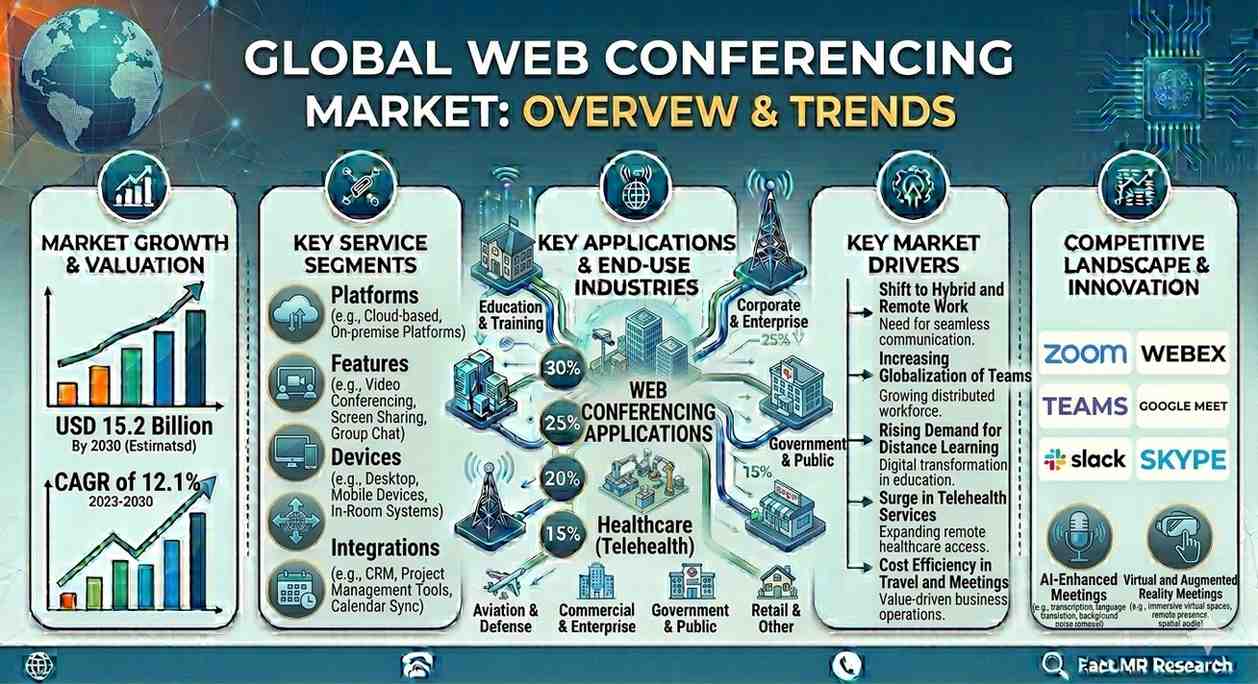
According to Fact.MR’s latest analysis, the global web conferencing market is valued at USD 16.8 billion in 2026 and is projected to reach USD 18.1 billion in 2027, expanding to USD 37.2 billion by 2036. The market is expected to grow at a CAGR of 8.2% during 2026–2036, creating an incremental opportunity of USD 20.4 billion.
The market is transitioning from basic video conferencing tools to AI-enabled collaboration platforms integrating transcription, workflow automation, and enterprise productivity features. Hybrid work models, digital education adoption, and government virtual service delivery are accelerating platform demand.
Quick Stats
- Market Size (2026): USD 16.8 Billion
- Market Size (2027): USD 18.1 Billion
- Forecast Value (2036): USD 37.2 Billion
- CAGR (2026–2036): 8.2%
- Incremental Opportunity: USD 20.4 Billion
- Leading Segment: Solutions (70% share)
- Leading Deployment: SaaS (38% share)
- Leading Region: North America
- Key Players: Microsoft, Zoom Video Communications, Cisco Systems, Google, RingCentral, GoTo, Zoho, Adobe
Executive Insight for Decision Makers
The web conferencing market is shifting toward AI-powered collaboration suites integrated into enterprise workflows. Video meetings are becoming entry points for workflow automation, knowledge capture, and productivity analytics.
Strategic priorities
- Integrate AI meeting assistants and summarization tools
- Expand SaaS subscription-based pricing models
- Ensure enterprise-grade security and compliance certifications
- Build ecosystem integrations with productivity platforms
Organizations that fail to upgrade risk employee productivity gaps, fragmented communication workflows, and rising collaboration costs.
Market Dynamics
Key Growth Drivers
- Hybrid work models becoming permanent across enterprises
- Rising digital learning and virtual classroom adoption
- AI-powered meeting intelligence and automation features
- Government digital service delivery initiatives
Key Restraints
- Data privacy and regulatory compliance challenges
- Bandwidth and infrastructure limitations in emerging markets
- Security concerns in highly regulated sectors
Emerging Trends
- AI meeting assistants with real-time summaries
- Unified communication and collaboration platforms
- Integration with productivity software ecosystems
- Vertical-specific conferencing solutions for healthcare and finance
Segment Analysis
Leading Segment
Solutions dominate with 70% market share in 2026, driven by recurring software subscriptions across enterprise and education sectors.
Fastest-Growing Segment
AI-powered collaboration analytics platforms are expected to grow fastest due to demand for workflow automation.
Deployment Breakdown
- SaaS – 38% share
- Hybrid cloud – growing adoption
- On-premises – niche regulated sectors
- Private cloud – healthcare and finance demand
Strategically, SaaS platforms offer higher scalability and recurring revenue, making them attractive for vendors.
Supply Chain Analysis
Raw Material Suppliers
- Cloud infrastructure providers
- Data center hardware vendors
- Network connectivity providers
Manufacturers / Producers
- Web conferencing software developers
- Unified communication platform providers
- Collaboration suite vendors
Distributors
- IT service providers
- Managed cloud service providers
- Enterprise software resellers
End Users
- Enterprises (corporate collaboration)
- Educational institutions (virtual classrooms)
- Government agencies (digital services)
- Healthcare organizations (teleconsultations)
Who Supplies Whom
- Cloud infrastructure providers host conferencing platforms
- Software vendors build conferencing applications
- IT integrators deploy platforms to enterprises
- Enterprises and institutions subscribe to SaaS services
Pricing Trends
Web conferencing pricing follows tiered SaaS subscription models.
Commodity Tier
- Basic video conferencing
- Low-cost or freemium offerings
- Limited analytics
Premium Tier
- AI transcription and summarization
- Enterprise security compliance
- Integration with productivity tools
Pricing factors include:
- Number of users
- AI feature availability
- Security compliance certifications
- Cloud storage capacity
- Integration ecosystem
Premium enterprise plans typically generate 25–40% higher margins compared to basic conferencing services.
Regional Analysis
Top Countries by CAGR (2026–2036)
- China – 9.0%
- United States – 8.8%
- United Kingdom – 8.1%
- South Korea – 7.8%
- France – 7.6%
Regional Insights
- North America: Largest revenue contributor due to enterprise SaaS adoption
- Asia Pacific: Fastest growth from education and digital transformation
- Europe: Strong demand driven by compliance-focused deployments
Developed vs Emerging Markets
- Developed markets adopt premium AI collaboration tools
- Emerging markets prioritize cost-effective SaaS platforms
Competitive Landscape
The global web conferencing market is moderately concentrated, led by major collaboration platform providers.
Key Players
- Microsoft (Teams)
- Zoom Video Communications
- Cisco Systems (Webex)
- Google (Meet)
- RingCentral
- GoTo
- Zoho
- Adobe Connect
- Verizon (BlueJeans)
- BigBlueButton
Competitive Strategies
- AI collaboration feature expansion
- Ecosystem integration with productivity tools
- Enterprise security compliance certifications
- Pricing flexibility for SMB adoption
- Vertical-specific solutions
Strategic Takeaways
For Manufacturers
- Develop AI-powered meeting intelligence tools
- Expand SaaS subscription offerings
- Strengthen enterprise integrations
For Investors
- Focus on AI-enabled collaboration platforms
- Target hybrid work productivity solutions
For Marketers & Distributors
- Offer bundled collaboration suites
- Promote vertical-specific use cases
Future Outlook
The web conferencing market is evolving into AI-driven collaboration ecosystems supporting hybrid work, digital education, and virtual services.
Key developments:
- AI meeting copilots
- Real-time language translation
- Workflow automation integrations
- Immersive collaboration technologies
Conclusion
The global web conferencing market is transitioning from video meeting tools to intelligent collaboration platforms. With hybrid work becoming permanent and AI enhancing productivity, vendors offering secure, integrated, and AI-enabled solutions will capture significant growth opportunities.
Why This Market Matters
Web conferencing platforms have become critical infrastructure for enterprise collaboration, education delivery, and digital public services, making them central to the future of global workplace productivity and digital transformation.
Browse Full Report –
https://www.factmr.com/report/web-conferencing-market