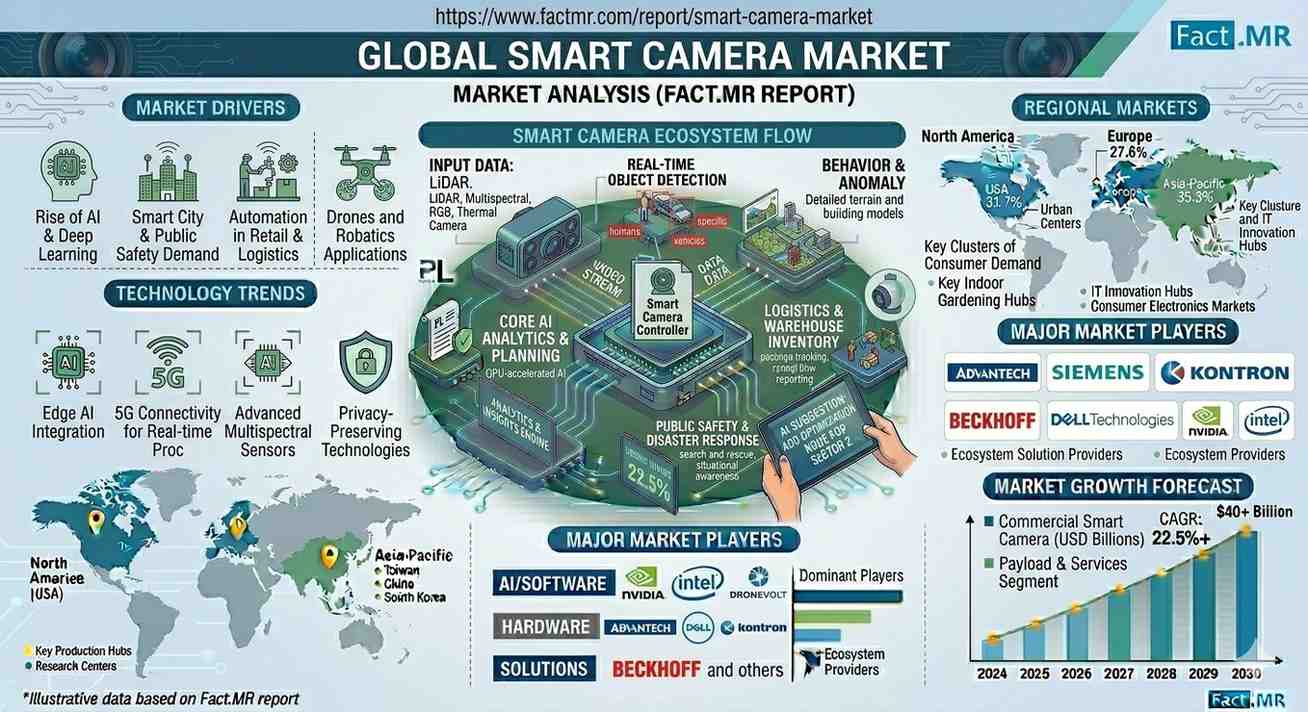
According to Fact.MR’s latest analysis, the global smart camera market is valued at USD 49.8 billion in 2026 and is projected to reach USD 54.2 billion in 2027, before expanding to USD 108.6 billion by 2036. The market is expected to grow at a CAGR of 8.1% during 2026–2036, creating an incremental opportunity of USD 58.8 billion.
The market is undergoing a structural transformation from traditional video capture devices to AI-enabled vision systems capable of real-time detection, classification, and predictive analytics. Rapid deployment of smart city infrastructure, rising adoption of ADAS cameras in vehicles, and growing industrial automation are accelerating demand for embedded AI processing cameras.
Quick Stats
- Market Size (2026): USD 49.8 Billion
- Market Size (2027): USD 54.2 Billion
- Forecast Value (2036): USD 108.6 Billion
- CAGR (2026–2036): 8.1%
- Incremental Opportunity: USD 58.8 Billion
- Leading Segment: Image Sensors (37% share)
- Leading Application: Transportation & Automotive (38% share)
- Leading Region: Asia Pacific
- Key Players: Sony Corporation, Bosch Security Systems, Axis Communications, Hikvision, Dahua Technology, Honeywell, Panasonic i-PRO, FLIR Systems
Executive Insight for Decision Makers
The smart camera market is shifting from hardware-centric competition to AI-enabled analytics platforms. Manufacturers integrating neural processing units and edge inference capabilities are gaining pricing power and long-term service revenue.
Strategic priorities for industry leaders:
- Invest in embedded AI chips and on-device analytics
- Develop industry-specific analytics software
- Ensure compliance with automotive safety and privacy regulations
- Build cloud + edge hybrid architectures
Companies that fail to integrate AI processing risk being commoditized in low-margin surveillance hardware segments.
Market Dynamics
Key Growth Drivers
- Smart city safety and traffic monitoring programmes increasing AI camera deployment
- Automotive ADAS regulations boosting cameras per vehicle
- Industrial automation demand for machine vision inspection systems
- Falling CMOS sensor costs enabling wider adoption
Key Restraints
- Data privacy and surveillance regulations in developed markets
- High integration costs for AI-enabled cameras
- Cybersecurity compliance requirements
Emerging Trends
- Edge AI processing replacing cloud-only analytics
- Multi-camera ADAS systems in vehicles
- Industry-specific AI analytics platforms
- Integration of neural processing units within cameras
Segment Analysis
Leading Segment
Image sensors dominate with 37% market share in 2026, as sensor performance directly influences image quality and AI detection accuracy.
Fastest-Growing Segment
AI-enabled system-on-chip processors integrated into cameras are expected to witness the fastest growth due to demand for real-time analytics.
Application Breakdown
- Transportation & Automotive – 38% share
- Industrial Automation – rapidly expanding
- Smart City Surveillance – strong demand
- Retail & Healthcare Analytics – emerging
Strategically, automotive and industrial segments provide higher margins due to specialized analytics requirements.
Supply Chain Analysis
Raw Material Suppliers
- Semiconductor wafer manufacturers
- Optical lens manufacturers
- PCB and memory component suppliers
Manufacturers / Producers
- Smart camera OEMs integrating sensors, processors, and AI software
- Electronics manufacturers producing embedded AI chips
Distributors
- Security equipment distributors
- Industrial automation solution providers
- Automotive electronics integrators
End Users
- Government smart city authorities
- Automotive OEMs
- Manufacturing plants
- Retail chains and hospitals
Who Supplies Whom
- Sensor manufacturers supply to camera OEMs
- AI chip vendors supply to smart camera manufacturers
- OEMs supply finished cameras to system integrators
- Integrators deploy solutions to government, automotive, and industrial buyers
Pricing Trends
Smart camera pricing varies between commodity surveillance models and premium AI-enabled cameras.
Commodity Segment
- Basic analytics
- Lower margins
- Price-sensitive markets
Premium Segment
- Edge AI processing
- Advanced analytics software
- Higher margins and service revenue
Key pricing factors:
- Sensor resolution and performance
- Embedded AI processor capability
- Compliance certifications
- Software analytics features
- Deployment scale
Premium AI cameras typically generate 20–35% higher margins than standard network cameras.
Regional Analysis
Top Countries by CAGR (2026–2036)
- China – 9.0%
- South Korea – 8.8%
- United States – 8.6%
- Germany – 8.3%
- United Kingdom – 8.1%
Regional Insights
- Asia Pacific: Largest market due to smart city investments and automotive electronics manufacturing
- North America: High-value deployments in enterprise security and transportation
- Europe: Strong growth driven by automotive safety regulations and compliance requirements
Developed vs Emerging Markets
- Developed markets prioritize compliance and premium AI cameras
- Emerging markets focus on cost-effective surveillance deployment
Competitive Landscape
The global smart camera market is moderately fragmented, with premium AI camera vendors competing on technology while volume players compete on pricing.
Key Players
- Sony Corporation
- Bosch Security Systems
- Axis Communications
- Hikvision Digital Technology
- Dahua Technology
- Honeywell Security
- Panasonic i-PRO Sensing Solutions
- FLIR Systems
- Hanwha Vision
- Avigilon
Competitive Strategies
- AI chip integration
- Edge analytics software development
- Vertical-specific solutions
- Strategic partnerships with OEMs
- Expansion into smart city infrastructure projects
Strategic Takeaways
For Manufacturers
- Invest in AI-enabled system-on-chip architectures
- Expand software analytics capabilities
- Build compliance-ready solutions
For Investors
- Focus on AI-enabled camera platforms
- Target automotive and industrial automation segments
For Marketers & Distributors
- Develop vertical-specific solutions
- Offer bundled analytics and service contracts
Future Outlook
The smart camera market is expected to evolve into intelligent sensing ecosystems combining AI, edge computing, and cloud analytics. Automotive autonomous systems, smart factories, and urban safety infrastructure will drive long-term demand.
Key future developments:
- Embedded neural processors
- Edge AI vision platforms
- 3D and thermal smart cameras
- Sustainability-driven energy-efficient designs
Conclusion
The global smart camera market is transitioning from surveillance hardware to intelligent AI-powered sensing platforms. With smart city deployments, automotive ADAS integration, and industrial automation accelerating adoption, the market presents strong opportunities for technology leaders. Companies investing in edge AI, compliance-ready platforms, and vertical analytics solutions will be best positioned to capture long-term growth.
Why This Market Matters
Smart cameras are becoming foundational to smart cities, autonomous mobility, and Industry 4.0. As AI moves to the edge, these devices will serve as the primary interface between physical environments and digital intelligence, creating significant long-term value across industries.
Browse Full Report –
https://www.factmr.com/report/smart-camera-market