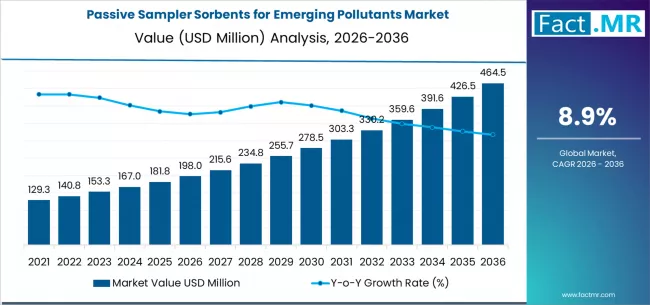
The global market for passive sampler sorbents targeting emerging pollutants is poised for significant growth over the next decade. Driven by increasing regulatory scrutiny, rising concern over persistent environmental contaminants, and advances in monitoring technologies, the market is projected to expand at a compound annual growth rate (CAGR) of approximately 8.9% between 2026 and 2036, potentially reaching USD 464.5 million by 2036. This growth aligns with broader trends in the environmental monitoring sector, which is experiencing steady expansion due to growing demand for accurate, cost-effective pollutant detection.
Market Drivers and Risk Assessment
A primary driver of market growth is the rising attention to emerging pollutants, including PFAS (per- and polyfluoroalkyl substances), pharmaceuticals, personal care products, endocrine-disrupting compounds, and micro- and nanomaterials. These contaminants pose long-term ecological and health risks due to their persistence and bioaccumulation potential. Passive samplers are increasingly favored because they provide time-integrated measurements and allow for precise monitoring of the freely dissolved fraction of pollutants, which is critical for accurate risk assessment and environmental management.
As governments impose stricter regulatory thresholds for drinking water, groundwater, and surface water, industries and environmental agencies are adopting passive sampling to support long-term exposure assessment, remediation verification, and compliance monitoring. This regulatory environment ensures a strong, sustained demand for high-performance sorbents capable of detecting contaminants at ultra-low concentrations.
Supply Chain and Manufacturing Insights
The passive sampler sorbents supply chain comprises specialty chemical manufacturers, polymer producers, and environmental technology firms. Raw materials primarily include advanced polymers, carbon-based sorbents, and resins designed for selective uptake of pollutants. The lightweight nature of these materials ensures relatively low transportation costs; however, the market is sensitive to fluctuations in specialty chemical pricing and energy costs.
Geographically, North America and Europe currently dominate market demand, driven by established regulatory frameworks and substantial environmental monitoring budgets. Asia-Pacific, however, is emerging as the fastest-growing region due to rapid industrialization, urban expansion, and increased government investment in environmental monitoring infrastructure. This shift is expected to significantly influence global market dynamics over the next decade.
Technology Trends and Competitive Landscape
Technological innovation is transforming the market. Modern passive samplers incorporate diffusion-based designs and sorbents optimized for specific classes of emerging pollutants. These developments enhance analytical accuracy, reduce laboratory preparation time, and increase operational efficiency. Sorbent materials tailored for PFAS, pharmaceuticals, and endocrine-disrupting compounds are being adopted widely, supporting large-scale environmental monitoring initiatives.
Strategic collaborations between research institutions, analytical laboratories, and sorbent manufacturers are accelerating product development and standardization. These collaborations are vital as regulatory bodies increasingly require validated, reproducible sampling methods for compliance monitoring.
Browse Full Report : https://www.factmr.com/report/passive-sampler-sorbents-for-emerging-pollutants-market
Market Outlook 2026–2036
Over the coming decade, the passive sampler sorbents market is projected to outperform adjacent segments of environmental testing due to its alignment with risk-based environmental management and sustainability goals. Market expansion will be fueled by stricter contaminant thresholds, increased monitoring of emerging pollutants, and ongoing investment in environmental infrastructure.
By 2036, stakeholders across the value chain—from sorbent manufacturers to environmental service providers—are expected to capitalize on opportunities to innovate, strengthen supply chains, and support global environmental and public health initiatives. The market’s growth trajectory underscores the critical role of passive sampler sorbents in advancing accurate, reliable, and cost-efficient monitoring of emerging pollutants worldwide.